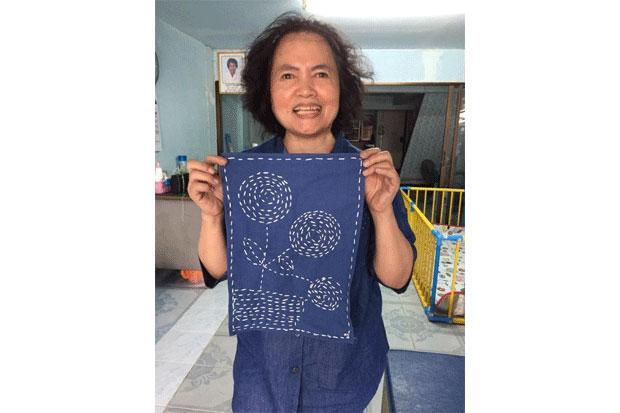
Pairin Mongnan lost part of his eyesight when he was 13 years old. Back then he could still manage to take care of himself and do some house chores. But after he lost his visibility completely seven years ago, he became more dependent on his mother and sister.
"I wish I could have a job that fits [my physical limitation], but I can't think of any," said Pairin.
The now-38-year-old recently attended the second sashiko stitching training for the visually impaired under the Pakjit Pakjai project, with hopes that he can turn it into something that could make him more financially secure.
As Pairin was slowly progressing with sashiko stitching on the last day of the workshop, he wasn't really confident he could adopt the craft as his career. He felt his stitching was too slow and not beautiful enough, despite praise and encouragement from trainers. Supported by the Foundation for the Blind, the second training, which included 11 people with visual impairment, including two with multiple disabilities, wrapped in early December in Chiang Mai.
Pairin admitted that the lack of access to knowledge and employment made him uncomfortable to imagine what he wanted to do or could do for a living. Living in the mountainous area in Hot district in Chiang Mai, his few choices for making money are selling lottery tickets and massage -- typical jobs for the blind. He had been earning about 1,600 baht from his lottery-selling and disability allowance for a long time.
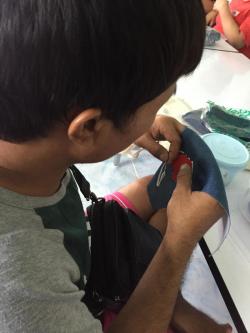
Pairin Mongnan is slowly progressing on his stitching. He's hoping for it to be his new career, to allow him to become more financially independent. Wandee Suntivutimetee
Thanks to the Pakjit Pakjai project, Pairin now has found a new alternative.
Since June 2018, 17 visually impaired, including two with multiple disabilities, received training that challenges the limits of their physical disabilities -- sashiko stitching.
"I couldn't help but keep asking myself why a purchase of any products [by people with disabilities] is always made out of sympathy," said Wandee Suntivutimetee, the project founder. "Most items, such as handbags or souvenirs embroidered with colourful beads, would end up in a store room because buyers never had the intention to use the item when they bought it."
During the past seven months, Wandee has tried to produce marketable items such as pouches or scarves, featuring sashiko stitching by the blind, to convince people to buy an item because of its design.
Such a marketing strategy actually worked. Bride-to-be Pimpisa Vudhichaiphun ordered 500 pouches from the Pakjit Pakjai project as a souvenir for her wedding next month.
After researching products by charity foundations, she found the handicrafts of the Pakjit Pakjai project were designed to compete in the marketplace -- not to be sold as a charity product. With the same amount of money, she could have bought other general products, such as a notebook or calendar, but the handicrafts will help provide jobs for the blind.
"If I produce a work, I want people to buy it because of the quality of the work and design, not because of my physical limitation. More importantly, the product is beautiful despite its imperfect stitching," said Pimpisa, 26.
So far, about 200 pieces of products such as tote bags and scarves have sold. Over 1,500 pieces are being produced to meet the orders.
According to the Ministry of Social Development and Human Security, there are currently about 1.9 million people with disabilities in Thailand, half of whom are of working age. But as of 2018, only 76,675 of them have been able to get a job.
According to the Empowerment Act of 2007, a company with more than 100 employees has three options. For every 100 employees, the organisation must either hire a disabled person, send money to support a fund for the disabled, or arrange places for products or services by people with disabilities to be used.
According to the Department of Empowerment of Persons with Disabilities, as of July 3, 2018, there are 195,646 people registered with visual impairment in the country. There are no official statistics, but the Foundation for the Blind estimates that only 20% of them have jobs; the majority are self-employed, with businesses such as traditional massage parlours.
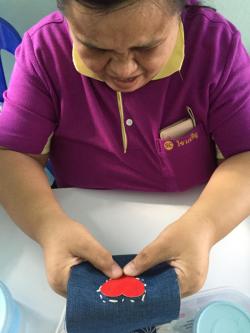
A participant learns how to stitch a heart-shaped pattern. Sirinya Wattanasukchai
Realising that finding a right job is a huge barrier for people with disabilities, Torpong Selanon, the foundation's president, supported the project, hoping it will also help boost their self-esteem.
"[For the disabled], it requires more than just a desire to change their perception and the public perception toward them, but also courage and confidence," said Torpong, 42, who lost his eyesight at 16 in a car accident.
Torpong said it's understandable people would question if the visually impaired are capable of sashiko stitching or if they could even make money from it.
"Can every able-bodied person with normal eyesight produce a piece of sashiko stitching?" he shot back. Economically, Torpong sees it as a division of labour in society, saying the handicrafts will provide another option for the blind to earn a living and to be proud of themselves for completing an unexpected challenge.
To make the project financially sustainable, Torpong said products have to be not only beautiful but functional in order to cater to the market.
Currently, the project is fully supported by the foundation. But Torpong knows the project will be just another charity cause unless it is turned into a real business. Social business models will be adopted. Revenue will be divided into three parts; the payment for the owner of the handicraft; management costs; and future workshops for more participants.
Therefore, Torpong said, the next step of the project is to add a real function and design to the products by a professional designer. Those who have attended the workshop are free to start their own business or become a part of the Pakjit Pakjai project if they can't find their own market.
After the two workshops, Wandee has witnessed the pride and confidence of the blind students as they managed to break boundaries and do something that nobody had ever imagined they could do.
Making ends meet is one thing, but being proud of themselves is another story, said Torpong. Many people with disabilities have been made to believe that they are incapable of working and end up as a burden on family and society. "It's sad when they can't find a purpose or pride in living a life," he said.
Torpong only wished that being part of the Pakjit Pakjai project and being able to produce a work in spite of physical restrictions can be inspiring, and that the latest challenge will change the perception for the next generation of blind people.
"So they can answer what they want to do or to be, rather than being taught not to have a dream."
It all began two years ago when Wandee Suntivutimetee, a Chiang Mai-based writer, started to learn about sashiko stitching and thought it could be a new tool to challenge the capabilities of the visually impaired.
Earlier this year, she discussed it with Pawanya Kaewnunta, a sashiko instructor at Sewing Studio in Chiang Mai, who was confident that the visually impaired could work with the larger thread and needle used in the traditional Japanese stitching.
The traditional stitching originated in the ancient times in Japan, when housewives had to repair the clothes at night, in the dim light of lanterns.
The Pakjit Pakjai project, started in June, aims to challenge prevailing perceptions of the visually impaired, be another source of earning for people with disabilities, as well as boost their self-esteem. Its logline, "The heartmade embroidery project", suggests the embroidered items are made by people with a heart, rather than with vision.
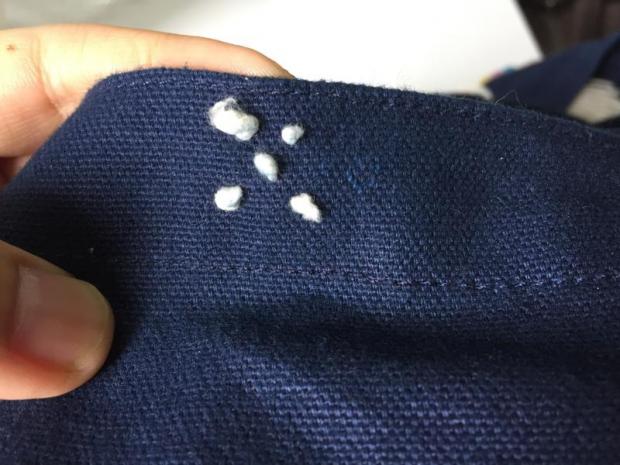
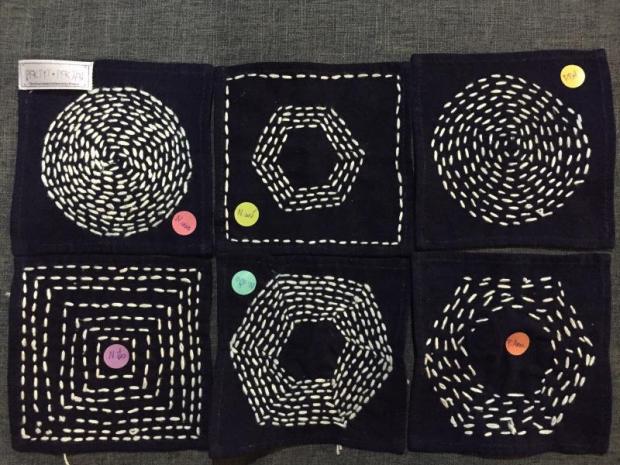
Like other students, the blind needed to learn from the very beginning how to thread a needle and then sew straight lines of short stitches, similar to rain drops, on a piece of fabric. It's not easy even for a sighted student to sew a straight line with even stitches; imagine how the visually impaired manage to complete a line.
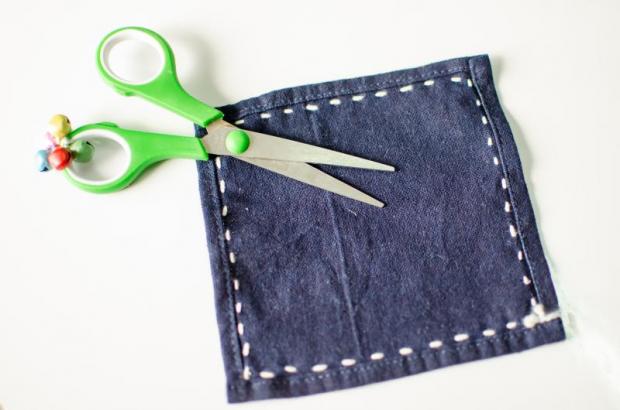
To start the workshop, Pawanya prepared a few sets of equipment — each with a small bell specially attached for her students. A special set of templates has been made for the students to start the basics of sashiko.
But again, it wasn't that easy for Pawanya to communicate with her students, who cannot see the pattern or fabric they are working on. The technique that was used to teach her other students — to compare the stitch with the size of a rice grain or a match — didn't work with the blind students because they couldn't visualise the length and comparison.
"It took us a while to figure out what the comparison was," said Sudaporn Yot-alai, recalling the first workshop she attended with five friends in June.
After a discussion among themselves, they came up with the idea to simply explain the different stitches among themselves as "short" and "long" stitch.
Throughout the workshop, both the instructor and students had to learn how to communicate the technique so they could complete the piece.
The explanation of sashiko technique discussed in class will later be included in the workbook, which will be used for the next workshop for the blind.
Within a few hours, instead of days spent by students with normal eyesight, the group managed to sew the basic pattern of straight lines.
Not perfect, though. But it was more than enough to inspire Aree Ruangrit, one of the participants, to design her own Flowers in Springtime by asking her relatives to make a template for her to complete.
Pawanya said that the works sewn by the blind were even more beautiful than those by the sighted students because they do the stitching with a greater sense of touch and patience.
Last month, a workshop was held in Bangkok for people with eyesight — blindfolded during the workshop — to witness how every piece under the project has been produced.
For more information, visit facebook.com/Pakjitpakjai-309069069835625.