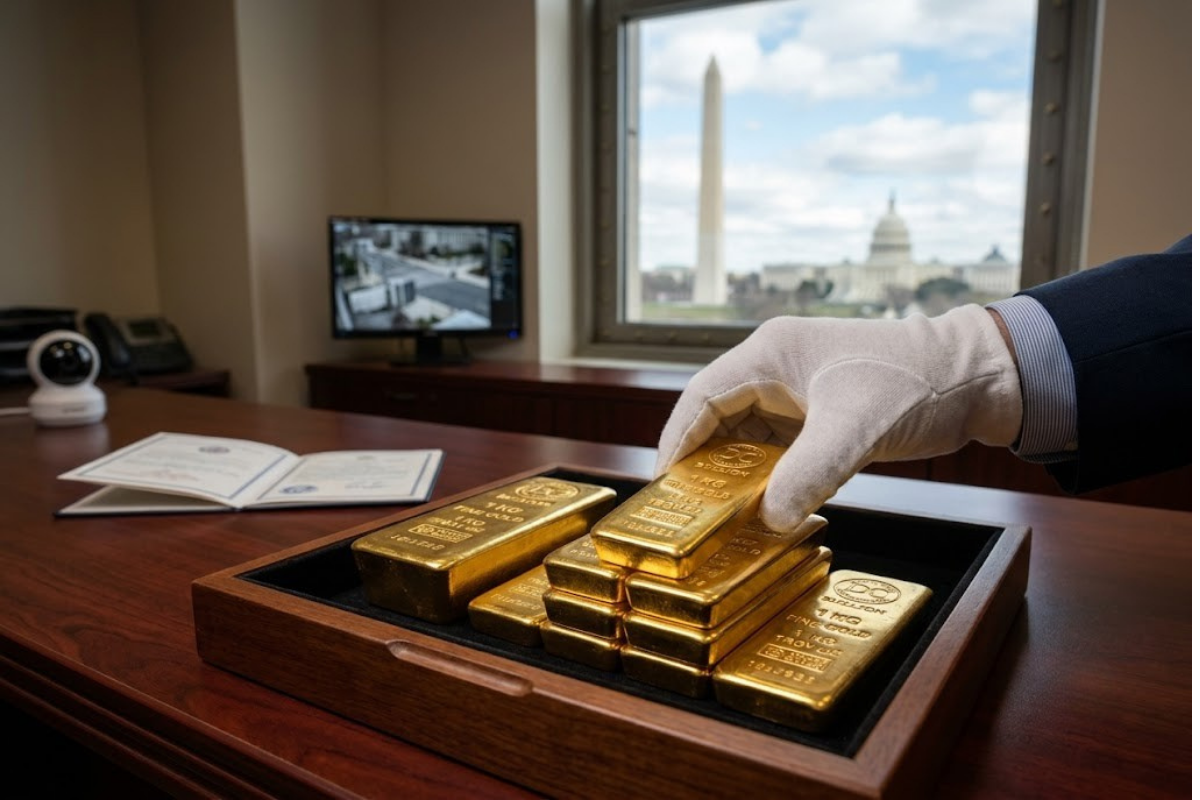
A gold dealer in Washington, DC, was asked to sell more than $200,000 (£148,000) of bullion to an 85-year-old customer. The dealer told the man he was being scammed and alerted the authorities.
Officers went on to arrest two men at the customer's home after they arrived to collect the bars, the Metropolitan Police Department said in a statement on 7 August.
Chu Lin, 50, of Fresh Meadows, New York, and Xiean Cheng, 42, of Cornelius, North Carolina, have each been charged with second-degree financial fraud. The department listed the case as CCN 26102601.
The contact began on Wednesday, 8 July. The man received an email and then a phone call from people who said they were federal agents working for the United States government, police said. He was told funds in his bank account were 'in jeopardy of being lost' unless he moved the money into bullion and passed it on. He believed them, police said.
The dealer went to the FBI and to the department's Financial and Cyber Crimes Unit, and officers from MPD's Violent Crime Suppression Division made the arrests. MPD did not name the dealer, say whether any of the man's money was lost, or state whether either suspect has entered a plea.
The Gold Bar Scam Script Federal Agents Never Use
The approach matches a pattern set out by the FBI's Boston division in a public warning last September. Callers pose as government or law enforcement officials and tell the target that their identity documents have surfaced in a drug seizure. Victims are told the only way to clear their name is to convert their money into cash, gold, or other precious metals, for deposit in a supposed government-owned bank account.
A courier then collects in person, leaving no record a bank transfer would create. Fraudsters often hand the target a password or serial number to check the collector against, the bureau said.
'Simply put, what these con artists are doing is cruel. These literal gold diggers are trying to get rich quick at the expense of our aging family members and friends,' said Ted E. Docks, special agent in charge of the Boston division. Its guidance to the public is that the US government and legitimate businesses will never ask anyone to buy gold or other precious metals.
Why Bullion Dealers Have Become a Choke Point for Gold Bar Fraud
The FBI said it works with financial institutions and other private sector partners to head off bulk bullion purchases and cash withdrawals before the money leaves.
Between 2023 and May 2025, it documented at least 1,737 cases nationally in which a courier collected bulk cash or gold bars, with losses of about $186M (£138M). The real total is probably higher, the bureau said, because some victims are too embarrassed to report.
Complaints to the FBI's Internet Crime Complaint Center from victims over 60 passed 201,000 last year, with reported losses above $7.7B (£5.7B), the bureau said in May. Complaints rose 37% in 2024, and losses rose 59%. Government impersonation accounted for close to $798M (£592M) of the national total, with more than 8,600 of those complaints filed by people over 60.
Gold was trading above $4,300 (£3,190) an ounce on Monday, around 29% up on the year. At that price, the Washington order came to roughly 46 troy ounces.
How the Same Gold Bar Scam Plays Out in Britain
British victims lost more than £21M ($28M) to courier fraud last year, up from £19.5M ($26M) in 2024. The figures came in June from the City of London Police, the national lead force for fraud. Reports rose from 1,721 to 1,891, and the average loss reached £15,311 ($20,600).
The force identified jewellery and gold as a growing method in 2025. Victims were persuaded to visit several jewellers over time, buying expensive items before handing them to a courier. That method produced the highest sums stolen and often involved repeat victimisation, it said.
Those aged between 76 and 96 accounted for around 62% of all reports, and London and its surrounding counties for about 65% of victims.
'Offenders are becoming more organised and persistent, sometimes maintaining contact with victims for days or weeks to maximise what they can steal,' said Detective Superintendent Ollie Little of the City of London Police.
Neither a bank nor the police will ask anyone to move money to a safe account or send a courier to collect cards, cash, or valuables, the force said. It advised verifying any such call on a number from an official website or the back of a bank card, or by dialling 159. Caller ID is not proof of identity. The Federal Trade Commission gives US consumers similar advice, and adds that no legitimate fraud department asks a customer to keep a call secret.
Suspected fraud is reported in the UK to Report Fraud on 0300 123 2040. MPD has asked anyone with information about the Washington case to call (202) 727-9099.