Snakes have appeared in myths and stories for as long as people have told them. But ask scientists how snakes lost their legs and evolved into their long, limbless form, and the answer is still not settled.
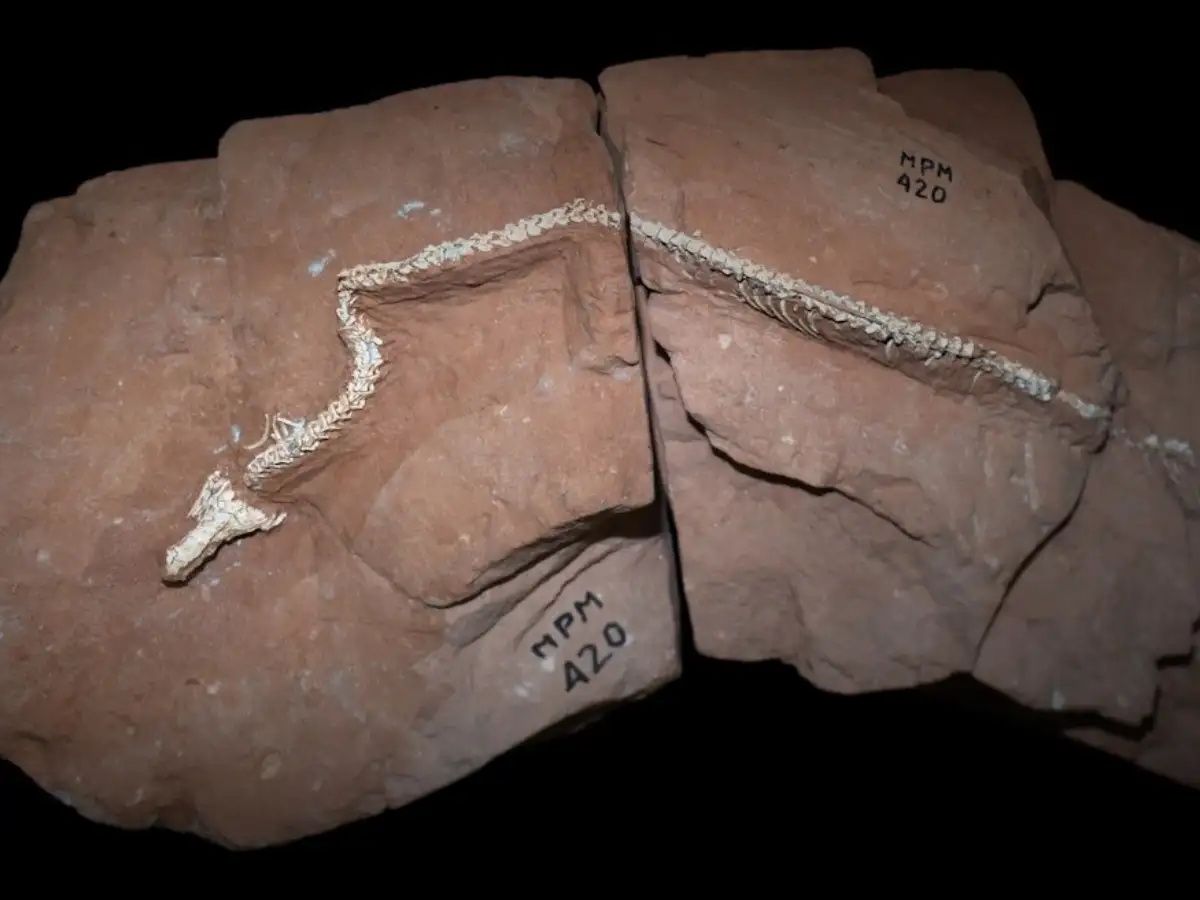
That may be changing. According to the journal Nature, researchers have described an exceptionally preserved, roughly 80-million-year-old snake fossil from Brazil that offers some of the clearest physical evidence yet about how the earliest snakes actually lived. The fossil, named Tametara mirim, was unearthed in São Paulo state and is only about 17 inches long, but it is already reshaping a debate on snake evolution that has run for more than a century.
The paper reports that the fossil preserves not just the skull but also the braincase and delicate inner-ear anatomy, and the team used high-resolution micro-CT scans to build a 3D reconstruction of the brain. Those scans point to a snake with a poorly developed optic lobe, an enlarged otic capsule and a thickened skull, a combination the authors say fits a burrowing lifestyle rather than a surface hunter.
CT scans of the 20-millimeter skull revealed a poorly developed optic lobe, an enlarged otic capsule and an unusually thick cranium, which the authors say point to a snake that navigated by touch and vibration rather than sight. They also note that Tametara mirim is one of only four dinosaur-age snake fossils preserved well enough to answer questions about early ecology.
How snakes lost their limbs has puzzled scientists for more than a century
Snakes are, in evolutionary terms, a lineage that diverged from lizards. At some point during the age of dinosaurs, one lizard lineage is thought to have lost its limbs and evolved into the tube-like form we recognize today. More than 4,000 snake species live today on every continent except Antarctica, in deserts, forests, and oceans alike.