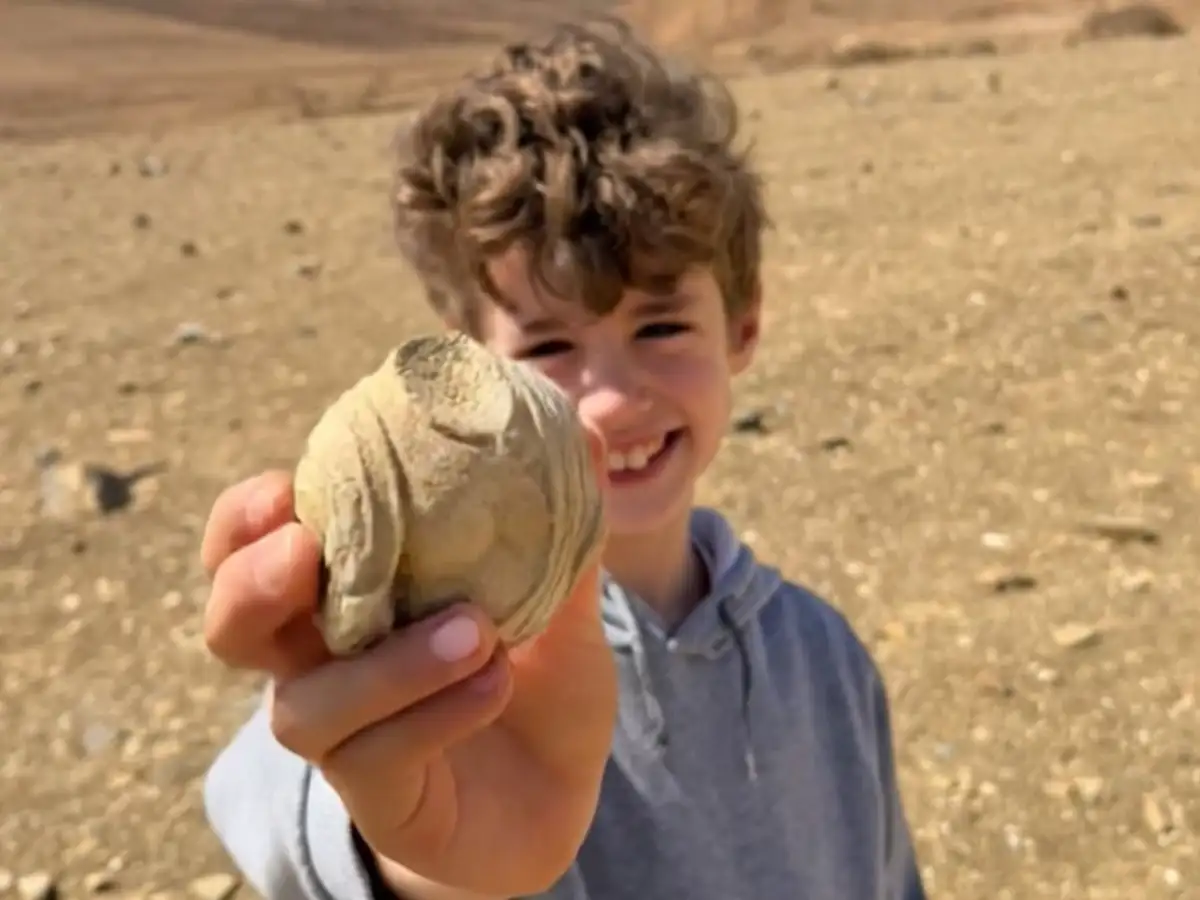
Dor Wolynitz was not on an archaeological dig. He was just a kid on a weekend trip with his dad, collecting rocks that looked interesting. However, the striped stone he pocketed at Israel’s Ramon Crater on May 11 turned out to be a 1,700-year-old statuette fragment. A small, expertly carved piece of a figure draped in flowing robes, most likely a Roman or Nabataean deity, and with that, an eight-year-old from Rehovot walked into history.
A rock that wasn't just a rock
The fragment measures about 6x6cm, the size of a large postage stamp, but what it depicts is extraordinary. The piece shows part of a human figure wrapped in carefully sculpted folds of fabric that fit a himation, a heavy outer cloak popular in classical Greek and Roman dress, the Israel Antiquities Authority (IAA) said. Experts say the quality of the carving is that of a highly trained artist.
It was handed to Akiva Goldenhersh, an archaeologist and supervisor in the IAA’s Theft Prevention Unit, who was on the same trip. "At first I thought it was a fossil," Goldenhersh admitted, until he saw the intricate folds of clothing carved into the surface. Later, IAA geologist Dr. Nimrod Wieler confirmed that the piece was made of phosphorite, a light mineral native to the Negev, meaning that it was manufactured locally and not imported from elsewhere.
Where the gods of different worlds came together
No one knows who the person actually is. The top contenders, Goldenhersh says, are Jupiter, the Roman god of the sky, or Zeus-Dushara, a Nabataean deity who merged with the Greek god Zeus as local traditions merged with Hellenistic-Roman culture. The same syncretic figure appears in the rock-cut city of Petra in present-day Jordan.
This kind of cultural cross-pollination was by no means uncommon in this part of the ancient world. The Nabataeans were the traders and builders who dominated the incense and spice routes across the Arabian Peninsula. They absorbed influences from outside, Greek art styles, and Roman religious iconography, but retained their own identity. The fragment, Goldenhersh said, "reflects the combination of local traditions with influences from the classical world."
The ancient highway running through the desert
This find was not in some random patch of desert. The Ramon Crater is part of the ancient Spice Route, one of the most commercially important thoroughfares of the ancient world. A peer-reviewed study in Antiquity, published by Cambridge University Press, has demonstrated that the Incense Route through the Negev connected the Arabian Peninsula with the Mediterranean Sea and was most active during the Nabataean and Roman periods. Excavations at waystation ruins along the route uncovered not only eastbound spices but also Mediterranean goods, such as glassware, fish, and olives, in the westbound direction, indicating a far more complex, two-way trading economy than had previously been understood.
That complexity of exchange is why finds like this statuette are so important. The range of commodities and cultural objects recovered from Negev waystations, as Biblical Archaeology Review said in its coverage of a related study, "illustrates the flow of commodities...connecting distant economic and cultural institutions." A locally made statuette of a Greco-Roman deity discovered in the desert is precisely the kind of object that still tests our assumptions.
Why this really matters beyond the cool factor
It’s easy to make this a feel-good story about a kid with a sharp eye, but the discovery has real historical weight. The Spice Route through the Negev was not just a road; it was a highway for ideas, religions, art styles, and economies to travel across continents. Each artifact retrieved from it helps fill in a picture of ancient globalization still being assembled.
Dor handed the fragment to the National Treasures Department of the IAA. In exchange, he was awarded an official certificate of good citizenship. The moment was "a reminder of how much history is right under our feet," Israel’s Heritage Minister Amichai Eliyahu said. Goldenhersh was more blunt: "Every archaeological find is part of our common heritage in this land."
For Dor, it was an easier mission. He was looking for something cool to show his class, and he found something that archaeologists will be studying for years to come.