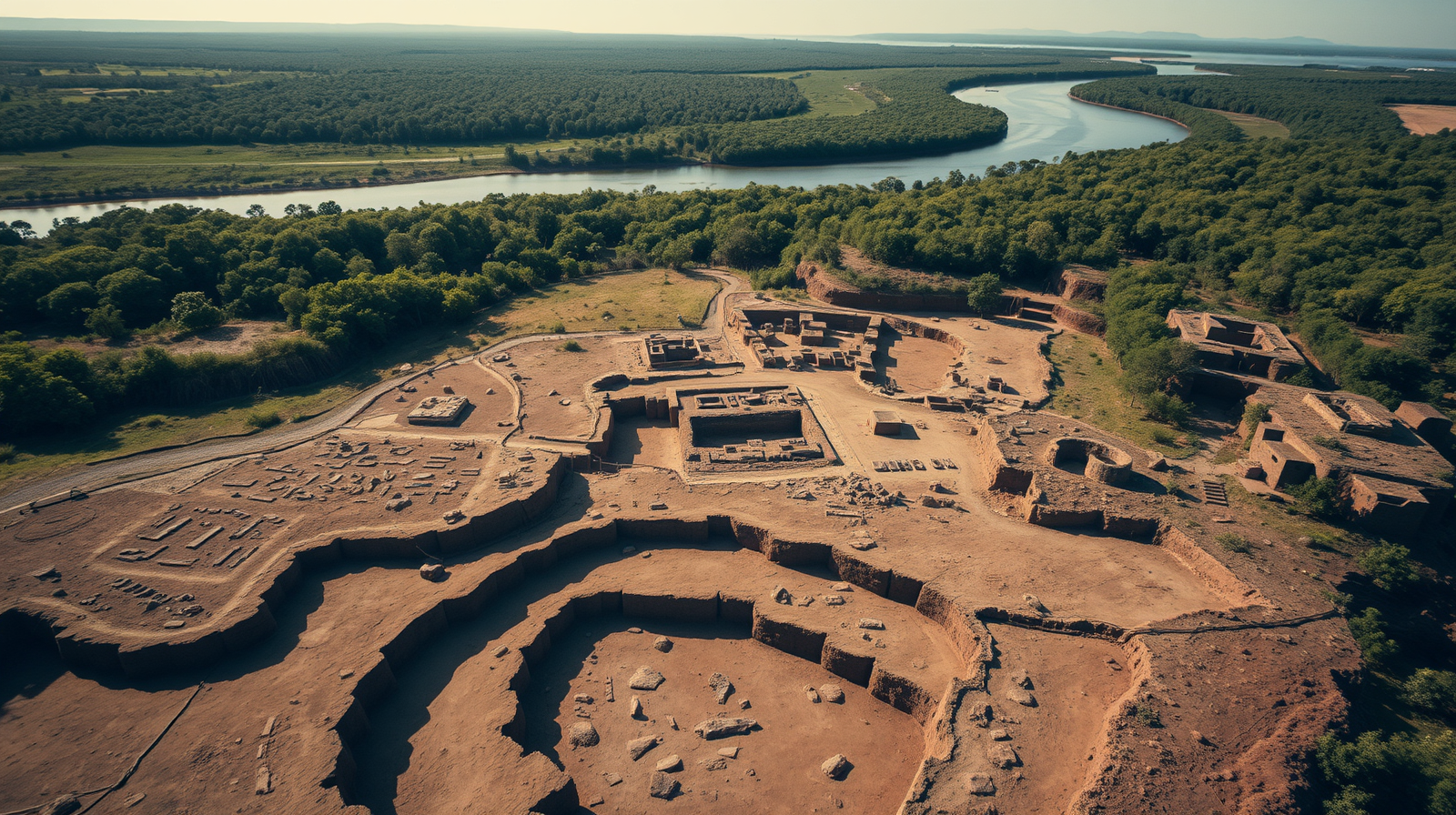
Walking a riverbank five kilometres north of Prince Albert, Saskatchewan, avocational archaeologist Dave Rondeau noticed something that didn't belong to any recent century. Erosion along the North Saskatchewan River had peeled back the soil, exposing layered stratigraphy that told him people had been here and had been here for a long time. "The moment I saw the layers of history peeking through the soil," he later said, "I felt the weight of generations staring back at me." What Rondeau had found in 2023 has since been confirmed as one of the oldest known Indigenous sites on the North American continent, and the implications reach well beyond Saskatchewan.
Why archaeologists say this was a village, not a campsite
The site, known as Âsowanânihk, a Cree word meaning "a place to cross", sits within Sturgeon Lake First Nation territory and dates to approximately 10,700 to 10,800 years ago, based on radiocarbon dating of charcoal samples taken from a hearth at the site. That makes it roughly 6,000 years older than the Pyramids of Giza. The University of Saskatchewan , which is collaborating on the research alongside the University of Calgary and the Âsowanânihk Council, confirmed these results in early 2025 following a January meeting at Sturgeon Lake's Cultural Centre between Dr Andrea Freeman, Dr Glenn Stuart, archaeologist Butch Amundson, and student Jayda Boux, who is leading analysis of the site's lithic materials.
What researchers found was not the scattered debris of a brief hunting stop. Stone tools, fire pits, raw materials for tool-making, and animal bones, including remains of Bison antiquus, an extinct species that could reach up to 2,000 kilograms, together indicate a place where people lived, worked, and returned repeatedly over extended periods. The pattern of deliberate fire management visible in the charcoal layers reinforces this reading. This was an organised settlement, not a transient camp.
Challenging the nomadic narrative
The site sits against a long-standing assumption in mainstream North American archaeology: that early Indigenous peoples in the northern part of the continent were primarily or exclusively nomadic. Dr. Glenn Stuart of the University of Saskatchewan addressed this directly. "This discovery challenges the outdated idea that early Indigenous peoples were solely nomadic," he said. "This indicates that people arrived in this location as soon as it was habitable, and then continually reoccupied the site for thousands of years. Ancestral First Nations have been living in the area west of Prince Albert for as long as it has been possible to live there."
That phrase "as soon as it was habitable" is significant. Researchers believe the site was occupied shortly after glaciers receded from the region around 10,000 years ago, placing its earliest inhabitants among the very first people to move into this part of North America following the last Ice Age. The evidence of organised community life at that early stage is what makes Âsowanânihk unusual.
What it means for the Bering Strait theory
The Bering Land Bridge theory holds that the first humans entered the Americas by crossing Beringia, the land bridge that once connected Siberia and Alaska during the last Ice Age. It remains the dominant framework for understanding how the continent was first peopled. The Sturgeon Lake site does not disprove it, but it does complicate any version of the theory that treats the earliest arrivals as a thin, scattered, or slowly settling population. A fully organised, long-term settlement appearing this quickly after glacial retreat suggests that the people who arrived in central Canada were not just passing through; they were building communities with remarkable speed and intent.
The research team noted that the findings raise questions about the Bering Strait theory and how it has been applied, particularly when used to portray early Indigenous presence in northern North America as recent, sparse, or socially simple.
Oral histories confirmed in the soil
For the Sturgeon Lake First Nation community, the discovery is less a revelation than a confirmation. Oral traditions had long described Âsowanânihk as an important site for culture and trade, a crossing point used by generations of ancestors. Elders had also noted that the location near the river was a significant corridor for migratory bison, making it an ideal place for long-term habitation. The archaeological record now aligns with those accounts in precise detail.
Chief Christine Longjohn put the significance plainly: "This discovery is a powerful reminder that our ancestors were here, building, thriving, and shaping the land long before history books acknowledged us. This site speaks for us, proving that our roots run deep and unbroken." For Indigenous communities whose oral histories have been dismissed or underweighted in academic and legal contexts for generations, physical evidence of this kind carries weight far beyond the archaeological record itself.
A site under threat
Despite its significance, the site faces real and immediate danger. Logging and industrial activity in the surrounding area threaten what remains. Elder Willie Ermine and the Âsowanânihk Council, which brings together Elders, Knowledge Keepers, teachers, youth, and researchers, have called for urgent protective action at local, provincial, and national levels.
Plans are underway to secure ongoing research funding and establish a cultural interpretive centre that would serve education, tourism, and community engagement. Youth participation in land-based learning is a central part of the vision, ensuring the knowledge embedded in this landscape carries forward into the next generation. Whether government and institutional bodies respond with the urgency the site demands is a question that remains open and one that the community is not leaving unanswered.
Âsowanânihk was always a place to cross, and it still is — not just a river crossing but a threshold between what the history books have said and what the ground has always known. The ancestors were here. The soil kept the record. Now the question is who listens.