Summary
- The third day of Amy Coney Barrett’s nomination hearings concluded. Barrett dodged questions from Democrats who tried to pin down her views on voting rights, climate change, and same-sex marriage. In a contentious exchange with vice presidential nominee Kamala Harris, Barrett said she believed Covid-19 was infectious and cigarettes cause cancer, but would provide an “opinion” on climate change.
- Lindsey Graham praised Barrett as “unashamedly pro-life,” describing her nomination as historic. “I have never been more proud of a nominee,” the Republican committee chairman said. “This is history being made, folks. This is the first time in American history that we’ve nominated a woman who is unashamedly pro-life and embraces her faith without apology. And she’s going to the court.”
- The first lady revealed Barron Trump had coronavirus. Melania Trump said Barron, her and the president’s 14-year-old son, tested positive for coronavirus but showed no symptoms. Barron and the first lady have both since tested negative, she said.
- Trump is in Des Moines, Iowa, where he held a campaign rally tonight. The president won Iowa by 9 points in 2016, but recent polls show Trump and Biden running neck and neck in the state.
- Virginia extended its voter registration deadline, after an accidentally cut cable caused the state’s online registration system to shut down yesterday. Virginia voters now have an additional two days to register.
- A judge ended efforts in North Carolina to help voters more easily fix problems with their ballots. This is the latest development in ongoing legal and political battles about which votes can be counted in a state where Biden and Trump are evenly matched.
- Twitter reportedly locked the account of White House press secretary Kayleigh McEnany for sharing a controversial New York Post article. The article claims to have implicated Biden in his son Hunter Biden’s Ukraine business. Biden Sr has repeatedly denied any such involvement and its claims do not appear to be backed by facts. Nonetheless, Trump and his supporters have been seeking to widely promote the story.
Updated
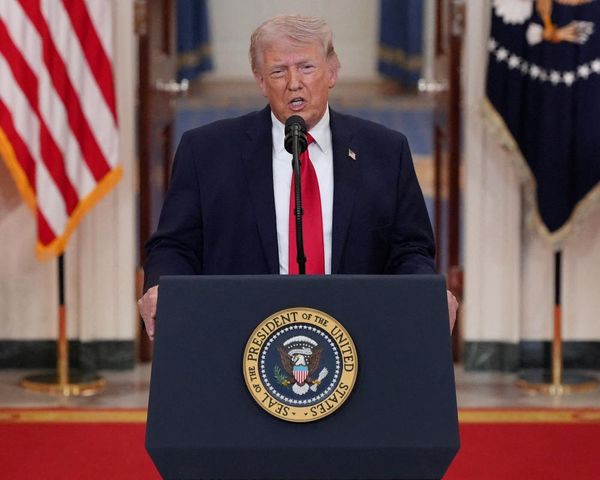
Donald Trump is speaking to his supporters in Des Moines, Iowa.
Per usual, he has unleashed a slew of lies, promoting the New York Post article about Hunter Biden (and struggling to pronounce Burisma), insisting that polls that show him lagging are a lie, saying he won Iowa by a greater percentage in 2016 than he actually did, and claiming that network cameras’ recording lights turn off when he talks about polling.
Per usual, supporters are not socially distanced and many are not wearing masks to slow the spread of coronavirus.
He took off his tie – which was flapping in the wind – and tossed it away dramatically, which is a new twist.
Updated
A federal judge ordered North Carolina to leave in place a policy allowing absentee ballots to be counted through Nov. 12, and blocked a policy that would have made it easier for voters to fix missing witness signatures on their ballots.
Judge William Osteen directed state officials to revise a policy that would allow voters to fix a lack signature by returning an affidavit, rather than casing a whole new ballot and having their old one thrown out. However, he allowed the affidavit fix for other small errors, like an incomplete witness address or misplaced signature.
Thousands of voters looking to fix problems with their ballots – mostly people of color – were left in limbo awaiting these decisions in a battleground state where Biden and Trump and polling neck and neck.
Efforts to suppress the Black vote in North Carolina have been executed with “almost surgical precision,” per a court ruling in 2016.
Republicans have been fighting efforts to make it easier for voters to correct mail-in ballot issues, even though the state’s bipartisan approved a plan to do allow affidavits as a fix for faulty ballots. That voters have to obtain a witness signature is an unfair burden to those who live alone and must avoid contact with others due to Covid-19, and works as a form of voter suppression itself, advocates have said - though efforts to do away with the requirement failed.
The Christian community where Amy Coney Barrett has previously served as a female leader – or handmaid – expels members who engage in gay sex, according to a 2018 interview with Craig Lent, the group’s current head.
Lent told the South Bend Tribune that the People of Praise, a charismatic Christian community that has counted Barrett as a member, would end the membership of a person who discloses gay sex or any other “ongoing, deliberate, unrepentant wrongdoing”.
Barrett, an appellate court judge who has been nominated by Donald Trump to serve on the supreme court, said in a confirmation hearing on Tuesday that she had “never discriminated on the basis of sexual preference and would not ever discriminate on the basis of sexual preference”.
Barrett has never openly discussed her affiliation with People of Praise. But media reports have pointed out she appears to be a longstanding member based on multiple factors: her work as a trustee at a People of Praise-affiliated school, which required her to be a member; the fact that she lived with one of the group’s co-founders when she was a law student at Notre Dame; the publication of her picture and other family announcements in the group’s magazine, Vine and Branches; and her father’s role as a leader in the group.
The Washington Post also was first to report that Barrett was listed as a handmaid, or female leader, in a 2010 directory.
Asked by the Guardian to comment on the apparent policy of expelling members who have gay sex, and asked whether this was a discriminatory policy, a spokesperson for the People of Praise said in a statement: “In the People of Praise, as in the Roman Catholic church and many Protestant churches, we follow the traditional New Testament teaching that marriage is a union of one man and one woman.”
Twitter locked the White House press secretary from her account
Twitter reportedly locked the account of White House press secretary Kayleigh McEnany for sharing a controversial New York Post article, which claims to have implicated Biden in his son Hunter Biden’s Ukraine business. Biden Sr has repeatedly denied any such involvement.
Facebook and Twitter limited the spread of the NY Post article critical of Democratic presidential candidate Joe Biden Wednesday, sparking outrage among conservatives and accusations of partisan online censorship.
“Smoking-gun email reveals how Hunter Biden introduced Ukrainian businessman to VP dad,” the newspaper’s headline read. The New York Post said it reported the story by obtaining a computer abandoned by Biden’s son Hunter.
As Biden’s campaign denied he ever met the businessman, Facebook and Twitter placed restrictions on linking to the article, saying there were questions about its validity.
AP contributed to this report.
The US politics sketch: Barrett’s confirmation hearings bring few surprises

It was the five-hour mark when the tech gods finally pulled the plug.
As Senator Richard Blumenthal started questioning supreme court nominee Amy Coney Barrett, the Senate’s audio system crashed and her words floated away on the air.
The gremlins were caused not by Covid-enforced video conferencing from some far-flung location but a simple breakdown in the committee room. By then the hearing on Capitol Hill in Washington had become background noise.
Barrett and the Republican senators backing her have to pretend she is a tabula rasa, as ideologically blank as the notepad in front of her when it comes to deciding cases about abortion, healthcare, same-sex marriage or myriad other issues.
So when the audio system cranked back into gear, Blumenthal of Connecticut asked if a ruling that barred states from criminalising contraceptive use was rightly decided. Barrett declined to say so.
And when Blumenthal asked about her views on the climate crisis, she parried: “Senator Blumenthal, I don’t think I am competent to opine on what causes global warming or not.”
Had he asked whether the president is allowed to stand in the middle of Fifth Avenue and shoot somebody, there is no guarantee that Barrett would have given an unambiguous answer.
In fairness, she was merely applying the “Ginsburg rule”: the late justice Ruth Bader Ginsburg’s dictum that nominees to the court should offer no hints, no previews, no forecasts.
Or as the law professor Elena Kagan put it 25 years ago: “Hearings have presented to the public a vapid and hollow charade, in which repetition of platitudes has replaced discussion of viewpoints and personal anecdotes have supplanted legal analysis.
Kagan is now a supreme court justice.
Barrett, however, is taking the Kabuki dance to new extremes. She remained evasive even when Democrats asked about Donald Trump and his evident belief that she would take his side, just as he demanded “loyalty” from the former FBI director James Comey and other public servants.
Another competitive senate race that has a good chance of flipping from Republican to Democrat is in Montana.
A new poll by Montana State University found that governor Steve Bullock, a Democrat, is leading slightly (by two points) ahead of incumbent Republican Steve Daines. The Cook Political Report rates this race between two Steves as a “tossup.”
Trump is still likely to owin the presidential race in Montana, but by a smaller margin than he did in 2016 – while
The MSU poll of 1,609 respondents found Bullock ahead by two points at 49%. The gap is within the margin of error.
Lindsey Graham announced that his campaign raised $28m in the third quarter. The figure is a quarterly fundraising record for Republican Senate candidates but still lags well behind the $57m his opponent Jaime Harrison has raised.
The two candidates are tied in the polls. Graham’s reliably Republican electorate has soured on him amid his flip-flopping on considering a Supreme Court nominee during an election year. As chair of the Senate Judiciary Committee, he has rushed through the nomination of Amy Coney Barrett despite promising publicly to oppose an election-year Supreme Court nomination when Republicans refused to consider Barack Obama’s nominee Merrick Garland.
A close ally of Trump, Graham is now facing the toughest re-election battle of his Senate career.
Updated
Public hearing poortion ends
Next is a closed hearing on FBI background checks. Tomorrow the judiciary committee will set up a vote and hear outside witnesses.
“You will be confirmed, God willing,” said Lindsey Graham.
“The hope was not to change anybody’s mind,” with the hearing, he noted - instead hope was for Americans to get to know Barrett.
Updated
Senator John Neely Kennedy, a Republican, used a Trump campaign talking point that Harris’ past career as a prosecutor deepened racial inequities to rebut her claim that systematic racism exists.
You can read more about Harris past as a prosecutor here. The Trump campaign – while itself promoting a “tough on crime” attitude and railing against Black Lives Matter protestors - has nonetheless adopted progressive critiques of Harris’ record as “top cop”.
Harris “thinks America is systemically racist - I think our history is the best evidence of that it is not,” said the senator from Louisiana, citing the Barack Obama presidency as proof. “With the blink of an eye, we went from institutionalized slavery to an African American president,” he said.
After lobbing several softball questions at Barrett including (“Do you hate little warm puppies?”) Kennedy ended by asking: “Who does the laundry in your house?” (which I’m sure he also meant to ask Brett Kavanaugh and Neil Gorsuch).
It is worth noting that Barrett didn’t clearly answer this one either: “We run a lot of loads of laundry.”
Barrett also would not comment on whether she believes voting discrimination exists.
Harris: Do you agree with Justice Roberts when he said voting discrimination still exists?
Barrett: “I will not comment on what any justice said in an opinion, whether an opinion is right or wrong, or endorse that proposition.”
Under questioning from Kamala Harris, Amy Coney Barrett refuses to say if she thinks voting discrimination still exists pic.twitter.com/gv9KN904fu
— Aaron Rupar (@atrupar) October 14, 2020
Harris took up questioning Barrett on climate change.
Harris: Do you think COVID-19 is infectious?
Barrett: Yes.
Harris: Do you think smoking causes cancer?
Barrett: I’m not sure exactly where you’re going with this... Yes, every package of cigarettes warns that smoking causes cancer.
Harris: Do you think climate change is happening?
Barrett: “Senator, again... You have asked me a series of questions that are completely uncontroversial, and then trying to elicit an opinion from me that is on a very contentious matter of public debate.”
Climate change is not a contentious matter of public debate - about 8 in 10 Americans say that human activity is fueling climate change, per a Kaiser Family Foundation poll. But most importantly, climate change is not a contentious matter of scientific debate.
Today so far
That’s it from me today. My west coast colleague, Maanvi Singh, will take over the blog for the next few hours.
Here’s where the day stands so far:
- The third day of Amy Coney Barrett’s nomination hearings is still unfolding. Barrett has been answering questions from the Senate judiciary committee for eight hours, and Democratic vice-presidential nominee Kamala Harris is currently questioning the nominee.
- Lindsey Graham praised Barrett as “unashamedly pro-life,” describing her nomination as historic. “I have never been more proud of a nominee,” the Republican committee chairman said. “This is history being made, folks. This is the first time in American history that we’ve nominated a woman who is unashamedly pro-life and embraces her faith without apology. And she’s going to the court.”
- The first lady revealed Barron Trump had coronavirus. Melania Trump said Barron, her and the president’s 14-year-old son, tested positive for coronavirus but showed no symptoms. Barron and the first lady have both since tested negative, she said.
- Trump is en route to Des Moines, Iowa, where he will hold a campaign rally tonight. The president won Iowa by 9 points in 2016, but recent polls show Trump and Biden running neck and neck in the state.
- Virginia extended its voter registration deadline, after an accidentally cut cable caused the state’s online registration system to shut down yesterday. Virginia voters now have an additional two days to register.
Maanvi will have more coming up, so stay tuned.
Democratic vice-presidential nominee Kamala Harris is now questioning Amy Coney Barrett. She is the last Democrat who will speak in this round of questioning.
Trump is en route to Iowa, a state that he won by 9 points in 2016. Polls currently show the president and Joe Biden running neck and neck in Iowa.
The president will hold a rally in Des Moines tonight, and attendees will be greeted by this billboard when they arrive at the event site.
Billboard outside Des Moines airport where Trump holds Iowa rally tonight. pic.twitter.com/XHix45wzlw
— Jim Acosta (@Acosta) October 14, 2020
Speaking to reporters before leaving for his Iowa rally, Trump very briefly addressed his son’s health before pivoting to praising Amy Coney Barrett.
Trump spent exactly one second answering a question about how his son Barron is doing after he tested positive for coronavirus pic.twitter.com/aiGXBSbHRZ
— Aaron Rupar (@atrupar) October 14, 2020
“Barron’s fine, and Amy is doing a fantastic job. We’re heading out to Iowa, and we have a big rally,” Trump said.
The first lady said in a statement that Barron tested positive but experienced no coronavirus symptoms. He has since tested negative, as has the first lady.
Like other Democrats on the Senate judiciary committee, Cory Booker pressed Amy Coney Barrett on voting rights.
As part of his questioning, Booker asked Barrett if she had ever waited in line for five hours to vote. She said no. Booker asked if she had ever waited an hour to vote. She said no.
Booker compared those answers to the experience of many black voters in America, who often face long lines at their polling stations.
Trump said his son, Barron, is doing “fine” after testing positive for coronavirus.
The president responded to a reporter’s question about Barron as he left for Des Moines, Iowa, where he is holding a campaign rally later tonight.
Shortly before Trump’s departure, the first lady revealed Barron had tested positive but shown no coronavirus symptoms in a statement about her own experience with the virus.
Melania and Barron Trump have both since tested negative, the first lady said.
Amy Coney Barrett told Democrat Cory Booker that she could not offer her opinion on whether it was wrong to separate immigrant children from their parents.
“That’s a matter of hot political debate in which I can’t express a view or be drawn into as a judge,” Barrett said. “I can’t express a view on that.”
The Democratic senator responded that he considered such matters to be “basic questions of human rights”.
The Trump administration attracted severe criticism in 2018 after its “zero tolerance” immigration policy resulted in thousands of children being separated from their parents.
Barron Trump had coronavirus, first lady reveals
Melania Trump released a statement about her experience with coronavirus, and the first lady revealed her son with the president, Barron Trump, tested positive for coronavirus.
The first lady said 14-year-old Barron initially tested negative after the president was diagnosed, as the White House announced. But the White House did not reveal Barron’s later test came up positive.
To all who have reached out - thank you. Here is my personal experience with COVID-19 :https://t.co/XUysq0KVaY
— Melania Trump (@FLOTUS) October 14, 2020
“To our great relief he tested negative, but again, as so many parents have thought over the past several months, I couldn’t help but think ‘what about tomorrow or the next day?’,” the first lady said in the statement.
“My fear came true when he was tested again and it came up positive. Luckily he is a strong teenager and exhibited no symptoms.”
The first lady noted Barron has since tested negative again, as has she. Trump said her own experience with coronavirus was like “a roller coaster of symptoms in the days after” she was diagnosed.
“I experienced body aches, a cough and headaches, and felt extremely tired most of the time,” Trump said. “I am happy to report that I have tested negative and hope to resume my duties as soon as I can.”
The first lady added, “Along with this good news, I want people to know that I understand just how fortunate my family is to have received the kind of care that we did.”
Trump said she continues to pray for the Americans who are currently struggling with coronavirus and their families.
Updated
Democrat Mazie Hirono has now concluded her questioning of Amy Coney Barrett, and Republican Joni Ernst is up next.
After Ernst, there are five members of the Senate judiciary committee who still need to speak today, so there are likely at least a couple hours left in this hearing.
Concluding his questioning of Amy Coney Barrett, Republican Thom Tillis encouraged every American to vote, a sentiment that the supreme court nominee echoed.
But Tillis got the date of the election wrong.
"I for one hope that every registered voter in this country votes on November 11" -- Sen. Thom Tillis doesn't know when Election Day is pic.twitter.com/efO2ltUt1c
— Aaron Rupar (@atrupar) October 14, 2020
“I for one hope that every registered voter in this country votes on November 11,” Tillis said.
The elections, including Tillis’ very close Senate race in North Carolina, will (of course) take place on November 3.
Some non-hearing news: Trump is reportedly hoping to beat Joe Biden in the ratings game tomorrow, when the two presidential nominees will participate in dueling town halls.
The Daily Beast reports:
According to multiple sources familiar with the president’s thinking, Trump has told close associates that he wishes to counter-program the Biden town hall and score higher TV viewership numbers, and then use such a contrast in ratings to humiliate his Democratic opponent. Predictably, Trump also wants his 2020 team to make a big deal out of pushing out those numbers, should his hour’s ratings beat Biden’s 90-minute-long event.
‘He looks at this the same way he looks at attendance at his rallies versus the [turnout] Biden gets for his events,’ one of these people told The Daily Beast. ‘He obviously wants to blow Biden out of the water.’
Trump has been fixated on his ratings since he was the host of “The Apprentice,” and he is always eager to boast about his favorable ratings.
Some commentators are criticizing NBC News for setting the town hall with Trump at the same time as Biden’s town hall, forcing Americans to choose which one to watch:
So, @NBCNews is presenting a Trump town hall opposite a Biden town hall? Do I have that right? They are forcing audiences to choose which candidate to watch? Isn't that serving Trump's agenda? Couldn't they have chosen a different time?
— David Rothkopf (@djrothkopf) October 14, 2020
Okay, we are back to the hearing, with working microphones and everything. Republican Thom Tillis is now questioning Amy Coney Barrett.
Well, we’ve been here before: the mics in the Senate hearing room have once again cut out.
The Senate judiciary committee briefly tried to keep the proceedings going despite the audio issues, but chairman Lindsey Graham has now again called a brief recess.
When the mics failed as Richard Blumenthal completed his questioning, Graham joked, “Are we not paying the bills?”
Democrat Richard Blumenthal asked Amy Coney Barrett whether she believed human beings were causing climate change.
“I don’t think I’m competent to opine on what causes global warming or not,” Barrett said, adding that she did not think her views on the matter would be relevant to her work with the court.
When Blumenthal asked Barrett if she agreed with Trump’s thinking on climate change, she claimed she was not familiar enough with the president’s comments to cast an opinion.
Updated
Responding to questions from Richard Blumenthal, Amy Coney Barrett said she believed Brown v Board of Education was correctly decided, as was Loving v Virginia, which relied on Brown as a precedent.
Brown established that racial segregation in schools was unconstitutional, and Loving found that laws banning interracial marriages violated the Fourteenth Amendment.
But once again, Barrett refused to say whether Griswold v Connecticut, which established married couples’ right to birth control access, was correctly decided.
Griswold was cited as the basis for Roe v Wade, and Barrett has steadfastly avoided offering an opinion on that landmark case as well.
After a 30-minute delay due to audio issues, Amy Coney Barrett’s nomination hearing has now resumed.
Democrat Richard Blumenthal is picking up his questioning, which he had just started when the mics went out.
As we wait for the hearing to resume, the blog is going to do a polling roundup from three battleground states -- Georgia, North Carolina and Ohio.
A new Quinnipiac University poll shows Joe Biden leading Trump by 7 points in Georgia, 51%-44%. The president won the state, a longtime Republican stronghold, by 5 points in 2016.
#JoeBiden is ahead of #PresidentTrump in #Georgia, but it is too close to call in #Ohio; Democrats lead in both Georgia Senate races https://t.co/vMVM84g78t #2020Election #GASen
— Quinnipiac University Poll (@QuinnipiacPoll) October 14, 2020
It should be noted that Quinnipiac’s result in Georgia is a bit out of step with other recent surveys. According to the FiveThirtyEight polling average of Georgia, Biden has a 1.4-point lead in the race.
Quinnipiac also found Biden and Trump to be virtually tied among likely voters in Ohio, which the president won by 8 points in 2016.
According to Quinnipiac, Biden is attracting the support of 48% of likely voters in Ohio, while Trump is at 47%.
And a New York Times/Siena College poll showed Biden is also leading in North Carolina, which Trump won by 4 points in 2016.
According to the poll, Biden is 4 points ahead of Trump among North Carolina’s likely voters, 46%-42%.
The battleground state polls, in combination with recent national polls, paint a pretty bleak picture for the president.
Reminder: we are now 20 days from election day.
The third day of Amy Coney Barrett’s nomination hearings is ... still delayed. Senators are now mulling around the room, and chairman Lindsey Graham is sipping a Coke Zero.
Durbin taps on his mic to see if it's now working (it's not).
— Julie Tsirkin (@JulieNBCNews) October 14, 2020
Graham says, "hello?" and clicks his mic on and off (still not working).
Senators continue to mull around. Graham cracked a coke zero.
Stay tuned...!
As we wait for Amy Coney Barrett’s nomination hearing to resume, Trump has given an interesting interview to the conservative website Newsmax.
Asked whether he intended to keep William Barr on as attorney general if he wins reelection, the president refused to comment.
“I have no comment. Can’t comment on that. It’s too early,” Trump said. “I’m not happy with all of the evidence I have, I can tell you that. I’m not happy.”
Bit of a flurry at the supreme court confirmation hearing, as Amy Coney Barrett’s mike goes down just as she was trying to respond to a question on gun control from Democratic Senator Richard Blumenthal, of Connecticut.
Murmurs went around the room as she suddenly began speaking into the void, then realized she could not be heard and started fiddling with the buttons on her microphone.
As the hearing paused, photographers sat on the floor in front of her lowered their heavy lenses for a quick rest, and everyone waited.
The Senate judiciary committee has just called a 10-minute recess to try to sort out the problem.
Updated
A federal judge has ruled that Tennessee’s 48-hour waiting period law for abortions is unconstitutional.
Tennessee’s 2015 law requires women to make two trips to an abortion clinic, first for mandatory counseling and then for the abortion at least 48 hours later.

In his ruling, US district judge Bernard Freidman found that the law “substantially burdens women seeking an abortion in Tennessee. Friedman also found the state did not show that the law furthers its purported goals.
“Women’s mental and emotional health is not benefited because the mandatory waiting period does nothing to increase the decisional certainty among women contemplating having an abortion.
“Further, the evidence demonstrates that at least 95% of women are certain of their decisions, post-abortion regret is uncommon, and abortion does not increase women’s risk of negative mental health outcomes,” Friedman wrote.
The ruling comes more than a year after a four-day trial on the law and amid the confirmation hearings for supreme court nominee Amy Coney Barrett, who critics worry could help to weaken or even overturn US abortion rights.
South Carolina Republican Senator Lindsey Graham earlier today praised what he saw as Barrett’s anti-abortion beliefs, saying she was “unashamedly pro-life”.
Democrat Chris Coons asked Amy Coney Barrett about Griswold v Connecticut, the landmark 1965 case that established married couples’ right to access birth control.
Griswold was cited as a precedent when the supreme court decided Roe v Wade, which established women’s constitutional right to abortion access.
Barrett said Griswold was “very very very very very very unlikely to go anywhere” because that would require state legislatures or Congress to pass a law banning birth control and for the court to then uphold that law, which seemed completely implausible.
That being said, Barrett still declined to offer an opinion on whether Griswold was decided correctly.
Today so far
Here’s where the day stands so far:
- The third day of Amy Coney Barrett’s nomination hearings is underway. About half of the members of the Senate judiciary committee have already posed their second-round questions to the supreme court nominee.
- Lindsey Graham praised Barrett as “unashamedly pro-life,” describing her nomination as historic. “I have never been more proud of a nominee,” the Republican chairman said. “This is history being made, folks. This is the first time in American history that we’ve nominated a woman who is unashamedly pro-life and embraces her faith without apology. And she’s going to the court.”
- Virginia extended its voter registration deadline, after an accidentally cut cable caused the state’s online registration system to shut down yesterday. Virginia voters now have an additional two days to register.
The blog will have more coming up, so stay tuned.
Amy Klobuchar asked Amy Coney Barrett if she had ever voted by mail, and the supreme court nominee said she could not recall doing so, although she may have sent a mail-in ballot when she was in college.
In response to a follow-up question from Klobuchar, Barrett said some of her friends and family members have voted by mail.
Amy Coney Barrett says she may have voted by mail when she was in college and has had "friends or family vote by mail" https://t.co/Xy3Sl57gsC pic.twitter.com/9vJDYgp87a
— CBS News (@CBSNews) October 14, 2020
But a Washington Post reporter noted that Barrett appears to have voted absentee as recently as 2016.
Barrett said she can't recall whether she voted by mail, but according to @FixTheCourt, Barrett voted absentee in 2016 https://t.co/Sw5dkwhb6I
— Seung Min Kim (@seungminkim) October 14, 2020
Amy Klobuchar expressed frustration with Amy Coney Barrett’s refusal to offer opinions on voting by mail.
Klobuchar asked Barrett if she considered mail-in ballots to be an “essential way to vote for millions of Americans right now.”
Barrett said she could not respond because that was “a matter of policy.”
Klobuchar replied, “To me that just feels like a fundamental part of our democracy.”
Trump has repeatedly attacked voting by mail and suggested that mail-in ballots in this year’s elections will be highly vulnerable to fraud, even though voter fraud is very rare.
Amy Klobuchar noted that if Amy Coney Barrett is confirmed, the supreme court will have three justices who worked for the Republican side in Bush v Gore.
Both Chief Justice John Roberts and Justice Brett Kavanaugh also worked on the case that settled the 2000 presidential election.
Amy Klobuchar pressed Amy Coney Barrett on whether she knew of Trump’s opposition to the Affordable Care Act when she was nominated.
“I am aware that the president opposes the Affordable Care Act,” Barrett said. But she would not say whether she was aware of his opposition before now.
Klobuchar again tried to nail down whether Barrett was aware of Trump’s opposition when she penned a 2017 essay criticizing the supreme court’s decision to uphold the ACA.
“To the extent you’re suggesting this was like an open letter to President Trump, it was not,” Barrett told Klobuchar.
Third day of Barrett's nomination hearings resumes
The Senate judiciary committee has reconvened, and questioning of Amy Coney Barrett has now resumed, with Democrat Amy Klobuchar speaking.
Hillary Clinton has weighed in on the nomination hearings of Amy Coney Barrett, who considers herself to be an originalist in her interpretation of the Constitution.
Asked to define originalism yesterday, Barrett said it means she interprets the Constitution to “have the meaning that it had at the time people ratified it.”
The former Democratic presidential nominee responded to that by saying, “At the time the Constitution was ratified, women couldn’t vote, much less be judges.”
At the time the Constitution was ratified, women couldn't vote, much less be judges. https://t.co/B0oxTT2nzt
— Hillary Clinton (@HillaryClinton) October 14, 2020
First break in today's hearing
We have reached the first break in today’s nomination hearing for Amy Coney Barrett.
The Senate judiciary committee will reconvene after a 30-minute lunch.
Senator Ted Cruz opened his questioning by arguing Democrats had “largely abandoned” efforts to paint Amy Coney Barrett as unqualified to join the supreme court.
Cruz also taunted Democrats for not appearing in person for today’s hearing with Barrett.
Democrat Dick Durbin interjected with a “point of personal privilege” to note that many of his colleagues were watching the proceedings from their offices because there is a global pandemic going on.
Cruz also said Democrats had spent “very little time” exploring Barrett’s judicial philosophy in their questions.
It should be noted that Cruz used his questioning time yesterday to deliver a 20-minute speech criticizing Democrats on religious liberty. He then asked Barrett how she had managed virtual leaning with her children and whether she knew any foreign languages.
While responding to Sheldon Whitehouse’s questions, Amy Coney Barrett had a rather hilarious slip of the tongue.
“Senator Whitehouse, I will approach every case with an open wine -- open mind,” Barrett said.
Responding to questions from Democrat Sheldon Whitehouse, Amy Coney Barrett said judges should not try to pursue policy objectives from the bench.
“I think judges should not have campaigns,” Barrett said. “I think they should not have pet projects. I think they should decide cases.”
During this week’s hearings, the supreme court nominee has repeatedly said policy agendas should be left up to legislators.
An update on coronavirus relief negotiations: House speaker Nancy Pelosi and treasury secretary Steven Mnuchin spoke by phone this morning.
The Speaker and Secretary Mnuchin spoke this morning by phone at 9:30 a.m. for approximately 1 hour. In response to proposals sent over the weekend, the two spent time seeking clarification on language, which was productive. (1/3)
— Drew Hammill (@Drew_Hammill) October 14, 2020
A spokesperson for Pelosi described the discussion as “productive,” although he noted the need for a national testing strategy remains a “major area of disagreement.”
Pelosi and Mnuchin are expected to speak again tomorrow, as their staffers continue to confer.
Senate majority leader Mitch McConnell has said the chamber will vote next week on a standalone relief bill to provide funding for small business loans.
However, the president has signaled he wants Congress to pass a massive stimulus bill, over the objections of a number of Republican lawmakers.
Democrat Dick Durbin used his questioning to press Amy Coney Barrett on voting rights.
Coney Barrett still isn't willing to acknowledge that the president can't unilaterally delay an election pic.twitter.com/BlrlC9332m
— Aaron Rupar (@atrupar) October 14, 2020
Durbin repeatedly asked Barrett what she would say if the president tried to block Americans from voting based on their race.
Barrett responded by simply citing anti-discrimination provisions in the Constitution, including the 15th Amendment and the Equal Protection Clause.
When Durbin again asked if the president could block someone from voting based on their race, Barrett again cited the 15th Amendment and said, “I really can’t say anything more than I’m not going to answer hypotheticals.”
Responding to questions from Democrat Patrick Leahy, Amy Coney Barrett would not say whether she believed Trump should be able to pardon himself as president.
Amy Coney Barrett won't close the door on the idea that Trump could pardon himself pic.twitter.com/J7uRafbXK0
— Aaron Rupar (@atrupar) October 14, 2020
Barrett said that question had never been litigated and thus called for “legal analysis” about the scope of the pardon power.
But Barrett agreed with Leahy that “no one is above the law.”
Leahy argued that principle was incompatible with the idea of a president pardoning himself.
Virginia voter registration deadline extended after technical failure
A bit of non-hearing news: a judge has extended the voter registration deadline in Virginia after an accidentally cut cable caused the online system to shut down yesterday.
The AP reports:
Wednesday’s order by U.S. District Judge John A. Gibney, Jr. in Richmond is an effort to make up for several hours of lost time on Tuesday, which had been the last day to register before the November general election.
The shutdown of the state’s website caused ‘a tremendous harm’ to the people who want to register to vote, Gibney said.
Both the voting rights advocates seeking the extension and the Virginia state officials they sued agreed that more time should be granted. The deadline to register to vote is now 11:59 p.m. on Thursday Oct. 15. It includes both online and in-person registration.
Early voting is underway in Virginia, and more than 1 million of the state’s residents have already cast their ballots.
During his questioning of Amy Coney Barrett, Republican Chuck Grassley made the bizarre claim that Democrats “don’t really care about Obamacare.”
“This is all a charade. It’s time to get real. This is all just a distraction,” Grassley said. “They want government-run Medicare for All.”
Many Democrats, including presidential nominee Joe Biden, do not support Medicare for All and instead say Congress should strengthen the Affordable Care Act.
Democratic members of the Senate judiciary committee have focused much of their questioning of Barrett on the need to protect the ACA.
Chuck Grassley, the former Republican chairman of the Senate judiciary committee, asked Amy Coney Barrett about allowing cameras in the supreme court.
Currently, cameras are not allowed during the supreme court’s proceedings, a practice that has attracted some criticism for lack of transparency.
At 87 years old, Grassley acknowledged he likely “won’t live long enough to see” cameras in the courtroom, but the Republican senator has pushed to change the practice.
Barrett promised to keep an “open mind” about allowing cameras into the courtroom.
Responding to questions from Dianne Feinstein, the top Democrat on the Senate judiciary committee, Amy Coney Barrett would not say whether she considered Medicare to be constitutional.
Asked if she agreed with originalists who have said the popular healthcare program for older Americans was unconstitutional, Barrett said she could not say because she was not familiar with the arguments for that.
“I can’t answer the question in the abstract,” Barrett told Feinstein.
The Democratic senator appeared taken aback that Barrett wouldn’t offer a clear answer on the matter.
“It’s hard for me to believe that’s a real question,” Feinstein said. “The Medicare program is really sacrosanct in this country.”
Barrett similarly deflected many questions yesterday about her opinions on major past cases and constitutional interpretations, insisting it would be inappropriate for her to do so before she joined the court.
Lindsey Graham criticized some of his Democratic colleagues’ questions about a 2006 ad that Amy Coney Barrett signed on to, which said life begins at fertilization.
The ad was organized by St Joseph County Right to Life, an extreme anti-choice group that has also argued the process of discarding unused or frozen embryos created during the in vitro fertilization (IVF) process should be criminalized.
“What we tried to do yesterday was to turn a pro-life organization into a legislative body,” Graham said. “I think that’s a dangerous thing.”
Graham’s decision to address the ad and specifically questions about criminalizing IVF indicated Republicans believe it could be an effective talking point against Barrett’s confirmation, as an NBC News reporter noted.
Lindsey Graham now trying to give Amy Coney Barrett cover on the issue of IVF and whether it should be criminalized, as a group whose ad she signed said. Another sign GOP knows that's dangerous ground for them to be on
— Kasie Hunt (@kasie) October 14, 2020
Lindsey Graham noted that many of his Democratic colleagues focused their questioning yesterday on the Affordable Care Act.
“Obamacare is on the ballot,” the Republican chairman said of the elections, which are less than three weeks away.
“This hearing has been more about Obamacare than about you,” Graham added.
The supreme court is set to hear oral arguments in a case challenging the ACA a week after the elections, and Democrats have argued Barrett’s confirmation to the court could jeopardize the healthcare law.
Graham celebrates Barrett as an 'unashamedly pro-life' nominee
Lindsey Graham, the Republican chairman of the Senate judiciary committee, opened his questioning by praising Amy Coney Barrett’s performance yesterday.
Graham tells Barrett: "I have never been more proud of a nominee...This is history being made, folks. This is the first time in American history that we've nominated a woman who is unashamedly pro-life and embraces her faith without apology. And she's going to the Court" pic.twitter.com/FmRNzfxBAy
— CBS News (@CBSNews) October 14, 2020
Graham took issue with Kamala Harris’ comments yesterday, after the Democratic senator compared Barrett to the late Justice Ruth Bader Ginsburg, saying Ginsburg was “was far more forthcoming at her hearing about the essential rights of women.”
Graham insisted Barrett had been “candid to the body about who you are and what you believe.”
“I have never been more proud of a nominee,” Graham said. “This is history being made, folks. This is the first time in American history that we’ve nominated a woman who is unashamedly pro-life and embraces her faith without apology. And she’s going to the court. A seat at the table is waiting on you.”
Graham described Barrett’s nomination had punched through “a reinforced concrete barrier around conservative women,” adding that her potential confirmation would be a great signal to conservative women about their potential for success.
It should be noted that Barrett would be filling the seat of Ruth Bader Ginsburg, who spent her career insisting abortion access was a constitutional right for women.
Updated
Third day of Barrett's nomination hearings begins
Amy Coney Barrett is seated in the Senate hearing room, and the third day of her nomination hearings is now underway.
This is Joan Greve in Washington, taking over for Martin Belam.
We are moments away from the third day of Amy Coney Barrett’s nomination hearings, which will include another day of questioning from the Senate judiciary committee.
Each member of the committee will get 20 minutes to speak in this second round of questioning, after yesterday’s marathon session.
It will be another long day -- although not quite as long as yesterday -- so stay tuned.
Amy Coney Barrett refused to be drawn yesterday on whether Donald Trump should commit in public to a peaceful transfer of power if he loses the election in three weeks time. She described that as “a political controversy right now [and] as a judge I want to stay out of it.”
That very question is the subject of our award-winning Today in Focus podcast today – what if Donald Trump refuses to concede?
Prof Lawrence Douglas, the author of the recently published Will He Go?, tells Anushka Asthana that the stage is being set for a disputed election if the result hinges on small margins and mail-in ballots, which take longer to count. In this scenario, he believes Trump is likely to refuse to concede if the vote goes against him.
It could open up a legal and political minefield that the US constitution and the separated powers of the US government is ill-equipped to deal with. One thing is clear: a new president must be sworn in at noon on 21 January 2020. But who turns up to that ceremony could be the result of a bitter and protracted battle.
And with that I am off. Joan E Greve will be here shortly to take you through the next session of the Amy Coney Barrett hearings, which you’ll be able to watch right here – you may need to refresh the page for the video to appear…
A reminder that we’ve got a live online discussion of the US election coming up on Tuesday 20 October at 2pm ET featuring a panel of our leading journalists. If like me you’ll be watching in the UK, that’s at 7pm BST over here.
Senior political reporter Daniel Strauss, political correspondent Lauren Gambino and columnist Richard Wolffe will be chaired by our columnist and Politics Weekly Extra podcast presenter Jonathan Freedland.
There are more details and the ability to book your tickets here: Guardian Newsroom: The US presidential election
Donald Trump Jr and Kayleigh McEnany are tweeting this morning about a New York Post story claiming that leaked emails show that, as the Post puts it:
Hunter Biden introduced his father, then-Vice President Joe Biden, to a top executive at a Ukrainian energy firm less than a year before the elder Biden pressured government officials in Ukraine into firing a prosecutor who was investigating the company.
🚨🚨 BOMBSHELL 🚨 🚨
— Kayleigh McEnany (@kayleighmcenany) October 14, 2020
Hunter introduced Joe Biden to a top executive at the Ukrainian energy firm he received $50K/month from!
BIDEN: “I have never discussed with my son or my brother or anyone else anything having to do with their businesses. Period.”@JoeBiden LIED. PERIOD‼️ pic.twitter.com/zDy75fxauq
Smoking-gun email reveals how Hunter Biden introduced Ukrainian businessman to VP dad https://t.co/b6TKXPbDNs
— Donald Trump Jr. (@DonaldJTrumpJr) October 14, 2020
You can read the Post story, which they have labelled an exclusive, here: Smoking-gun email reveals how Hunter Biden introduced Ukrainian businessman to VP dad
Nadja Sayej has a fascinating piece for us today on Martin Schoeller’s photographic exhibition in New York City called Death Row Exonerees which is on display until January:
“These women and men bear witness to the unacceptable costs of a misguided system of laws, which are in desperate need of revision, and a prison system that focuses on punishment, rather than on rehabilitation.”
Among the exonerees that Schoeller worked with for the exhibition, there is Derrick Jamison, who spent 20 years in prison for a murder and robbery he didn’t commit.
“There is a double standard when it comes to justice in our judicial system, especially with wrongful conviction,” says Jamison. “If you are a minority or a low-income citizen, the pursuit of justice can be an elusive one. But if you are rich, it happens overnight.”
He also worked with Kwame Ajamu, who was sentenced to death in 1975 for the murder and robbery of a salesman, due to a false eyewitness testimony and police misconduct. He was released from prison in 2003, after serving 28 years.
Read more – and see some of the photographs – here: Death Row Exonerees: behind a powerful photo project on injustice
The Johns Hopkins university tracker has the updated coronavirus numbers for the US. Yesterday there were 52,406 new Covid cases reported, and 802 new deaths. That brings the overall total recorded to 215,914 deaths out of 7,859,365. These remain the highest totals of anywhere in the world.
Using figures calculated from their own database, the New York Times says that new coronavirus cases in the US are now running at a level 21% higher than they were two weeks ago. They have placed 28 states and territories into their category of “cases are higher and staying high”.
A ballot drive has turned in more than 483,000 signatures for an initiative to prohibit discrimination against LGBTQ people in Michigan by amending the state’s civil rights law.
David Eggert reports for the Associated Press that if election officials determine roughly 340,000 are valid, the bill would be placed before the Republican-led Legislature, where similar legislation has long stalled. If lawmakers did not adopt the measure within 40 days, it would go to a statewide vote in November 2022.
“Michigan stands united to bring LGBTQ rights into law for the first time,” said Trevor Thomas, co-chair of Fair and Equal Michigan. He called the group’s submission of petitions yesterday a milestone “as we continue the work of making sure everyone has an equal chance to succeed.”
The proposal would revise the state’s 1976 law to bar discrimination based on sexual orientation or gender identity in employment, housing and public accommodations. Religion-based discrimination, which already is barred, would be defined to include an individual’s “religious beliefs.”
Last year, Democratic Gov. Gretchen Whitmer joined with Democratic legislators to renew a push for legislation to add legal protections for LGBTQ people to the Elliott-Larsen Civil Rights Act. But legislative committees have not held hearings on the bills.
Republican lawmakers have not embraced such measures, or have insisted that they be paired with a religious objections measure that is opposed by backers of LGBTQ rights.
Only twenty-one US states currently prohibit discrimination in employment, housing and public accommodations based on sexual orientation and gender identity.
Poll: Support for confirming Amy Coney Barrett rises slightly to 48%
Cameron Easley at Morning Consult brings news of polling which shows a slight increase in support for the Senate confirming Amy Coney Barrett to the supreme court. He writes:
Forty-eight percent of registered voters in the Oct. 9-11 survey said the Senate should vote to confirm Barrett as a Supreme Court justice, up 2 percentage points from 46 percent in a poll one week ago, though inside the surveys’ 2-point margins of error. Thirty-one percent of voters said the Senate should vote down Barrett’s nomination, unchanged from the previous polling.
The latest poll provides another warning sign for Senate Democrats — process arguments about when the chamber should hold a vote on Barrett’s nomination have yet to sway public opinion.
By an 8-point margin, voters say that the Senate should vote on Barrett’s nomination as soon as possible, rather than wait to see if the president can defeat Democratic nominee Joe Biden on election day.
Read more here: Morning Consult – Bulk of voters continue to back Barrett’s supreme court confirmation
Jessica Glenza reports for us this morning that the US is entering a “perilous” cold and flu season with high levels of Covid-19 transmission.
Experts said cooler weather would drive people indoors and help the virus spread. Covid-19 transmission is still high across much of the south, filling many hospitals in the Great Plains and Rocky Mountain regions, and ticking up slightly in the north-east. Experts said if current trends held, the death toll could reach 400,000 people before the year is out. More than 215,000 people in the US so far have died of coronavirus.
States such as South Dakota, Montana, Wisconsin and Wyoming are all seeing increasing rates of new cases. North Dakota is seeing its worst surge in deaths since the pandemic began in the US early in 2020, a trend that started in mid-September and has only worsened.
In the deep south, such as Tennessee, already-broad transmission is trending upward. In New York and New Jersey, there are small but noticeable increases.
“I look at it as less of a wave than [that] people have let down their guard in terms of very strict social distancing regulations,” said Howard Markel, pandemic historian and professor of health at the University of Michigan School of Public Health. “Most of us are also getting pandemic fatigue; we just want it to be over.”
Read more here: US poised for ‘perilous’ flu season with worsening Covid spread, experts say
Trump and Biden televised town hall events set to clash on Thursday night
NBC News has confirmed that it will broadcast a town-hall-style event with Donald Trump from Miami on Thursday at 8pm ET. The president is expected to field questions from Florida voters.
That means that it will directly clash with ABC’s previously announced town hall meeting featuring Joe Biden in Philadelphia. That is also set to begin at 8pm ET.
The two events replace the planned second presidential debate, which was cancelled after the president dismissed plans to turn it into a virtual event over Covid fears.
The Associated Press report that prosecutors are asking the Missouri State Highway Patrol to investigate the police shooting of an unarmed Black man in Kansas City.
Mike Mansur, a spokesman for the Jackson County, Missouri, prosecutor’s office, said that Kansas City police recently submitted the findings from their investigation into the shooting of Donnie Sanders. But Mansur said prosecutors still wanted an outside agency involved, even though Sanders was killed in March, before the patrol began to investigate Kansas City police shootings.
“It is clear, I am guessing, why we don’t want people investigating themselves, so we need to make sure we have the best investigation that we can have,” Mansur said.
Police said at the time that Sanders raised his arms “as though he had a weapon” as he ran away from a traffic stop. An officer then ordered him to get on the ground and fired when Sanders didn’t follow the commands, police said.
One of Sanders’ sisters, Reshonda Sanders, said her brother had been released from the hospital just one day earlier after undergoing hernia surgery. “We knew he was in intense pain,” she said, suggesting he may have been moving slowly. He was 47.
Kansas City Police spokesman Capt. David Jackson said the department is not naming the officer involved because no charges have been filed. He declined to comment further, saying police have an agreement with the prosecutor not to comment on active cases.
Senator Thom Tillis is on that CNN list of vulnerable Senate seats. A poll yesterday suggested that revelations over an extramarital affair which threatened to derail the candidacy of Cal Cunningham against him haven’t had much effect, and the Democat challenger has slightly widened his lead over the incumbent.
Cunningham led Tillis, who is running for a second term, by a 48 to 44 percent margin among registered voters in a new Monmouth University poll.
Tillis has just returned to the Senate after a period isolating with the coronavirus. And he’s taken a leaf out of Donald Trump’s law and order book this morning, posting a clip of himself from the Amy Coney Barrett hearing yesterday lamenting that fewer people are applying to join law enforcement, and more law enforcement officers are opting to retire.
In our country, we have seen great cities burned and looted. In North Carolina, applications are down and retirement requests are up because Democrats are unwilling to condemn the acts of violence against law enforcement. pic.twitter.com/piORygL0J1
— Senator Thom Tillis (@SenThomTillis) October 14, 2020
It’s important to remember that it isn’t just the White House at stake this November, with a slew of competitive Senate races putting at stake whether Republicans will still control it come January. CNN have this useful round-up of the ten Senate seats that look most vulnerable to being flipped. Simone Pathe’s top three?
- Democratic Doug Jones in Alabama – no matter how good national polling looks for Biden, CNN say it’s not likely to get Jones across the finish line in a Republican state.
- Republican Cory Gardner in Colorado – CNN assess that there isn’t much of a path for Gardner to hang on in a state that’s likely to soundly reject Trump in November. He’s up against former Governor John Hickenlooper.
- Republican Martha McSally in Arizona – she will have a better chance of hanging on against well-funded NASA astronaut Mark Kelly, the husband of Gabrielle Giffords, if Trump can cling on to the state.
Read it here: CNN – The 10 Senate seats most likely to flip, 3 weeks from Election Day
Axios have a piece this morning arguing that ‘Joe Biden is the luckiest, least scrutinized frontrunner’. Taking its cue very much from attack lines prepared by the Trump campaign, Mike Allen and Hans Nichols highlight that:
- Since 31 August Biden has answered less than half as many questions from the press as Trump — 365 compared with 753 — according to a tally by the Trump campaign, which the Biden campaign didn’t dispute.
- In that time, Biden has done approximately 35 local TV interviews, three national interviews and two town halls.
- Biden went almost three months without taking questions from beat reporters.
Biden, they say, has yet to be pinned down on an array of legitimate questions ranging from his views on the supreme court, Medicare for All, police funding, Pentagon spending, fracking, reparations for African Americans, the Green New Deal and his support for the 1994 crime bill.
In part, though, they ascribe this to “The media’s obsession with Trump — and Trump’s compulsion to dominate the news.”
However, having provided the data for the analysis, Trump’s campaign may be somewhat dismayed by the conclusion that Allen and Nichols reach at the end of their piece:
Then the coronavirus hit. Biden looked wise, rather than weak, for staying off the trail and campaigning via video calls. Trump continued to light himself on fire, bombed the first debate, then got the coronavirus.
Read it here: Axios – Joe Biden is the luckiest, least scrutinized frontrunner
NBC’s Joe Scarborough has just posted a map of what he says is Trump’s best hope for an electoral college victory on 3 November. It involves him winning Florida, Arizona, North Carolina and Ohio, while conceding battleground states Michigan, Pennsylvania and Wisconsin to Biden. That would still get the president back in the White House by 272 votes to 266.
Trump’s best hope for victory. pic.twitter.com/uLvvPO7kf7
— Joe Scarborough (@JoeNBC) October 14, 2020
Don’t forget you can plot your own fantasy election results night, and work out how either Trump or Biden can wend their way to the White House with our ‘build your own US election’ interactive.
Talking of foreign policy, in that Julian Borger piece I just linked to, he mentions the ongoing efforts between the US and Russia to resolve the future of New Start accord. There’s been a slight development on that.
Reuters are reporting that this morning the Kremlin has said that Russia had not done a deal to extend the pact – the last major nuclear treaty between the two countries – despite US assertions suggesting significant progress.
Signed in 2010, New Start limits the number of strategic nuclear warheads that Russia and the United States can deploy. It expires in February next year.
US officials have indicated on social media that an agreement to extend it has been reached in principle, but Kremlin spokesman Dmitry Peskov said this morning that no deal had yet been reached despite what the Kremlin hoped was a joint understanding that the pact did need to be extended.
Our world affairs editor Julian Borger has a sweeping piece for us this morning looking at the consequences of the result of November’s US election for the wider world. He notes that Trump and Biden offer starkly different visions of the role of the US in the world. As he puts it:
Foreign policy barely gets a mention in this US election, but for the rest of the world the outcome on 3 November will arguably be the most consequential in history.
All US elections have a global impact, but this time there are two issues of existential importance to the planet – the climate crisis and nuclear proliferation – on which the two presidential candidates could hardly be further apart.
The result in three weeks time suggests a very divergent path for US engagement with the rest of the globe. Borger writes:
Trump has made a bonfire of multilateral treaties and international commitments in pursuit of the splendid isolation of America First. He has threatened judges and lawyers at the international criminal court in the Hague with sanctions, and has severed US ties with the World Health Organization at the height of a global pandemic.
He has shown a consistent preference for dealing with autocrats abroad, over America’s traditional democratic partners. That trend is likely to be accentuated if he wins a second term, a success he would see as proof he need not be constrained by US traditions and institutions.
Biden has vowed to reverse that trend, and put a new emphasis on partnerships with democracies beyond Europe and North America. In his first year in office he has said he would host a global “Summit for Democracy” as a way of mobilising world opinion behind the US, sidestepping the chronic impasse in the US security council.
Read it in full here: Trump and Biden offer starkly different visions of US role in world
Adam Liptak has an analysis of Amy Coney Barrett’s performance yesterday in the New York Times. He describes her as displaying “a deft mix of expertise and evasion”
Speaking without notes, she gave sure-footed accounts of Supreme Court precedents and then, almost without exception, declined to say whether the decisions were correct.
Judge Barrett was patient, calm, a little stern and sometimes surprisingly terse when she spoke about the law, easily parrying most questions from the Democratic senators who tried to put her on the spot.
She was adamant that she had made no promises about how she would rule: “I have made no commitment to anyone, not in the Senate, not over at the White House, on how I would decide any case.”
It’s a good read, and delves quite deeply into how Barrett had obviously learned from the traps that had been laid in prior confirmation hearing sessions over the previous four decades.
Read it here: New York Times – Barrett’s testimony is a deft mix of expertise and evasion
Richard Luscombe has been in Miami for us looking at how the economic and health effects of Covid have special resonance for the state’s older voters – and that’s not good news for the president.
National opinion polls show the 74-year-old president is chasing a substantial deficit among seniors, and his standing with older voters in the Sunshine State appears equally grim, with less than a month until election day.
In 2016, Trump trounced Hillary Clinton in Florida by about 17 points among elderly voters, exit polls indicated. The state is considered critical for Trump’s path to victory in 2020, yet this time around, some polls of voters 65 and older suggest it could be a virtual tie between the Republican incumbent and his challenger Joe Biden, while others give the Democrat an even healthier advantage.
“You go to places like The Villages [retirement community] and mostly they’re going to vote for Trump, but it’s gone from most to mostly,” said Charles Zelden, professor of history and politics at Nova Southeastern University, and a veteran Florida poll watcher.
“That additional 10 to 20% may be enough for Biden to win the I-4 corridor. You win the I-4 corridor, you win Florida. You win Florida, effectively Biden has won the election.”
Read it here: ‘They’re turned off by him’: Trump in trouble as Florida’s seniors shift towards Biden
Joe Biden specifically addressed Trump’s proposition to senior voters in a Florida campaign stop yesterday - telling them that the president views older voters as ‘expendable’ and ‘forgettable’.
Updated
The mayor of Anchorage, Alaska, has resigned overnight in somewhat murky circumstances. Ethan Berkowitz offered his resignation four days after an anchorwoman at a local television station threatened to report he had posted nude photos of himself on a website.
Berkowitz adamantly denied her allegations, but on Monday admitted he had an inappropriate relationship with Maria Athens, the anchor at a Fox/ABC combined station in Anchorage.
“It is with profound sadness and humility that I resign as mayor of the Municipality of Anchorage,” he said in a statement read at the Anchorage Assembly meeting by his chief of staff, Jason Bockenstedt, and later emailed to the media.
“My resignation results from unacceptable personal conduct that has compromised my ability to perform my duties with the focus and trust that is required,” Berkowitz wrote.

Berkowitz, 58, noted that his conduct did great injury to his wife, their family, his staff and the people of Anchorage. “For that, I am deeply sorry,” he said.
Associated Press report that a small but vocal crowd stood and cheered the resignation, which is effective 23 October.
The saga that has been the buzz of Anchorage started when Athens posted a video on her Facebook page Friday, the same day the station barred her from the studio. In the video, she claimed she would break a story that night claiming Berkowitz posted nude photos to an underage website. She later also posted what she said was a photo of the mayor’s nude back side.
Berkowitz’s office immediately denied the unsubstantiated allegation. A day later, Anchorage police said they and the FBI investigated and found no evidence of criminal conduct.
Audio of a profanity- and racist-laden voicemail also surfaced late Monday, in which a woman who identified herself as Athens and who rattled off her network affiliations threatened to kill Berkowitz, who is Jewish, and his wife. The audio of the Friday morning phone call to Berkowitz was obtained by the online blog The Alaska Landmine.
“The FBI Anchorage Field Office coordinated with the Anchorage Police Department in the early stages of their investigation into allegations made against Mayor Berkowitz, concerning inappropriate photos on an underage website and threatening communications he received,” an FBI statement released Tuesday said. “Based on that initial investigation, there was no immediate evidence to support a violation of federal law; however, the FBI Anchorage Field Office continues to monitor the situation.”
Athens was arrested later Friday after trespassing in the television studio after being told she could not return there. She allegedly accosted the station manager, who charging documents identify as her boyfriend, and she was arrested by police. Athens was charged with assault, criminal mischief and disorderly conduct. She was released Monday after posting bail.
Dana Milbank at the Washington Post has identified what he says is “the most chilling moment of her Supreme Court confirmation testimony” – her refusal to rule out a president delaying a US presidential election:
“President Trump made claims of voter fraud and suggested he wanted to delay the upcoming election,” Sen. Dianne Feinstein, the ranking Democrat on the Judiciary Committee, observed. “Does the Constitution give the president of the United States the authority to unilaterally delay a general election under any circumstances? Does federal law?”
This should have been a gimme. There was only one correct answer: No.
But this is not the answer Barrett gave. “Well, Senator, if that question ever came before me, I would need to hear arguments from the litigants and read briefs and consult with my law clerks and talk to my colleagues and go through the opinion-writing process,” she answered. She said she didn’t want to give “off-the-cuff answers” like a “pundit” but rather approach matters “with an open mind.”
What? Sure, nominees try to avoid the slippery slope of opining on potential cases, but there is no room for argument here, especially from a self-proclaimed “originalist” and “textualist.”
Read more here: Washington Post – Postpone the election? Voter intimidation? Amy Coney Barrett is open to it
By the way, if you’ve ever wondered what the level of scrutiny feels like as you sit down at a supreme court nomination hearing, this photo of Amy Coney Barrett from yesterday will maybe give you a glimpse…

Mind you, in these socially distanced times, that image looks relatively peaceful compared to some previous Senate occasions.

Here’s a reminder of one of the key exchanges from yesterday’s judiciary committee session, when Democratic nominee for vice president Kamala Harris pressed Amy Coney Barrett over the Affordable Care Act. Barrett made the doubtful claim that she was not aware of Donald Trump’s campaign promise to appoint justices who would dismantle Obamacare.
Harris also tackled Barrett’s views on abortion, making a carefully laid-out case that despite Barrett’s equivocation and insistence that she is unbiased on the issue of reproductive rights, she is far from it.
Good morning, and welcome to today’s live coverage of US politics. Here’s a quick catch up on where we are, and a little of what we might expect to see later today…
- The second day of Amy Coney Barrett’s nomination hearings concluded. Barrett dodged and deflected questions about her views on healthcare, abortion, presidential transfer of power, climate change, Donald Trump’s public statements, and many other issues.
- Democrats reiterated their concerns that Barrett’s confirmation could jeopardize Obamacare. “I’m not here on a mission to destroy the Affordable Care Act,” Barrett told the committee. “I’m just here to apply the law.”
- Trump called for a massive coronavirus relief package, as Senate majority leader Mitch McConnell announced plans to vote on a standalone bill for small business loans.
- The president held a rally for packed-in, maskless supporters in Pennsylvania. Lagging in the polls, the president directly appealed to suburban women to “please” vote for him.
- Joe Biden told supporters in Florida that the Covid crisis shows Trump sees older voters as “expendable”.
- The supreme court ruled that the Trump administration can end the US census early.
- The president will deliver virtual remarks from the Rose Garden to Economic Clubs around the country, then heading to a rally in Des Moines, Iowa.
- Joe Biden is attending a virtual fundraiser – he also teased yesterday that former president Barack Obama may shortly be out on the campaign trail.
- We’re hosting an online discussion panel on the US election on Tuesday 20 October, featuring senior political reporter Daniel Strauss, political correspondent Lauren Gambino, columnist Richard Wolffe, chaired by Jonathan Freedland. There’s more details and tickets here.