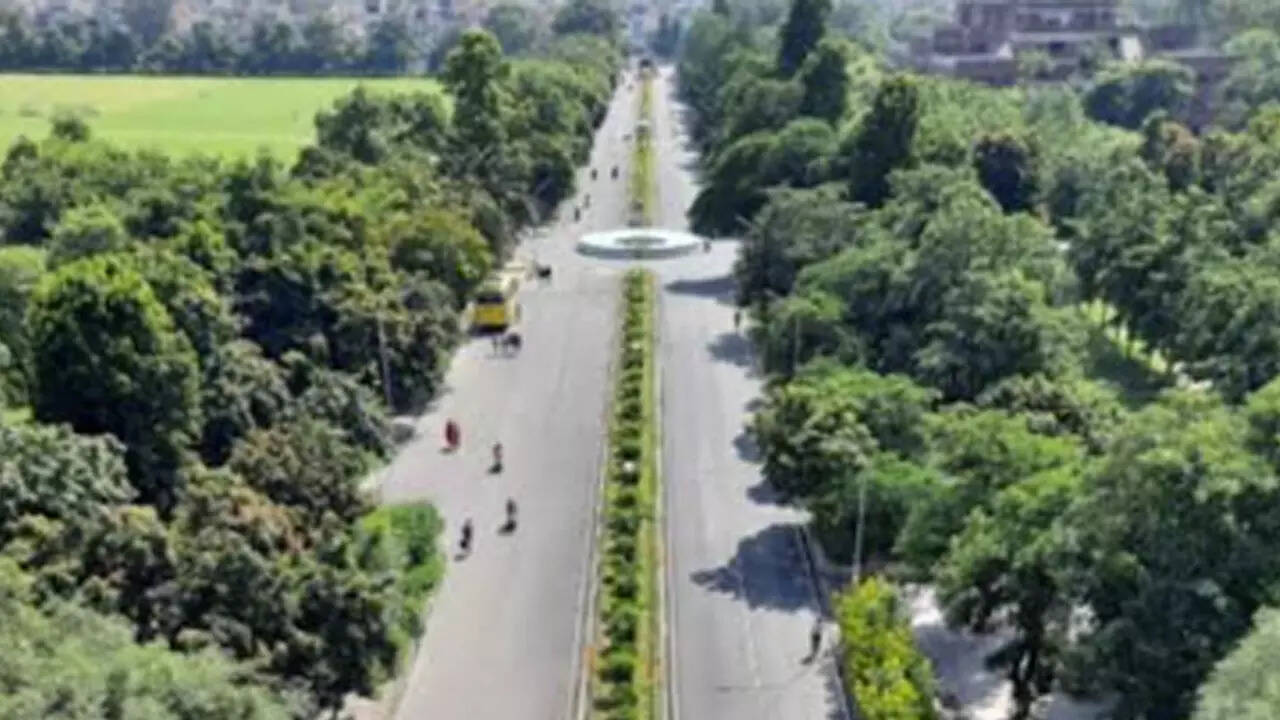
AMRITSAR: Haphazard plantation of trees will not help to fight climate change but a scientific approach has to be adopted in the plantation of trees to address the severity of climate change which has been proved by the Guru Nanak Dev University (GNDU) in Amritsar whose botanical garden has 3-4°C cooler temperature than the surrounding neighbourhood.
“The most effective strategy to alleviate heat stress is to increase the city's green cover, especially by planting trees in clusters rather than in rows. If trees are to be planted on both sides of the road, there should be three layers of trees to allow them to form their own microclimate and withstand harsh weather. Many tree plantation drives are noted, but the trees' long-term survival (say, after three years) is questioned”, said Dr. M S Bhatti, professor of environmental engineering at GNDU.
Stating that only 10% to 20% of trees planted on roadies survive after three years of their planation due to poor upkeeping, Bhatti said trees required habitat to survive that’s why they should be grown in clusters besides they require regular watering in absence of which they wither.
He informed that the 500-acre campus of GNDU had 150 tree species offering more than 90% green areas.
The majority of Amritsar’s green cover has been lost and only a few places like GNDU and army cantonment have the green tree cover. Ornamental and non-native trees generally have no shade and don’t serve the purpose. Presently, Amritsar is experiencing a wind speed of 11km/hour from the south-west direction. The city’s temperature also touched up to 42°C on Saturday.
Vice-chancellor of GNDU, Jaspal Singh Sandhu said that the university offers its expertise to plant trees in a scientific manner which could help to address the climate issue.” We have also made the repository of indigenous plants since other species wither in extreme summer and winter conditions, he said.
Bhatti, who has recently served as a government expert reviewer for the first order draft of the intergovernmental panel on climate change ( IPCC ) Sixth assessment report (AR6), which will be released in September 2022, said that the excessive use of air conditioners, high vehicular density on the highways, usage of diesel generators, and consumption of coal and other fuel by power plants and industries were the key drivers of temperature rise in cities compared to villages.
“The city should be built on the natural landscape philosophy, with more tree shade along roadways, parking lots, and other areas” he suggested adding that the construction of cycle paths would lessen the vehicular traffic. He also suggested that the city should conduct a real-time water audit and reuse all treated water for the upkeep of public parks and gardens.
Suggesting some harsh measures to protect the climate, he said to combat abuse of electricity, smart meters and the peak load of each house may be charged double the electricity prices besides parking fees could be increased in the city’s interior to discourage personal automobiles.