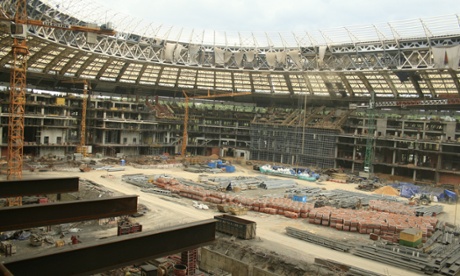
As cranes swing through this vast cavernous space and diggers scuttle around below, workers take blow-torches to the heavy iron beams propping up the facade of one of Moscow’s most iconic structures: Luzhniki stadium in the south-west of the city, still very much on schedule to host the World Cup final in 2018.
“These iron beams are 50 years old, and they could stand for another 50 years,” said the foreman Murat Akhmadiyev, patting the dark metal. “But we’re tearing them down and replacing them. Everything here is changing constantly.”
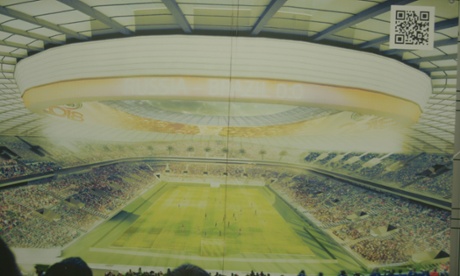
Built in the Stalinist Empire style, Luzhniki was opened in 1956 as the Central Lenin Stadium and hosted the summer Olympics in 1980. A 25-foot-high statue of Lenin still dominates the entrance, but the interior has been scooped out like an egg yolk, currently leaving only the facade and parts of the roof intact.
It looks unpromising, but officials are confident they are well ahead of schedule in preparing this upgraded stadium – and 11 others across Russia – for a World Cup which kicks off exactly three years on Sunday. “Our preparations are going very well, much better than in some other World Cup countries,” the deputy prime minister Arkady Dvorkovich told the Guardian. “We have learned from them.”
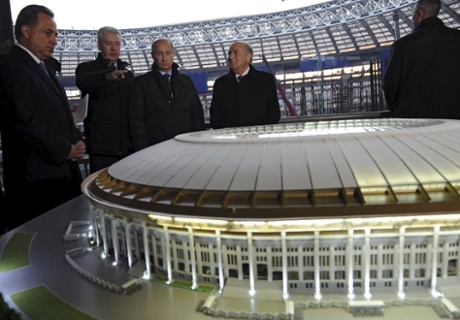
Organising committee head Alexei Sorokin insisted at the World Football Forum in Moscow on Thursday that the investigations of Fifa corruptions and calls to take the World Cup away from Russia were not affecting its plans. He said construction would begin on the two stadium projects not yet started – in Kaliningrad and Yekaterinburg – in the next two months, after they had changed plans to reduce the capacity of the stadium projects there.”We are very deep in the preparation process,” Sorokin said. “This does not have an impact on our preparations. We intend to fulfil all our obligations.”
“Even if [corruption at Fifa] is found, which I doubt, Russia is fulfilling its obligations,” deputy transport minister Nikolai Asaul added. “The airport and transport infrastructure is being prepared according to schedule, and there hasn’t been one instance of a delay so far. There’s no reason to cancel the World Cup.”
Few doubt the stadiums will be ready. But will they hold the matches? The FBI’s announcement last week that it was expanding its investigation into corruption at Fifa to include the selection process for the 2018 and 2022 World Cups brought fresh calls to strip Russia and Qatar of the events, provoking an angry response from both countries.
Publicly, officials in Moscow are sanguine, dismissive even, about the threat of a Fifa rethink on the 2018 award. But they also know that if the unthinkable does happen, it will mean an awful lot of effort – and money – has been spent in vain.
“It would be unpleasant,” Akhmadiyev said, with typical understatement. “I’ve put so much of my soul, so much of my strength into this. But I don’t worry because I will have built a great field. Russia will have something to be proud of.”
Cancelling the event would inevitably bring legal action, with Russia seeking hefty compensation from Fifa. At least 40% of the $11bn World Cup construction programme – including stadiums, training facilities, transport infrastructure and hotels – is either under way or has been completed, the Russian organising committee told the Guardian this week. Luzhniki stadium alone is costing $400m to rebuild.
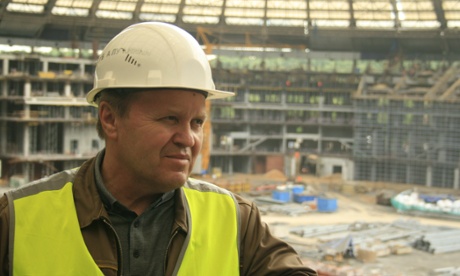
Some 1,500 workers at Luzhniki have been labouring around-the-clock and the stadium’s reconstruction will be finished next year, Akhmadiyev said, adding that 86,000 of a planned 101,000 cubic metres of concrete had already been laid. The upgraded stadium will hold 81,000 spectators and boast an LED light display across the roof showing the score and national flags to those outside the stadium.
The project is a labour of love for many who work on it. “I think of the structures I build as living things,” Akhmadiyev said. “You start with the skeleton. When the utilities, water, electricity are put in, it’s like arteries and nerve endings. Then when it all works, the baby has been born.”
Anastasia Ipatova, a communications specialist for the state-owned Luzhniki reconstruction company, has lived near the stadium for 11 years. She used to go to football matches there with her father, and jogs on the paths in the park around it: “Of course it will hurt if the stadium is not used for what it’s being built for,” she said.
The official budget for infrastructure and related measures for Russia’s World Cup is 660bn roubles ($10.8bn), including government and private investment. But if last year’s Sochi winter Olympics is any indication, the actual amount being spent is higher (the initial budget for the Sochi games was $12bn but the final cost was estimated at $50bn). Already the cost has increased since Putin’s first estimate when Russia won the bid in 2013.
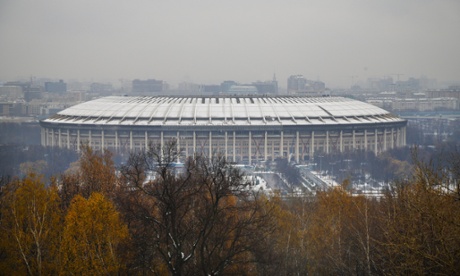
The 2018 World Cup’s organising committee said it couldn’t say exactly how much had been spent so far – but Russian officials maintain that work is too far along to cancel the event. “I don’t see any problem: everything is going according to plan, everything’s moving along,” sports minister Vitaly Mutko told the Guardian last week.
On Tuesday, Fifa secretary general Jérôme Valcke arrived at the newly built airport in Samara and pronounced that building works on the stadium there “are well under way and on schedule”. Three of the 2018 World Cup’s 12 venues have been built so far, with seven more currently under construction. The stadium in Kazan, capital of the central Tatarstan republic, was completed in 2013 and has already hosted games for the local Rubin Kazan squad. Last August, surrounded by a bevy of young footballers, President Vladimir Putin opened Otkrytie Arena, the other Moscow World Cup venue and new home of the Spartak club.
Economic jitters have resulted in plans being both accelerated and trimmed back. After the rouble lost more than half its value and inflation began skyrocketing in 2014 amid low oil prices and western sanctions, construction materials also started to get more expensive, deputy Moscow mayor Marat Khusnullin said this month. As a result, Moscow city hall decided to begin round-the-clock work and take other measures to speed up Luzhniki’s construction, which will now finish building three months earlier than planned, according to Khusnullin.
Against that, Russia’s World Cup organisers are considering cancelling plans for 25 luxury hotels, and rail projects have also been scaled back. In 2013, state-owned Russian Railways head Vladimir Yakunin had said he hoped to build a high-speed rail line between Moscow and Kazan in time for the World Cup, but late last year admitted that it wouldn’t be ready in time. Only the two existing high-speed train lines – from Moscow to St Petersburg and Moscow to Nizhny Novgorod – will be able to transport World Cup fans to regional venues. The train to Yekaterinburg, the farthest flung host city, takes more than 26 hours from Moscow.
Even if corruption is found in the 2018 selection process, Fifa surely can’t take the World Cup away from Russia until after Blatter is replaced – on 16 December, according to the BBC. By then, construction will be further along, and such a decision would almost certainly prompt Russia to appeal to the Court of Arbitration for Sport – with any compensation claim starting at $4.7bn or more.
“We won’t lose as much as other cities because the infrastructure is already built here,” Vladimir Leonov, sports minister for the Tatarstan republic, told the Guardian this week. “But it’s a big honour to hold such a tournament in your city, region and country. I’m scared to think what could happen; that they could deny us the right to hold the World Cup.”