At age 14, Madison Keys was kind of a big deal.
She was the youngest player ever to play World Team Tennis, and defeated Serena Williams 5-1 in a one-set match that’s part of the exhibition league’s unique format. She made her professional debut at a now-defunct clay-court tournament in Florida that year, and defeated a top-100 player in her first-ever match.
“I was like, I got paid to play tennis, this is awesome. So I think I was pretty excited about that,” Keys, now 19, remembered on Monday after defeating countrywoman Madison Brengle to reach the Australian Open quarterfinals. It will be her Grand Slam last-eight debut.
“I think I went out and bought a new phone like two days later,” she said.
The “phenom” tag is a load to put on anyone’s back, especially on that of an easygoing, blithely unaware young teenager.
Back then, the “American tennis is dead” laments were arguably at their loudest, with no perceived successors yet on the radar as Andy Roddick and the Williams sisters moved towards the latter stages of their careers.
The physique was there with Keys, the size so indispensable to the modern game. The power. And, most promisingly, the serve.
And then … well, it has taken awhile. When everyone wants to rush you to greatness, reality often has other plans.
A generation ago, 14-year-olds took just a year or two to get to the top of women’s tennis if they were talented enough. The most infamous among them, Jennifer Capriati, had long been a champion by the time she was Keys’ age. So were the Williams sisters.
There’s a hint of Capriati in Keys; it’s in the singsong inflection of the voice, the “you knows” sprinkled liberally in the sentences, the big, toothy grin, the joyful exuberance.
But it’s likely this story will have a far happier ending. Because it has taken nearly six years for Keys to at last fashion her first big breakthrough on a big tennis stage. Surely she’s far better equipped to handle it.
Keys will face another former phenom, Venus Williams, in a Wednesday matchup that can’t help but excite every tennis fan in the country.
One is in her dotage yet in full renaissance (when Williams, now 34, was a 14-year-old turning pro, Keys wasn’t even born).
The other is putting it together during the final Grand Slam tournament she will play as a teenager. Keys turns 20 on Feb. 17.
To complete the circle, Keys’ new coach is Lindsay Davenport, a contemporary of Williams who played her 27 times during her career.
“Lindsay used to just hit a clean ball. She was so fun to watch play. I loved watching her play. Of course, didn’t love watching her hit those clean balls against you,” Williams said. “Yeah, definitely some similarities. Madison hits a clean ball, goes for it.”
Davenport is the latest of the “super-coaches” now dotting the tennis landscape, top players who have returned to the game to sprinkle a little pixie dust and inspiration to push already accomplished players one step further.
For Keys, though, it’s an out-of-the-box choice. She’s not Andy Murray, or Novak Djokovic, or even Agnieszka Radwanska, who is working with Martina Navratilova. She’s not at the mature stage of her career; she’s just getting started, and there remains so much more to do developmentally beyond adding those finishing touches.
There are obvious similarities between Keys and Davenport, at least on the tennis side. But there are striking differences as well.
For one thing, by the standards of the day, Davenport was a late bloomer, not a phenom.
The Keys-Davenport collaboration has quickly turned into a family affair, with Davenport’s husband Jon Leach jumping in to help; the original plan was to have Davenport consult occasionally, and former Simona Halep coach Wim Fissette be the full-time coach.
Davenport, beguiled and impressed with her new protégée, wanted to be more involved than originally planned.
The comfort zone created by the commonality of family — Davenport has four children under the age of 9; Keys comes from a family of four children — looks to have created an instant comfort zone.
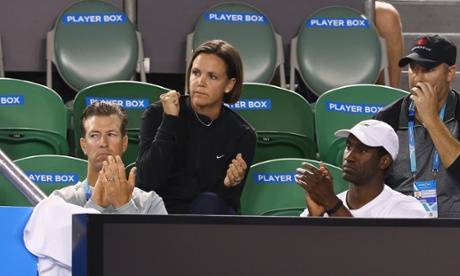
It remains to be seen if it’s too comfortable, too low-key, as the pyramid narrows. But after Keys upset two-time Wimbledon champion Petra Kvitova in the third round of their first official tournament together, you can’t argue with the early returns.
Keys’ junior career wasn’t nearly as hardware-laden as expectations would have it.
She dominated at the American level, which helped her to get to the top 20 in the ITF junior rankings. But at the junior Grand Slams, only once did she get past the second round of singles.
To be fair, she was 16 when she stopped playing them. There are different roads to the pot of gold; the Williams sisters didn’t play the juniors at all.
The pros had been calling Keys for a while, and the call was answered early.
Fellow Australian Open quarterfinalist Genie Bouchard, less than a year older than Keys, already in the top 10 and a Grand Slam finalist last year, stayed in the juniors until she had almost used up her eligibility.
The Canadian won junior Wimbledon in 2012 and reached the top 10 on the WTA Tour two years later. These days, that’s a meteoric rise.
For Keys, there was a lot more to do.
The raw talent and promise had to be re-imagined for the big leagues.
The first step was to mature physically, manage her tall, solidly-built frame better and figure out how to stay away from injuries. Too many times, a younger Keys had this body part or the other, usually the legs, encased in bandages. She needed to get fitter, stronger, healthier.
Her physical transformation over the last two years has been impressive, although there is still work to do.
The next challenge was to learn how to battle.
When you’re 14 and you’re beating everyone on skill and size, you don’t need much more. When everyone is as good as you are — or better — talent is no longer enough.
Keys worked on that, too. She may never have the killer instinct so many of the top women have; it doesn’t seem to be in her DNA. But she may discover she’s a lot steelier than even she yet knows.
The next step was to take that raw ability — that gift of innate power — and tame it, make it work for her every time instead of working against her too many times.
That, of course, goes hand in hand with having the fitness to last, which creates the confidence that breeds the patience.
It’s a work in progress, but that’s coming along nicely, too.
After defeating Kvitova, Keys’ words were music to the ears.
“I think I was just a little bit more disciplined this time. I think, you know, on shots that I, you know, maybe would have changed up the line or gone for a higher shot, I was a little bit smarter, maybe played with a bigger margin,” she said. “I think that kind of helped me out.”
A January ago, before the 2014 Australian Open began, Keys and Venus Williams practiced together on one of the show courts.
Helmets required. The sound of the ball being thwacked with relentless abandon would have drowned out even the most ear-piercing Victoria Azarenka screech.
But Keys went out in the second round. Williams went out in the first round.
Just look at them now.
When they meet on Rod Laver Arena on Wednesday, the sound of punishment will be the same. But the stakes will be so much higher.
“I think if I play right and I do what I’m supposed to do, I definitely think I can be a contender for it,” Keys said.