"During that first year of confusion ... I came across an interesting sign on a side street of Shinjuku. Half in romaji, the sign led me down some ratty stairs into the unkempt basement of a tall building. I pushed open a massive heavy door and entered a small, dark, smoky room. Immediately, I felt at home: it was a jazz club."
-- From "Tokyo's Mystery Deepens" by Michael Pronko
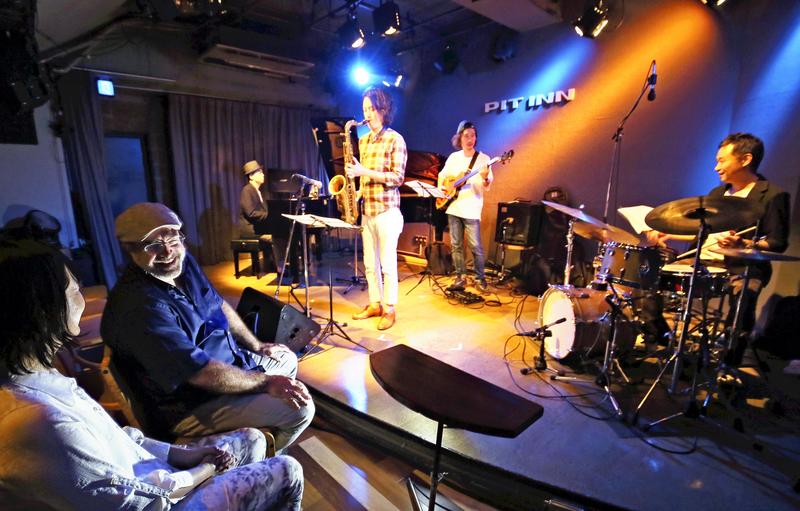
It was a cloudy, unusually cool afternoon in early September when Michael Pronko and I pushed open the heavy door to Pit Inn, located at the edge of the Shinjuku Nichome area of Tokyo.
Pronko, an American writer and professor at Meiji Gakuin University, runs the website Jazz in Japan (jazzinjapan.com) where he posts columns, interviews with musicians and listings for the Tokyo metropolitan area. Being an avid jazz fan, I thought I'd accompany him to some of his favorite jazz spots open in the daytime to see what was on offer.
"Traditionally, foreigners did [Japanese activities] like togei [pottery] or aikido or studied language to have some way into the culture, but for me that was just jazz," said Pronko, who has lived in Japan for 20 years.
Pit Inn opened in 1965 and spearheaded Japan's modern jazz scene. A number of legendary musicians still active today such as saxophonist Sadao Watanabe and pianist Yosuke Yamashita performed there.
"I think this kind of place is devoted to music," Pronko said. "It's more music as culture, music as art."
Blue Note, Cotton Club and other high-end jazz houses may have a beautiful atmosphere and can be memorable, but the music offered in places such as Pit Inn has "no frills," he added.
At 2 p.m. when Pit Inn opened, people started coming in, taking seats at a respectful distance from each other. Some flipped open books or sipped drinks before the set started at 2:30 p.m. Everybody except us came alone and the venue was extremely quiet at first.
Assuming the 100 or so wall-to-wall seats facing the stage would be filled at night or on weekends, the afternoon session is quite a luxurious experience, specially when the cover charge is 1,300 yen including a drink.
"This is my retirement plan right here," Pronko said.
The band for the afternoon session was Blue Dot, led by drummer Makoto Rikitake, along with Masanori Sugimoto on sax, Tamashi Goto on piano and Goro Katano on electric bass. Rikitake, who has played here several times, said, "Playing Pit Inn is something of a status symbol."
The quartet performed originals, starting with some melodious tunes that easily induced a mellow early-autumn mood in me. The set then finished with Rikitake's powerful solo in an arrangement of "A Town With an Ocean View (Umi no Mieru Machi)" from Studio Ghibli's animated film "Kiki's Delivery Service." The minutes-long solo was so overwhelming that I wanted to stand up and whistle, but I was too shy. I needed a drink.
All I could bring myself to do was whisper, "The drummer's good."
"Yeah, he is," Pronko replied.
Pronko checks out jazz bars at least twice a week and has encountered many great Japanese musicians. In Tokyo, he said, even amateur musicians are really good.
"It's shameful, in a way, that these great musicians are not written about in English," Pronko said in explaining why he started his website.
Into the cellar
From Pit Inn, it's about a five-minute walk along Yasukuni-dori avenue to Dug, a longtime jazz cafe and bar in the Shinjuku Sanchome area. Cafes dedicated to playing jazz from vinyl collections boomed in the '60s. Pronko said such jazz kissa (from kissaten, the Japanese word for cafe) are unique to Japan in the way that customers do nothing else but sit and listen intently to jazz from the speakers. He used to go to Dug every Friday afternoon between his classes.
Dug opened less than two years after Pit Inn and has served as a home for many Japanese and overseas musicians to chill out after a performance.
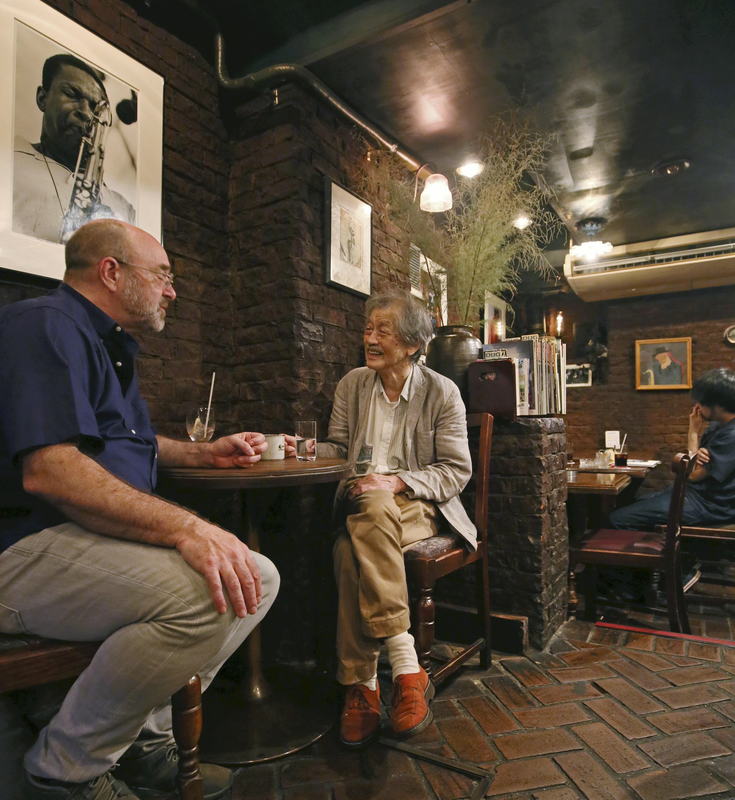
Going down the steep stairway, we were welcomed by a familiar jazz standard coming from flat square stereos embedded in brick walls and monochrome photos of jazz musicians. These photos are another attractive feature of Dug.
While chatting, we heard the staff greeting a person entering. It was Hozumi Nakadaira, Dug's owner and the person who took all those photos. Nakadaira and Pronko know each other so we sat together.
"I went to hear Charles Lloyd last night at Blue Note ..." Nakadaira said as he quickly got me involved in the conversation.
Nakadaira, 83, comes to his cafe almost daily in the evening. While many jazz kissa have the attitude of "no talk allowed," Nakadaira opened his place for customers to chat over some drinks. He instructs his staff not to play music too loud.
Decorating the cafe were photos of John Coltrane, Thelonious Monk and Horace Silver -- to name just a few. A bookshelf contains albums of photos taken by Nakadaira.
"Customers ask me, 'Were you there at that moment?'" Nakadaira said. "And I say, 'Yes, I had to be there, or I couldn't have taken these photos.'"
The three of us laughing was a great way to cap off the hour at Dug that slipped by so quickly amid the great conversations we had with the owner.
In the 1960s, Shinjuku was the center of Japan's jazz scene. Today, Pronko said, jazz clubs and bars are scattered all around. Along the JR Chuo Line, for example, he knows of jazz bars at every stop all the way from Tokyo to Tachikawa.
"[It's a] very intense jazz scene. You know there's like a hundred jazz clubs in Tokyo and Yokohama alone. Of course, many are small places," Pronko said. "People want jazz in their neighborhood, they enjoy that and support that."
The tour with Pronko made me eager to ask, Why does he think Japanese people love jazz so much? Among several reasons he gave me, I liked this bit best:
"Jazz is the sound of freedom. Somebody described jazz as 'the sound of surprise.' I think a lot of Japanese society is very unsurprising. It's very set, very planned ahead. But jazz is not like that. It's improvised."
-- Pronko's 5 musts for a good jazz bar
1. An atmosphere that makes musicians love playing
2. A great sound system so the audience can hear well
3. A relaxed atmosphere so the audience unwinds
4. Good service, good food, good drinks
5. A consistent variety of quality music
Read more from The Japan News at https://japannews.yomiuri.co.jp/