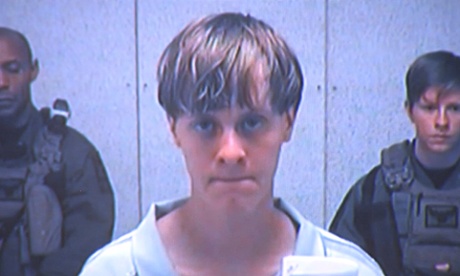
No violent white supremacist in America is ever quite a “lone wolf”. Dylann Roof’s manifesto taught us that by itself. In it, he credits a group known as the Council of Conservative Citizens with verifying his youthful racist suspicions. The leader of that group, Ed Holt, has already been quick to sidestep any real responsibility. “The CofCC is hardly responsible for the actions of this deranged individual merely because he gleaned accurate information from our website,” he said in a statement.
There are people for whom that name clearly pings a radar. But then there are the rest of us, for whom the existence of hate groups in America may not be news, but naming a particular one is difficult. The Confederate flag is a clear symbol of institutionalised white supremacy, which is no doubt why it has been under such clear attack in recent days. But it’s a bit harder to get at the substance of groups like the one that inspired Roof. They’re trickier, slippery. Or so one comes to believe, anyway, reading the sparse shelf of books that journalists and historians have written about these modern rightwing movements.
There’s already a crowdsourced Charleston Syllabus floating around out there, but to date, it hasn’t included much material on these modern hate groups. They are every bit as much a part of American history as the civil war, and their reach and scope far exceed what the public usually imagines.
For example, from Leonard Zeskind’s Blood and Politics: The History of the White Nationalist Movement from the Margins to the Mainstream, you’ll learn that this Council of Conservative Citizens has been around, in one form or another, since the mid-1950s. The blandly named hate groups were inspired by initial white resistance to the supreme court decision in Brown v Board of Education, which ruled segregation in classrooms unconstitutional. (Such groups got a second wind in the 1990s when militias were the trendy thing to have on the far right.)
As Zeskind documents, the groups have also long had clear ties to Republican politicians. Occasionally, these ties pop up and embarrass the GOP, after which they routinely claim ignorance. In one famous incident, former senator Trent Lott denied his association with the CofCC until a photograph of Lott with its leaders was dug out from their newsletter.
But after these periodic incidents, the Council habitually vanishes from headlines again. Until someone like Dylann Roof finds it. This ability to slip in and out of public consciousness – “shadowy” and its variations are adjectives that get used a lot in this field – turns out to be key to the success of rightwing extremism in America.
One consequence of their knack for flying under the radar that so many of the books recommended to me as the best on this subject – say James Ridgeway’s Blood in the Face: The Ku Klux Klan, Aryan Nations, Nazi Skinheads, and the Rise of a New White Culture, or James Corcoran’s Bitter Harvest: The Birth of Paramilitary Terrorism in the Heartland, or David Neiwert’s In God’s Country: The Patriot Movement and the Pacific Northwest – are out of print. And these books are never bestsellers, likely because people seem to find it hard to look this subject squarely in the face.
These rightwing groups come to play this to their advantage. Daniel Levitas’s The Terrorist Next Door: The Militia Movement and the Radical Right, a much more readable tome than Zeskind’s, is focused on a single subset of the extreme right wing: the so-called Posse Comitatus group. It took Levitas eight years to research their activities. Early on, Levitas explains that William Gale, the group’s founder, had stumbled on a strategic insight:
For decades, the Ku Klux Klan and its various allies had created social movements and sought political power based upon explicit appeals to racial purity and Christian Nationalism. Bill Gale was no less fanatical in his devotion to “white survival” or his denunciations of world Jewry. But Gale also fashioned an elaborate, American-sounding ideology that married uncompromising antisemitism, anticommunism, and white supremacy with the appealing notion of the extreme sovereignty of the people.
Put differently, these groups figured out that their continued survival depended on some blending in with the crowd. It’s not that their beliefs always differ significantly from the dogma of, say, the Ku Klux Klan; it’s that they drop the robes and cloak it in a theory of themselves as “sovereign citizens”, which they link back to the Constitution. And while that may sound like a slight softening of beliefs, it isn’t. Posse Comitatus first came to public attention, as Levitas details, when one of its members killed two federal marshals in 1983. Violence has always been a central part of its work.
Levitas points out that in fact, Terry Nichols had ties to Posse Comitatus. Nichols was the accomplice of the Oklahoma City bomber Timothy McVeigh. And the deeper you dig into the case of McVeigh himself, the more it turns out that he and Nichols were not themselves “lone wolves” either. The most recent thorough book on the subject is by Guardian correspondent Andrew Gumbel and Roger G Charles, a former private investigator. In Oklahoma City: What the Investigation Missed – and Why It Still Matters, they dug through the investigation in hindsight and discovered much to suggest that McVeigh and Nichols had not acted alone. The FBI, they conclude, missed the boat: “Ironically, by the time McVeigh and Nichols went on trial, the leaders of each prosecution team, Joseph Hartzler and Larry Mackey, were more willing to acknowledge the possibility of other coconspirators than the FBI.”
Roof’s situation, of course, does not mirror McVeigh’s. No one has so far suggested he had any real co-conspirators. In terms of his particular case, the only option is to wait and see. But the more you read about this part of America, the harder it is to quell worries that at the very least, Roof’s beliefs hint at a much larger problem.