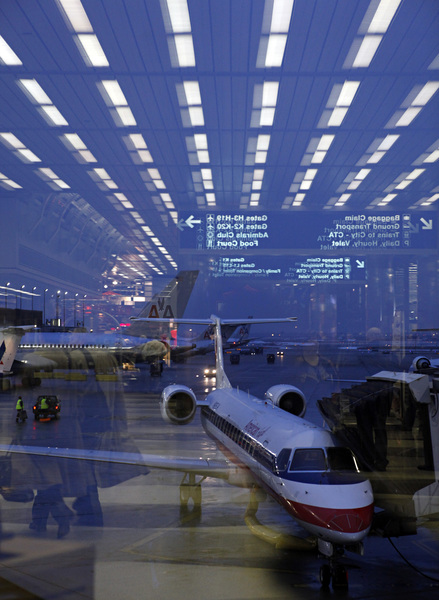
CHICAGO _ American Airlines is opposed to Mayor Rahm Emanuel's major $8.5 billion expansion of O'Hare International Airport, alleging Chicago's City Hall cut a secret deal with United Airlines to get more gates.
Hours before Emanuel was expected to formally introduce to aldermen the blockbuster proposal to build a state-of-the-art global terminal, dozens of new gates and several additional concourses, American voiced the first public opposition to the plan from O'Hare's airline carriers.
"American Airlines is excited about seeing O'Hare transformed into an airport that sets the global standard in airline passenger experience and efficient operations. And, after 18 months of multi-lateral, transparent negotiations, we were looking forward to supporting the new lease," said Leslie Scott, the airline's senior manager of global communications. "But American cannot sign the lease in its current form because of a secret provision, inserted at the last minute, awarding additional gates to United."
It's unclear whether the city would move forward with a new lease agreement if American refuses to sign on. In December, Emanuel and aldermen passed an ordinance setting higher airport fees and charges for airlines in the current 35-year lease were to expire in May without a new one in place. The move was made to provide an incentive for the airlines to reach an agreement on a new lease to avoid paying even higher fees than a new lease would contemplate.
Representatives for Emanuel's office and United could not immediately be reached for comment Wednesday.
Leading much of the day-to-day negotiations on the O'Hare deal has been Aviation Commissioner Ginger Evans, who laid out the details of the eight-year overhaul in an exclusive interview with the Tribune published Sunday. At that time, representatives for both United and American released statements expressing optimism about a major expansion of O'Hare while declining to discuss details, citing the ongoing negotiations.
Since then, American has been unsuccessful in getting Emanuel to sign off on a compromise it has argued would create a more fair balance between O'Hare's two hub airlines.
At the heart of the disagreement is the number of gates that would be awarded to United and American under an expansion that would grow the amount of space for planes to park at airline gates by 25 percent and increase the total number of gates at O'Hare from 185 today to roughly 220 upon the project's completion in 2026.
Improvements and changes at O'Hare are typically paid for from fees the airlines pay at the airport, and the current lease gives United and American veto power over virtually any changes. That dynamic has resulted in sniping between the two airline giants.
Later this year, American is set to open five new gates on Concourse L in Terminal 3. Those gates will not be paid for by airline fees, but instead entirely by American. That's because United opposed the additional gates, city officials have confirmed.
Emanuel awarding United five more gates under the expansion of O'Hare could represent an effort to make up for the extra American gates awarded earlier in his tenure, though those gates were granted separately from the new lease negotiations.
The mayor is cognizant of United's stature in Chicago and previously has noted how the airline is the city's No. 1 private sector employer. Chicago, however, is rare in that it is home to three major airline hubs _ United and American at O'Hare and Southwest Airlines at Midway International Airport.
Scott, the American spokeswoman, argued awarding extra gates under the expansion would give United an unfair advantage in the market.
"Chicago is extraordinarily well positioned with three carriers operating hubs and competing aggressively against each other. The United gate deal would undermine competition, allowing the largest airline at O'Hare to expand its size advantage for years into the future," she said. "The United gate deal creates a clear winner, United, and clear losers: namely, competition, Chicago travelers and American Airlines."
Last year, 79.8 million passengers flew to, from or through O'Hare, according to Chicago Department of Aviation figures. About 44 percent of passengers flew with United and 37 percent with American, according to the city figures. The next closest airlines: Delta Air Lines and Spirit Airlines with 4 percent each.
United and American's dominance at O'Hare is thanks in large part to the current lease agreement that was signed in 1983, in which Evans said the city "gave away the store, gave away the farm." The stranglehold the two airlines have held over the airport prevented the city from upgrading and maintaining O'Hare because United and American vetoed projects they argued would use fees they largely paid to help competitors.
Evans has called the current agreement the "strongest airline control lease" in the U.S. and said the new agreement would not grant the airlines such veto powers. Some travel experts have said it is in O'Hare's best interest to limit American and United's reach under the new deal to free up more gate space for competitors who have long sought more access to one of the world's busiest and best-connected airports.
Scott said American would sign off on Emanuel's $8.5 billion plan and new lease agreement if the city simply removed the five extra gates for O'Hare. She said American also has offered a compromise to "re-level the playing field" by asking the city to accelerate the construction of three more gates for American.
"To date, the city has dismissed that approach without explanation," Scott said. "We encourage city leaders to fix the lease and ensure competition remains vibrant at O'Hare."
The expansion of the 73-year-old O'Hare seeks to transform an airport long known for gridlock and delays by growing its sluggish number of international flights and creating more room for domestic carriers. Emanuel has said no taxpayer money or federal dollars would be needed to be pay for the plan, which he said the city would bankroll by borrowing against a future increase in airport fees and revenue generated by the expansion and new airport lease.
Under the proposal, the 55-year-old Terminal 5 would be torn down to make way for a new "Global Terminal" with wider concourses and gates to accommodate large international flights. Terminals 1, 3 and 5 would be renovated, two new satellite concourses would be built and connected by a pedestrian tunnel and more than 3.1 million square feet of terminal space would be added to O'Hare � a 72 percent increase.