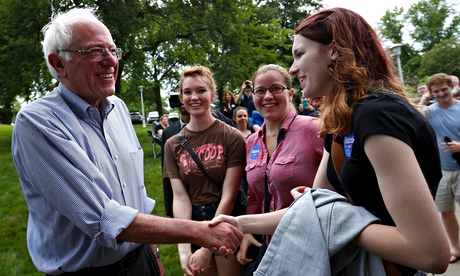
Until recently, Hillary Clinton was the election’s uncontested Democratic frontrunner. She was said to be intimidating, unbeatable, as strongly favoured as an incumbent. The biggest concern about her candidacy as the Democrats’ presumptive nominee was that her path to power would be too easy, leaving her rusty in a competitive general election. But as insiders continued to underperform in polls last week, that prophecy is looking increasingly like the rosy spin of operatives out of touch with the electorate. With the entire Democratic party establishment rallied around Clinton, it’s 74-year-old Vermont socialist Bernie Sanders who continues to surge. From Texas to Wisconsin to California, he’s been drawing huge crowds, overtaking Hillary in Iowa, according to a new Quinnipiac poll this week, and even besting her by a full nine percentage points in New Hampshire – traditionally safe territory for the Clintons – according to NBC.
A class-warrior with the aesthetic sensibility of an eccentric uncle, Sanders has been called the guy “willing to upset the apple cart”. Not that he’s an outsider in every sense; the irascible junior senator has served in the Senate since 2007 and in the House since 1991. Yet as the longest serving independent in congressional history, he’s an outsider to both major parties. And with his constant calls for revolution, the fact that he was ever elected to Congress is something of a miracle. It’s also powerfully appealing to an electorate grown disillusioned with a gridlocked congressional process and elected leaders who appear more intent on pleasing the permanent political class in Washington than the voters who sent them there. As one Sanders superfan sees it, he’s “our last hope for democracy”.
On the Republican side, everything’s coming up Donald Trump, a guy who until this month didn’t even see fit to pledge loyalty to his party. (Following a personal appeal from the Republican chairman, he signed a pledge promising not to run as an independent if he loses the nomination.) His candidacy seems to exist almost exclusively for the purpose of self-aggrandisement. But as establishment candidates kick into him with increasing vigour, the brash billionaire’s popularity shows no signs of abating. Even Clinton is getting in on the Trump-bashing, taking him to task on Thursday for insulting women. He’s now so dominating the Republican side of things, she didn’t even have to mention him by name to make her point.
That Trump should be so successful without any coherent platform or earnest attempt at finessing the particulars of policy is in itself a curiosity. Then there’s the fact that, at seemingly every turn, he’s insulting somebody or some entire group of people anew. Yet for all the internet fury and siren headlines, for all the times pundits have written his political obituary, Trump has become more dominant. And even before Clinton and other candidates were targeting him, he was saying the kinds of things that ought to have made him political toast. He described Mexican immigrants broadly as “rapists”, then called torture-survivor John McCain “not a war hero”. After Fox political commentator Megyn Kelly questioned him critically regarding his views on women, he suggested it was because she had “blood coming out of her wherever”. Then last week he kicked the offensive rhetoric meter up a notch higher. He cited his education at a military-themed boarding school as proof that he had “more training militarily than a lot of guys that go into the military”, and also appeared to claim that the physical appearance of Carly Fiorina disqualified her for the presidency. “Look at that face!” he said. “Would anyone vote for that? Can you imagine that, the face of our next president?”
Under the unwritten laws of campaign discourse, any one of these comments alone should have doomed him. But so far, despite untold quantities of analysis and TV soundbites to the contrary, that hasn’t proved true. He’s been alternately called a useful idiot and a dangerous one, but mostly, he’s been cast as a running political joke. In July, the Huffington Post announced plans to cover Trump as “entertainment” alongside the Kardashians and The Bachelorette, rather than in their main politics section. As he cements his status as a frontrunner, such antics seem increasingly tone-deaf.
And now there’s a new Trump in town. Currently polling in second place for the Republican nomination, Ben Carson has risen seemingly out of nowhere. And stylistically, he’s the exact opposite of Trump: all thoughtfulness and reserve to Trump’s bravado and bombast. The soft-spoken former brain surgeon is not an intuitive pick for top presidential contender. His temperament seems better suited to the field of medicine. Indeed he is almost aggressively calm and collected, qualities that are life-savingly comforting in a brain surgeon but deadly boring in a politician. And his style of speaking, so slow and deliberate, often obscures his zany politics. That you could not pick two more different outsiders underscores how deep the appetite for one really is. The only thing he and Trump have in common, it seems, is the fact that neither has held elected office.
Carson continued to enjoy the success of his own unique brand of outsider this week, climbing higher into the double digits in polls. A new CNN/ORC poll puts him at 19%. Combined with Trump’s polling at 32%, their collective support is over the 50% mark. To put it bluntly: two non-politicians now hold majority support for Republicans and Republican-leaning independents. It’s them. Not the five senators in the race, nor the nine former and sitting governors. Not even the Fortune 500 CEO, or the son and brother of former presidents.
Even the halls of Congress are not immune to the outsider insurgence. When lawmakers came back to Washington last week, the two biggest issues on the docket underscored the power of political outsiders further. First, there’s the Iran nuclear deal. After it became clear that Obama had secured enough support for the deal, Republican leaders were ready to throw in the towel. But on Wednesday Trump and fellow presidential hopeful Ted Cruz – best known for shutting down the government two years ago – held a Tea Party-backed rally outside the Capitol opposing the deal.
In the face of this conservative opposition, Republicans leaders were forced to backtrack and change strategy mid-fight, paving the way for them potentially to sue the president over the deal. Second, lawmakers turned their attention to the fact that government funding is scheduled to run out on 1 October and there’s a real possibility of shutdown. Conservatives have stressed they won’t vote for any funding bill that funds Planned Parenthood, given its role as the nation’s single largest abortion provider. Regardless of which party takes the blame, shutdowns are highly unpopular, fuelling disgust with Washington’s inability to legislate. It’s also the sort of event outsider candidates point to in claiming the political system is broken.
The early conceit of liberalswas that the media have taken outsiders – particularly Trump – too seriously. But maybe we haven’t taken them seriously enough. Take the allure of Trump. It is not simply an illusion bought by money or manufactured by media: Americans like the guy. Many feel he has their best interests at heart or, at the very least, sees things the way they do. To disbelieve the authenticity of Trump’s appeal is to miss the spirit of a large share of the electorate, no matter how much we might wish that spirit were otherwise. As one person in a focus group put it: “Trump’s the first person that came out and voiced exactly what everybody’s been saying all along. When he talks, deep down somewhere you’re going, ‘Holy crap, someone is thinking the same way I am.’” If anything scares you about that comment, it should be how closely it resembles representative democracy.
The fundamentals still overwhelmingly suggest we won’t see a Trump presidency, and highly regarded analyst Nate Silver has pegged his chance of even becoming the nominee at as low as 2%. But it doesn’t mean the rise of Trump and other outsiders is insignificant. Far from it. Rolling Stone’s Paul Solotaroff spent more quality time with Trump than most: “Over the course of 10 days and several close-in encounters... I saw enough to make me take him dead serious.”
The pundits and political operatives who dismiss Trump, Carson and Sanders as jokes and political theatre might talk down about their supporters (largely middle America and pockets of white liberals) at cocktail parties or on the privacy of their own boats. But you won’t find them doing it on-air or in a public, professional capacity so often. That’s because to talk down to these supporters is to talk down to a very large segment of the populace. It’s an inherently pretentious, egg-headed argument and the very reason anti-establishment candidates have enjoyed so much traction to begin with: Americans know what establishmentarians think of them, and they’re mad as hell.
Lucia Graves is based in Washington DC and staff correspondent for National Journal magazine