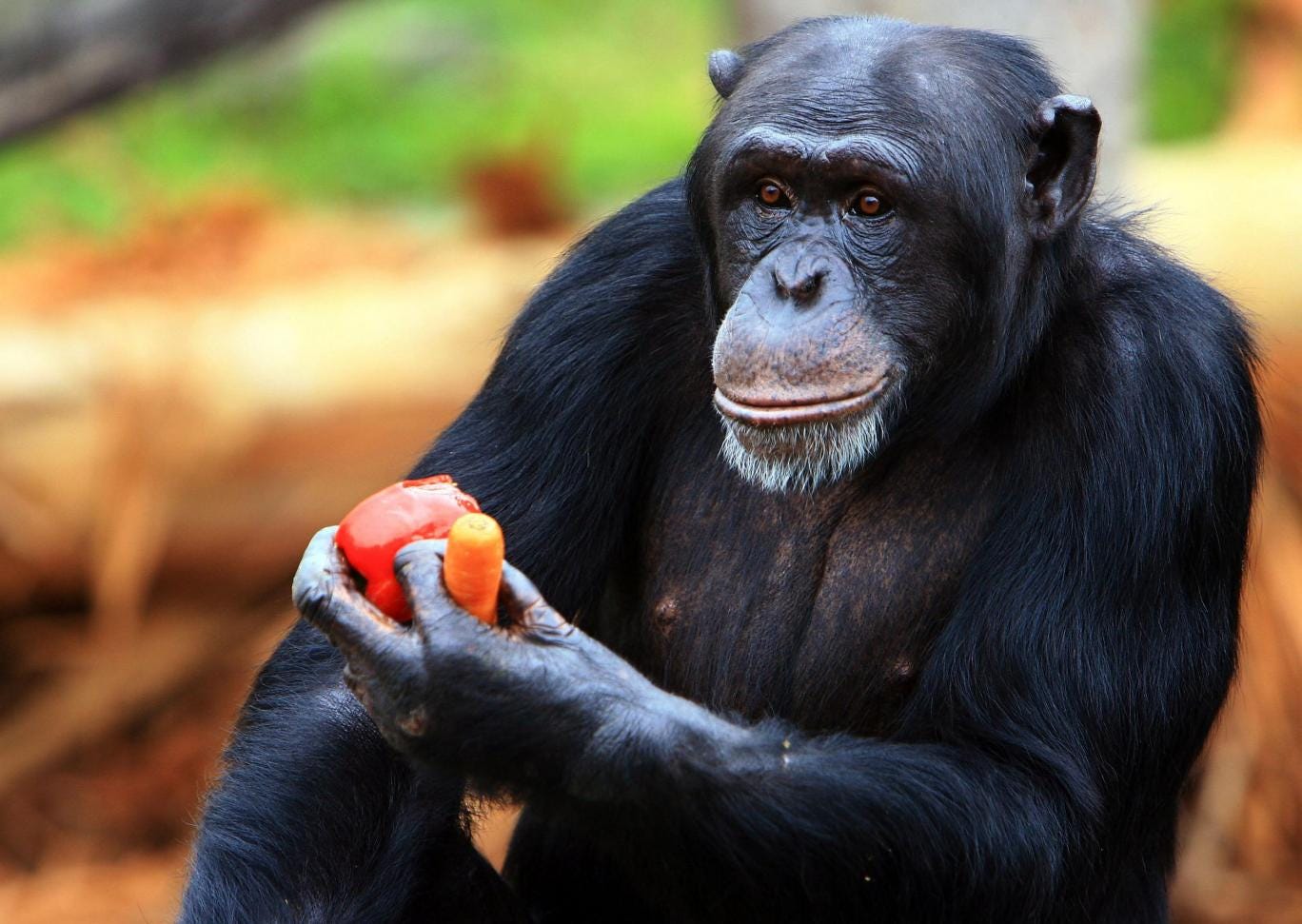
The handful of chimpanzees still used by the US National Institutes of Health (NIH) for animal testing will soon be sent off to sanctuaries to enjoy their retirement, as the governmental medical research agency ceases its chimp programme altogether.
The NIH retired most of its research chimpanzees two years ago, but in an email to agency bosses on 18 November, NIH director Francis Collins announced the 50 remaining chimps will be retired.
On top of this, the NIH will also draw up a plan to phase out the use of chimps who are not owned by the NIH, but whose keeping is funded by them.
Animal testing on chimpanzees used to be relatively commonplace, but the practice is now either illegal or not used in most of the world.
The use of great apes in animal testing was banned in Europe in 2011, and currently the US and Gabon are the only two countries that still use chimps for research.
Speaking to Nature, Collins said: "I think this is the natural next step of what has been a very thoughful five-year process of trying to come to terms with the benefits and risks of trying to perform research with these very special animals."
"We reached a point where in that five years the need for research has essentially shrunk to zero."
After around 310 chimps were retired in 2013, the NIH decided to keep a stock of 50, just in case a major public health emergency required urgent research.
On top of this restriction, the US Fish and Wildlife Service named chimps as an endangered species, meaning scientists would need a special permit to conduct tests that injured or stressed the animals.
Upon reitrement, the chimps will be sent to Chimp Haven - a government-funded facility in Louisiana that currently houses 208 chimps.
The first batch of 25 animals could arrive at Chimp Haven by Christmas, with the other half arriving early next year.
However, not everyone is happy with the news - Frankie Trull, of the Foundation for Biomedical Reserach, told Nature: "Given NIH's primary mission to protect public health, it seems surprising."
Trull sees the total scrapping of NIH's chimp programme as too extreme, saying: "I don't understand the decision of 'we're going to take that resource away forever.'"