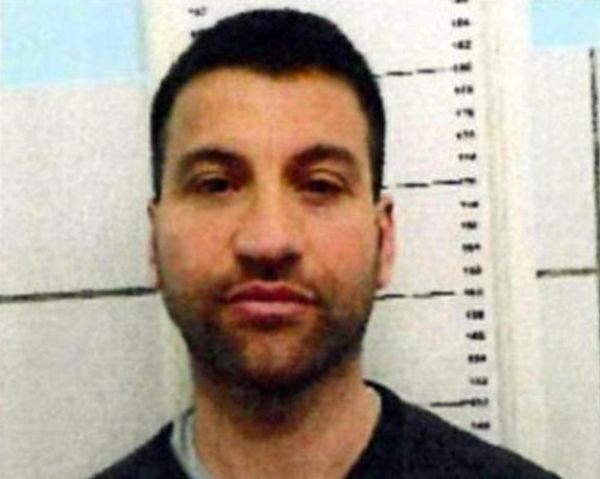
PHILADELPHIA _ Whenever Jalil Frazier opened his eyes, he found himself on an island barely wide enough to contain his frame, boxed in on both sides by unforgiving metal bars. A familiar landscape surrounded him: four bare walls, a beige tile floor, and a tiered chandelier that hung above what used to be his family dining room.
He was stuck on this uncomfortable hospital bed because he'd had the misfortune of being inside a North Philadelphia barbershop on an unseasonably warm January night at the same moment two men barged in, looking to rob the place.
Frazier, whose round face is framed by a scraggly beard and short dark hair, glanced at three children who happened to be in the shop. He was a father, with two kids at home, and felt an instinctive urge to protect them. He hurled himself at the would-be thieves. One had a handgun, and fired two shots. The bullets punched through Frazier's midsection and leg, ricocheting off his insides, tearing through tissue and bone before exiting his body.
At age 28, he was paralyzed from the waist down.
Frazier was a hero by anyone's definition of the word, but he was also a victim, one of the estimated 116,255 people who are shot in the U.S. every year. He belongs to an often-overlooked fraternity of gun violence survivors who are left with lifelong disabilities, whose ranks include schoolchildren, movie-theater patrons, politicians and grandmothers.
Several thousand miles from Philadelphia, Richard Castaldo, 37, sits in a wheelchair in Los Angeles, trapped in a pose he's held since April 20, 1999, when he was shot eight times and paralyzed by his classmates Eric Harris and Dylan Klebold outside of the cafeteria at Columbine High School in Colorado. Harris and Klebold killed 13 people and wounded 21 others that spring morning, ushering in an age of relentless mass shootings in America.
The price tag of our gun violence epidemic is staggering. Between 2006 and 2014, patients suffering from gunshot wounds incurred $6.6 billion in hospital costs, according to the Brady Campaign to Prevent Gun Violence. More than a third of those bills were paid by taxpayers, in the form of Medicaid. In Philadelphia, where more than 1,250 people have been shot so far this year _ up 15 percent over 2017 _ survivors face an average of $46,632 in medical costs, according to the Department of Public Health.
But as Castaldo _ and Frazier _ found out, hospital bills are just a small portion of the financial burden that's shouldered by survivors, no matter if they're injured in a nationally prominent mass shooting or a spurt of inner-city violence that attracts only glancing media attention. Many struggle to navigate a confusing web of local, state, and federal assistance programs, which are plagued by steep backlogs and in some cases can award as little as $1,500 to victims whose injuries require expensive lifelong care. Some, in their desperation, turn to Kickstarter or GoFundMe campaigns to help them obtain such basic needs as handicapped-accessible housing, transportation, and even functional wheelchairs.
Castaldo has had visibility that victims of inner-city gun violence like Frazier could never dream of _ he met former President Bill Clinton, and received a portion of the $6 million that donors gave to Columbine charities after the school massacre. But like so many gunshot victims, he still struggles to make ends meet, and almost lost his condominium in California to foreclosure in 2012. In December, he will finally move into a handicapped-accessible apartment that he and his mother have sought for years.
Frazier, meanwhile, has pined for freedoms that seem well beyond his family's grasp, like a house large enough for him to move through in his wheelchair. Much of his energy has been spent on trying to keep his head above the waves of a depression that threatens to pull him down into the darkness.
"No other country has this level of gun violence, or the cost shifted to individuals for treatment of the wounds they suffered as a result of that gun violence," said Kris Brown, co-president of the Brady Campaign. "It's unconscionable."