America celebrates its 250th birthday this week. The US is now the world's most powerful country, and every word and signature of President Donald Trump can shape events around the globe.
Contrary to conventional wisdom that America is in decline, the country today is more powerful than ever before -- just watch President Donald Trump's daily pronouncements. In the past, Washington had to consider other countries and their perceptions. For many, America was the good guy, seeking to reshape the world in its own image, especially on issues of democracy and human rights.
But Mr Trump's "America First" policy has gradually upended the approach of previous administrations. Today, US foreign policy is about getting allies and partners to share more of the burden. This approach is based on the belief that these alliances have relied on the American taxpayer for far too long.
The change reflects America's new approach to the world. In the past, Washington believed helping other countries also served American interests by promoting global peace and stability.
Under Mr Trump, that thinking has been replaced by a quid pro quo. Development assistance alone is no longer enough. Countries seeking US support must now demonstrate what strategic benefits they can offer America in return.
Gone are the days when the US generously provided assistance to developing countries to promote the so-called "common good". Since Mr Trump returned to office in 2025, foreign assistance has dropped sharply.
So far, he has ended about 80–85% of United States Agency for International Development (USAID) programmes and cut the overall budget by 41%, from US$53 billion (1.76 trillion baht) to US$31.1 billion. In Thailand, several civil society organisations have been forced to halt or scale back campaigns promoting democracy and human rights.
That is now the foremost criterion in the new global order. Before Mr Trump, the emphasis was on shared values. America and its partners sought to maintain peace and stability together.
Today, the US has become more inward-looking. Strange but true, the White House sees illegal immigration as one of its biggest domestic challenges. Likewise, the Trump administration believes much of the world has taken advantage of America while enriching itself at the expense of the American people.
During the Biden administration, America still embraced the idea of enlightened self-interest -- the belief that serving the common good would ultimately benefit the American people. Since Mr Trump returned to power, that notion has been replaced by a demand for measurable reciprocity.
Closely linked to this idea is development assistance, long a cornerstone of American foreign policy. Global programmes aimed at improving living standards have often borne an American imprint.
Today, however, Mr Trump is looking for tangible strategic returns. Developing countries must therefore consider what strategic value they can offer the US.
US allies in both Europe and the Indo-Pacific know they must remain vigilant. Long-standing relationships can now be disrupted at any time, depending on Mr Trump's priorities and those of his inner circle.
Europe has already grown increasingly anxious about the US commitment to the North Atlantic Treaty Organization (Nato). The continent now realises it must strengthen cooperation on defence and security.
In that vein, Defense Secretary Pete Hegseth delivered a clear message at last month's Shangri-La Dialogue, urging US allies to increase defence spending to 3.3% of GDP.
Many countries are likely to comply to preserve the US security umbrella. Thailand, one of Washington's five treaty allies in the Asia-Pacific, is among them.
Given the sluggish economy, however, Thailand is unlikely to meet that target.
If Washington presses Bangkok to fulfil those expectations, it could have serious implications for Thai-US relations. Thailand is already struggling to understand Washington's treatment of allies and friends through the imposition of blanket tariffs.
In response, Thailand should also review its security relationship with the US.
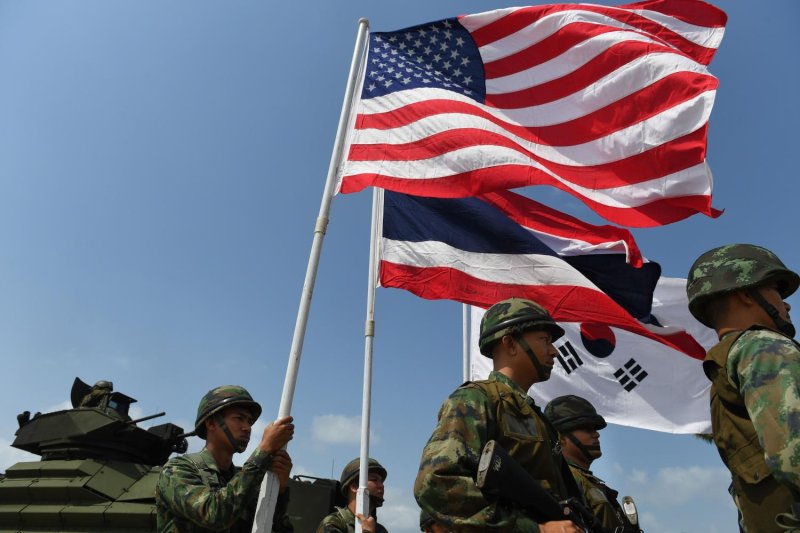
The strongest pillar remains the annual Cobra Gold military exercise, the region's largest joint military drill. For the past 45 years, Thailand and the US have co-hosted the exercise. This year's drills brought together 8,000 personnel from more than 30 countries, including many of America's allies and partners.
Cobra Gold has continued uninterrupted, even after Washington imposed political sanctions on Thailand following military coups. The exercise has endured because both countries continue to value the partnership.
However, as Thailand reassesses its ties with the US, it should play a greater role in shaping Cobra Gold's priorities rather than simply following Washington's lead. The exercise has strengthened military cooperation and improved the ability of participating forces to operate together.
It has become a cliché for Washington to describe Thailand as its oldest friend in Asia. Thailand was the first Asian country to sign a treaty with the US, the 1833 Treaty of Amity and Commerce, which declared that their friendship would endure "as long as heaven and earth shall endure".
Thailand has taken that commitment seriously. Whether Washington still does is another question.
Recently, the US Trade Representative also placed Thailand under Section 301, along with 60 other countries that have not banned products made with forced labour, imposing an additional 12.5% tariff. The irony is that Thailand has made significant progress in tackling forced labour in the fisheries and migrant worker sectors since the EU yellow-card episode.
Being grouped under Section 301 alongside countries with far worse records is politically damaging and reflects Washington's overly simplistic approach. Many Thais still remember how the US Farm Act hurt Thailand's agricultural sector in the 1980s. They also recall that Washington turned a blind eye when Thailand faced the 1997 financial crisis.
In addition, Bangkok has come under US scrutiny over what Washington sees as excess production capacity in industries such as auto parts and machinery.
Thai-US trade negotiations are expected to begin this month. Thailand wants to keep its exports competitive in the US market, but it should also use the talks to consider what kind of relationship it wants with Washington in the years ahead.
In the months ahead, Thailand will face growing challenges in managing its relationship with the US.
One concern in Washington is Thailand's increasingly close relationship with China. American policymakers believe Bangkok has tilted too far towards Beijing, helping expand China's economic and strategic influence in Southeast Asia. While Thailand insists it seeks balanced relations with all major powers, Washington expects its long-standing ally to do more to support American strategic interests.
Despite the ongoing conflict with Cambodia, the government under Prime Minister Anutin Charnvirakul sees Thailand as a bridge-builder and peacemaker on the global stage. This approach is consistent with its broader policy of promoting economic growth, trade and investment while pursuing its ambition of becoming a high-income country by 2038.