
If you're looking for the best CPUs for gaming or one of the best budget CPUs, there are only two choices: AMD and Intel. That fact has spawned an almost religious following for both camps, and the resulting AMD vs Intel flamewars make it tricky to get unbiased advice about the best choice for your next processor. But in many cases, the answer is actually very clear: AMD's X3D chips dominate gaming performance, from the Ryzen 5 7600X3D up to the Ryzen 9 9950X3D2. For application performance, AMD still tops the charts with flagships, but Intel's recent Arrow Lake Refresh chips provide nearly the same level of performance under $300 based on the data in our CPU benchmark hierarchy.
This article covers the never-ending argument of AMD vs Intel desktop CPUs (we're not covering laptop or server chips). We judge the chips on nine criteria based on what you plan to do with your PC: pricing, specifications and features, gaming performance, productivity performance, driver support, power consumption, overclocking, chipset and socket support, and security, giving us a clear view of the state of the competition. Throughout each section, we'll also discuss the process nodes and architectures influencing the moving goalposts. However, each brand has its strengths and weaknesses, so which CPU brand you should buy depends mostly on what blend of features, price, and performance is important to you.
The latest 'Arrow Lake Core Ultra 200S series builds on Intel's hybrid architecture formula but leverages a new design philosophy that constrains gaming performance. However, the chips do provide strong performance in single- and multi-thread productivity workloads, along with improved energy efficiency. New refreshed chips like the Core Ultra 7 270K Plus shore up the gaming front and provide a big boost in productivity performance, as well.
AMD's answer is its Zen 5 Ryzen 9000 series. These chips debuted with a fizzle on the gaming front, but subsequent firmware and operating system updates have improved the overall performance significantly, making these chips the bang-for-the-buck leader for most users looking for a balanced system.
AMD's powerful gaming-optimized Ryzen 9000 "X3D" models utilize a breakthrough 3D chip-stacking tech to take the lead in gaming performance, as you can see in our Ryzen 9 9850X3D review that finds the 9850X3D to be the fastest gaming CPU on the planet, bar none. AMD has also leveraged this X3D tech with its older architectures to make incredibly value-centric gaming chips, like the Ryzen 5 5600X3D. The gains in gaming performance are phenomenal, so much so that the competition against Intel chips isn't even close, giving AMD a walk-in touchdown for gaming PCs.
AMD vs Intel: Which CPU is Best?
Intel |
AMD |
|
|---|---|---|
Pricing and Value |
X |
|
Gaming Performance |
X |
|
Productivity and Content Creation Performance |
X |
|
Specifications and Features |
X |
|
CPU Power Consumption and Heat |
X |
|
Overclocking |
X |
|
CPU Drivers, Software, and Firmware |
X |
X |
Chipset and Socket Support |
X |
|
Security |
X |
X |
Total |
5 |
6 |
Comparing Intel vs AMD in 9 categories in 2026, AMD and Intel are in lockstep with a win in three categories each, with the brands coming in tied in two categories. Despite long-standing as the value alternative, AMD’s original Zen microarchitecture has kicked off a slow rise to the top. The Steam hardware survey now shows AMD only slightly behind Intel in market share, and from the Passmark database, AMD outpaced Intel in desktop market share for the first time last year.
Although the earlier years of Zen were met with an audacious Intel, that story quickly changed as AMD started to gain ground, particularly around the release of Zen 3. Intel was finally able to move onto its 10nm node after years of manufacturing challenges, as well as introduce a hybrid architecture in a desktop x86 CPU. Alder Lake, Raptor Lake, and Raptor Lake Refresh all maintain competitive positions against their Zen 3, Zen 4, and even Zen 5 counterparts, but Intel’s market dominance – and the price it demanded from it – has disappeared in desktops.
Fierce competition is good for everyone, but Intel didn’t maintain its trajectory, instead opting for a radically different architecture with Arrow Lake that ditched Hyper-Threading. In AMD’s camp, it doubled-down on the wildly successful 3D V-Cache, introducing a second generation of the technology that places additional cache below the compute die for more thermal headroom, and as a result, higher clock speeds.
Although Arrow Lake brings much-needed efficiency improvements to Intel’s desktop line-up, as well as great overclocking headroom on CPU cores and the memory subsystem, AMD dominates gaming performance with its X3D lineup, sometimes by as much as 30%. At the same time, AMD is able to match or exceed Intel’s productivity performance, despite how impressive the Arrow Lake architecture is from a technical perspective.
Broadly, AMD earns our recommendation for most people. It clearly leads in gaming performance with X3D CPUs, and despite stagnant specifications, AMD has continued to show architectural advantage in comparative performance scenarios. Intel has gained by some ground with the 270K Plus and Core Ultra 5 250K Plus, which are both excellent processors are affordable prices. For now, however, AMD remains our go-to recommendation.
AMD vs Intel CPU Pricing and Value 2025
AMD has long stood as the value king, and although you can get a lot for your money with chips like the Ryzen 7 9800X3D, Intel has slid into the value position as AMD continues to rise in market share. Looking at like-for-like CPUs in the AMD vs Intel battle, the two are in lockstep on pricing within a margin of $20 to $30 in most cases, outside of sales.
For the current generation lineup, Intel’s Arrow Lake chips are slightly cheaper at the Core Ultra 9 and Core Ultra 7 levels, though only by $20. Factoring in sales, Arrow Lake ends up much cheaper. At the time of writing, for instance, the Core Ultra 9 285K is available for $500 while the Ryzen 9 9950X will run you $570.
CPU |
AMD |
Intel |
|---|---|---|
~$600 |
~$580 |
|
~$450 |
N/A |
|
~$330 |
~$310 (~$350) |
|
~$210 |
~$230 (~$220) |
The prices above are based on the average selling price of the main lineups from AMD and Intel over the past 60 days. Notably, these aren’t list prices, which aren’t reflective of what you can expect to spend, especially this late into a generation. As an example, the Core Ultra 7 265K launched at $395 while the Ryzen 7 9700X launched for $359. Now, however, Intel comes out slightly cheaper.
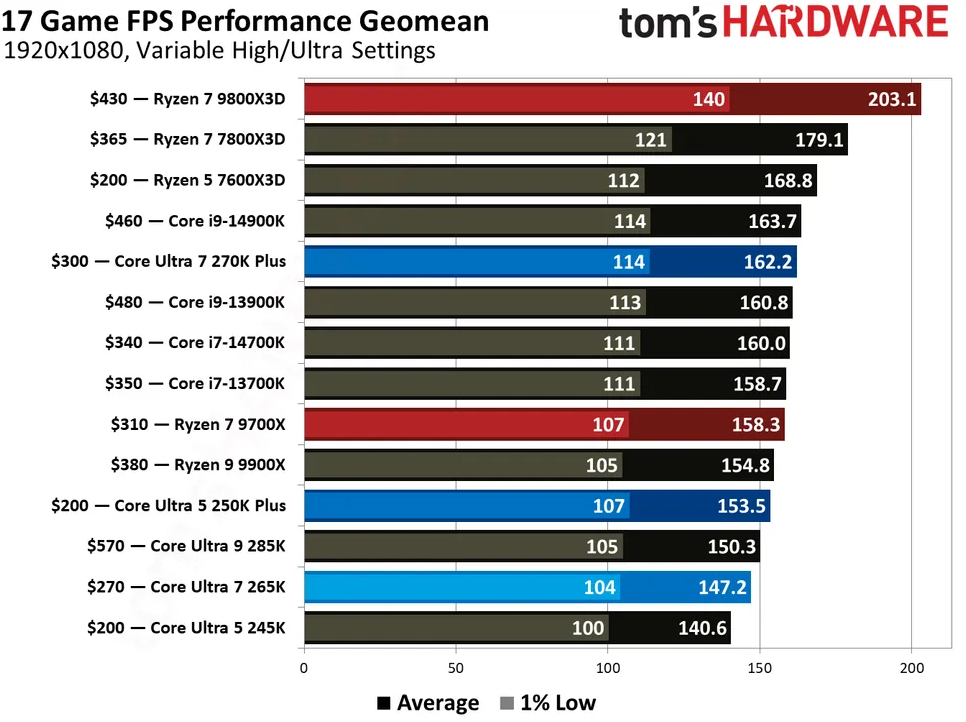
AMD leads in overall value for lower-end offerings like the Ryzen 5 9600X, but Intel isn't far behind with the recent Core Ultra 5 250K Plus. In gaming performance, you can see Intel is delivering better average frame rates, as well, though only with its newer Arrow Lake Refresh chips.
CPU |
AMD |
Intel |
|---|---|---|
~$510 (low stock) |
~$470 |
|
~$320 |
N/A |
|
~$280 |
~$320 |
|
Ryzen 5 7600X / Core i5-14600K |
~$180 |
~$210 (low stock) |
AMD and Intel flip positions when looking at last-gen options, with only the Core i9-14900K coming in slightly less than the Ryzen 9 7950X. Intel has clearly recognized the value proposition of the Core i5-14600K and Core i7-14700K, with both now selling for around the same price as their Arrow Lake counterparts.
Winner: Intel. Intel and AMD are more competitive on pricing than they’ve been in years. Intel comes out slightly ahead on value with lower-end SKUs, but value demands context. The Ryzen 7 9800X3D might be a worse value than the Core i5-14600K, but if you have $480 to spend on a CPU and want the best gaming performance, AMD’s X3D chip is right for you.
However, Intel shook things up massively with the 270K Plus and 250K Plus. Now, Intel is offering competitive gaming performance around $200 to $300 while pushing flagship-level application performance. For now, at least, Intel is in the driver's seat when it comes to overall value through Arrow Lake Refresh.
AMD vs Intel CPU Gaming Performance 2025
In the AMD vs Intel CPU gaming performance battle, AMD's X3D processors hold the lead in all critical price bands. Below, we have a wide selection of collective gaming performance measurements for the existing chips in the different price bands. You can see a much more holistic view in our CPU Benchmarks Hierarchy.
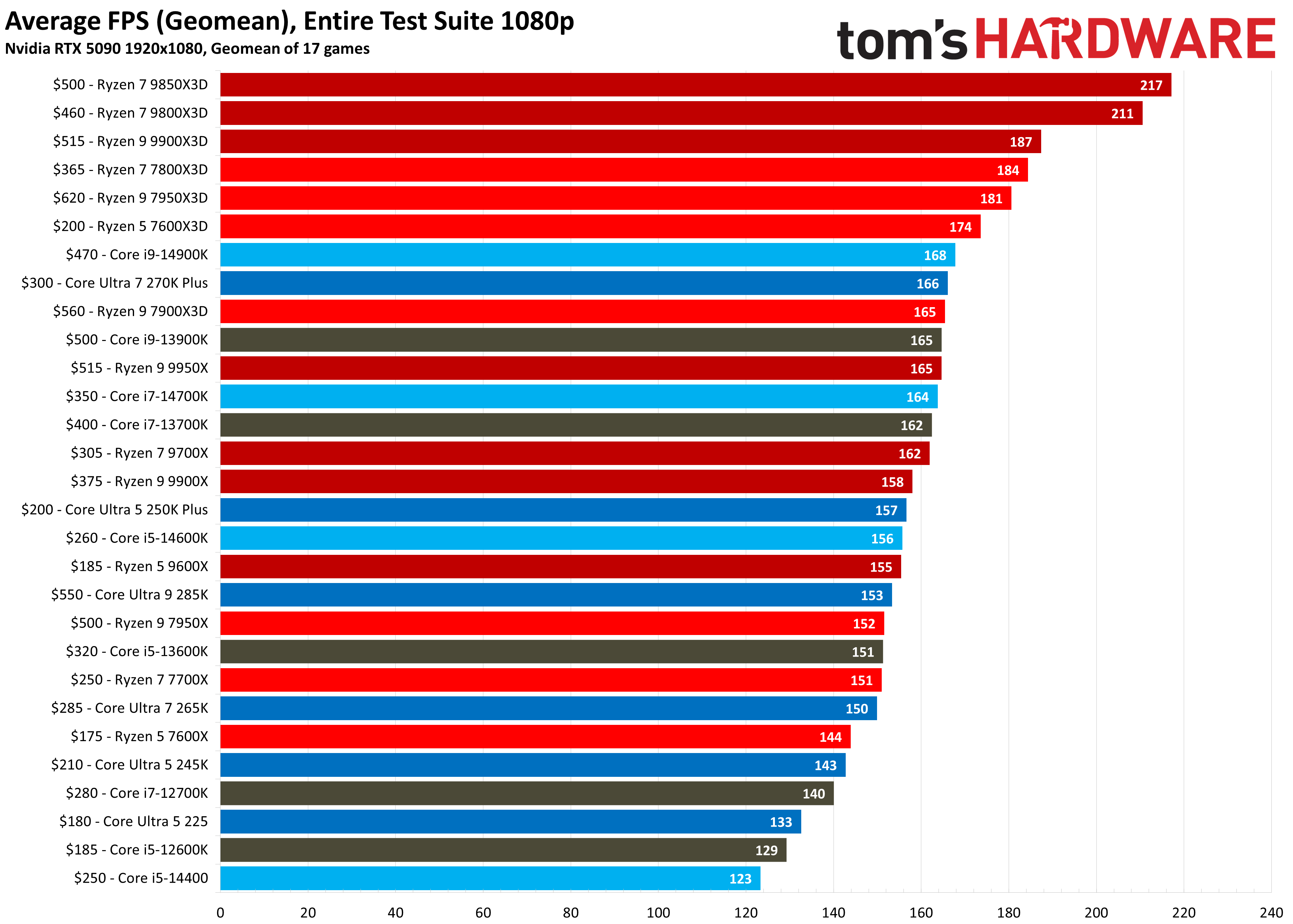
As you can see, AMD's standard 'Granite Ridge' Ryzen 9000 models take the lead over Intel's current-gen Core Ultra 200S 'Arrow Lake' processors, and the gaming optimized Ryzen 9000X3D chips, which cost more than the standard models, take an overwhelming lead, often by 30% or more.
Intel's current-gen Core Ultra 9 285K is the new flagship, but its unique tile-based (chiplet) design has a negative impact on gaming performance, so it isn't as fast as the prior-gen models in gaming. That leaves the Core i9-14900K as the fastest Intel gaming chip, and it often sells at a steep discount. The recent Core Ultra 7 270K Plus, however, is just marginally behind the Core i9-14900K, and it's available for around $350.
AMD's standard Ryzen 9000 models, like the flagship Ryzen 9 9950X, are faster in gaming than Intel's Core Ultra 200S series, but Intel's previous-gen 14900K holds the edge. However, AMD's X3D models, like the Ryzen 7 9800X3D and the Ryzen 9 9950X3D, are the fastest gaming chips on the planet, beating Intel's current-gen chips by 30+%. These chips also deliver the full performance of the standard models in productivity workloads, eliminating the tradeoffs associated with the X3D models that we've seen in the past. The X3D models do come at a premium, but they justify their price tag with the fastest gaming performance money can buy.
Older X3D chips leverage AMD’s first-gen 3D V-Cache, which stacks the cache on top of the compute die rather than below, which is the case with the latest Zen 5 X3D offerings. That design limits thermal headroom, and in turn, clock speeds, so expect a dip in productivity performance if you aren’t using one of AMD’s latest X3D offerings.
Kicking your resolution up to 1440p and beyond typically pushes the bottleneck back to the GPU, so you won't gain as much from your CPU's gaming prowess. However, a bit of extra CPU gaming performance could pay off if you plan on updating your graphics card (see our best graphics cards) with a newer generation while keeping the rest of your system intact. We expect most builds in the mid-range to come with lesser GPUs, which generally serve as an equalizer in terms of CPU performance.
In terms of integrated graphics performance, there's no beating AMD. The company's current-gen Phoenix Point APUs offer the best performance with the 8700G and 8600G. We’ve seen even more capable APUs out of AMD with its mobile Strix Point offerings like the Ryzen AI Max 395, but Strix Point hasn’t made its way to desktop yet.
Winner: AMD. AMD's standard Ryzen 9000 models deliver solid performance in gaming, beating Intel's current-gen models, but they trail the previous-gen Intel chips. However, the Ryzen 9000X3D models take the unequivocal lead in gaming by massive margins, giving AMD an easy win in the gaming department. The previous-gen Raptor Lake Refresh models are a distant second in gaming performance, and they aren't as performant as the Ryzen 9000 models in productivity applications, making them a tough choice as an alternative.
AMD vs Intel Productivity and Content Creation Performance 2025
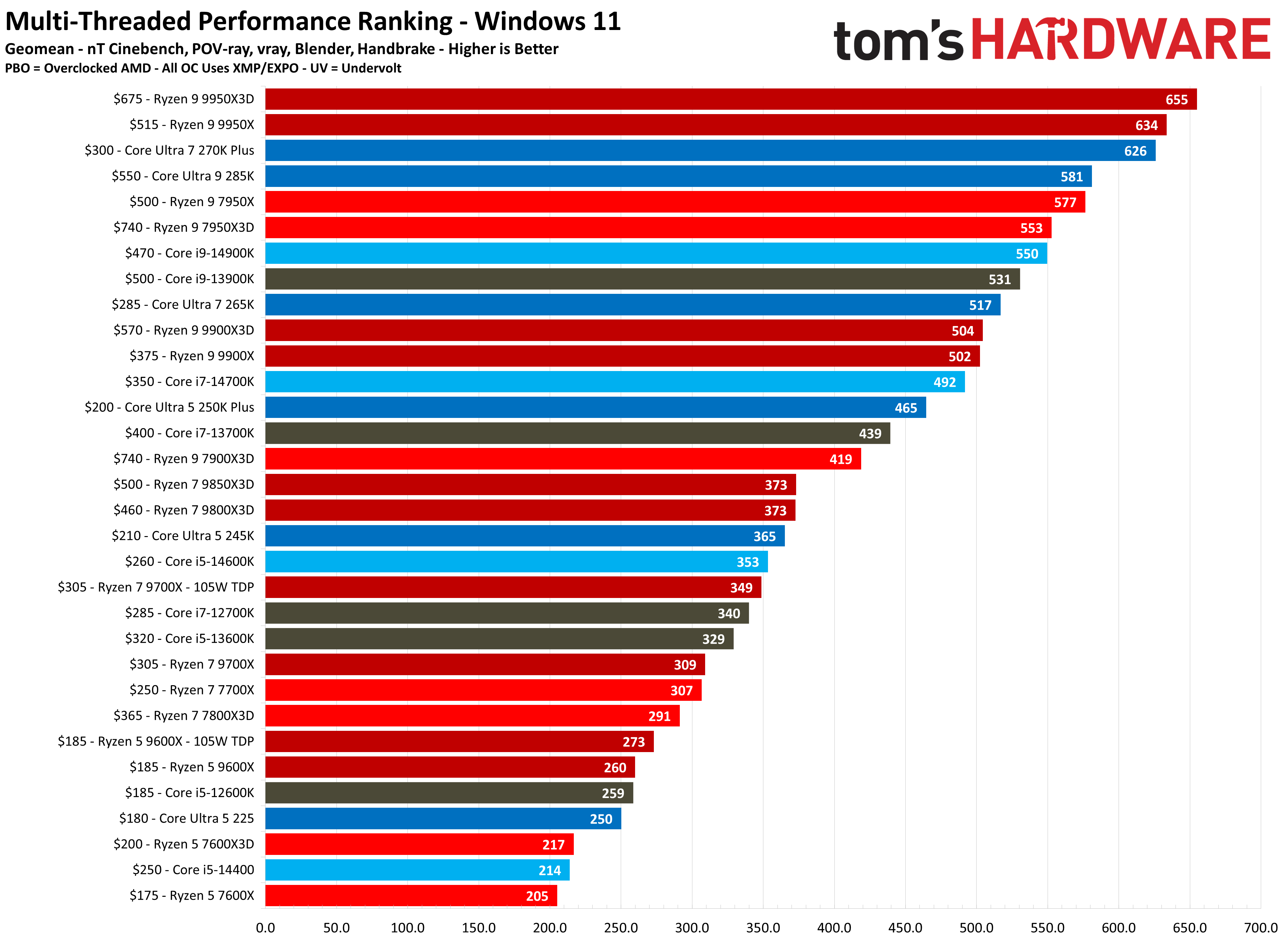
In the non-gaming performance battle of AMD vs Intel CPUs, Intel's Arrow Lake chips have made great strides against AMD's finest, but they fail to deliver a tangible enough lead over AMD's core-heavy models to make productivity performance a make-or-break buying decision. AMD leads in overall multi-threaded performance with its Ryzen 9 9950X3D and 9950X by a slim margin, but Intel keeps a solid grip on the lead in single-threaded applications. The new Arrow Lake Refresh CPUs don't radically change the performance picture overall, but they come in much less than AMD's Zen 5 competition.
Arrow Lake marks Intel's continuation of using a mixture of two types of cores for the mainstream desktop PC. The big performance cores (P-cores) are best for latency-sensitive work, giving Intel the uncontested lead in single-threaded applications. The efficiency cores (E-cores) step in to add some additional heft in threaded and background applications, which pays big dividends in heavily-threaded content creation and productivity applications.
In contrast, AMD continues to leverage its tried-and-true P-core only design, which also supports AVX-512, a big consideration for those who leverage powerful productivity applications that employ the high-performance instructions. Zen 5 brought a 512-bit data path for AVX instructions – Zen 4 used two 256-bit paths – which provides a massive performance advantage in applications that leverage AVX-512, even compared to Zen 4. Intel’s latest CPUs don’t support AVX-512 instructions.
Solid performance in single-threaded work equates to faster performance in all manner of workloads, particularly day-to-day applications that rely on snappy responsiveness from the processor. The Core 7 270K Plus has taken the uncontested lead in single-threaded performance across the full suite of our benchmarks, and it comes in at a mid-range price point. And on the multithreaded front, Intel is able to match the Ryzen 9 9950X despite the Core Ultra 7 270K Plus coming in at half the price.
Winner: Intel. Although AMD offers compelling productivity performance with its most expensive offerings, the Core Ultra 7 270K Plus and Core Ultra 5 250K Plus punch far above their weight class in productivity performance, easily delivering flagship performance at entry-level prices.
AMD vs Intel Processor Specifications and Features 2025
Modern Intel and AMD CPUs sport much different architectures, so comparing specifications directly is a fool’s errand in most cases. AMD has a traditional approach with a homogeneous core architecture that sports simultaneous multi-threading. Intel moved onto a heterogeneous architecture with Alder Lake, which it has maintained since, and it removed Hyper-Threading with Arrow Lake.
This departure in architecture means you can draw inaccurate conclusions from specs alone. For instance, Intel’s flagship Core Ultra 9 285K only has 24 threads compared to AMD’s 32 on the Ryzen 9 9950X. Despite that, the two chips offer competitive multi-threaded performance, as you can see in our performance results in the above section.
CPU |
Street (MSRP) |
Arch |
Cores / Threads (P+E) |
P-Core Base / Boost Clock (GHz) |
E-Core Base / Boost Clock (GHz) |
Cache (L2/L3) |
TDP / PBP or MTP |
Memory |
|---|---|---|---|---|---|---|---|---|
$699 |
Zen 5 X3D |
16 / 32 |
4.3 / 5.7 |
— |
144 MB (16+128) |
170W / 230W |
DDR5-5600 |
|
$669 ($699) |
Zen 4 X3D |
16 / 32 |
4.2 / 5.7 |
— |
144MB (16+128) |
120W / 162W |
DDR5-5200 |
|
$599 |
Zen 5 |
16 / 32 |
4.3 / 5.7 |
— |
80MB (16+64) |
170W / 230W |
DDR5-5600 |
|
$579 ($589) |
Arrow Lake |
24 / 24 (8+16) |
3.7 / 5.7 |
3.2 / 4.6 |
76MB (40+36) |
125W / 250W |
CUDIMM DDR5-6400 / DDR5-5600 |
|
$529 ($599) |
Zen 5 X3D |
12 / 24 |
4.4 / 5.5 |
— |
140MB (12+128) |
120W / 162W |
DDR5-5600 |
|
Ryzen 9 7900X3D |
$599 |
Zen 4 X3D |
12 / 24 |
4.4 / 5.6 |
— |
140MB (12+128) |
120W / 162W |
DDR5-5200 |
$480 |
Zen 5 X3D |
8 / 16 |
4.7 / 5.2 |
— |
104MB (8+96) |
120W / 162W |
DDR5-5600 |
|
$365 ($449) |
Zen 4 X3D |
8 / 16 |
4.2 / 5.0 |
— |
104MB (8+96) |
120W / 162W |
DDR5-5200 |
|
$380 ($469) |
Zen 5 |
12 / 24 |
4.4 / 5.6 |
— |
76MB (12+64) |
120W / 162W |
DDR5-5600 |
|
$329 ($394) / $309 ($379) |
Arrow Lake |
20 / 20 (8+12 |
3.9 / 5.5 |
3.3 / 4.6 |
66MB (36+30) |
125W / 250W |
CUDIMM DDR5-6400 / DDR5-5600 |
|
$298 ($349) |
Zen 5 |
8 / 16 |
3.8 / 5.5 |
— |
40MB (8+32) |
65W / 88W / 105W |
DDR5-5600 |
|
$210 ($279) |
Zen 5 |
6 / 12 |
3.9 / 5.4 |
— |
38MB (6+32) |
65W / 88W |
DDR5-5600 |
|
Core Ultra 5 245K / KF |
$245 ($309) / $219 ($294) |
Arrow Lake |
14 / 14 (6+8) |
4.2 / 5.2 |
3.6 / 4.6 |
50MB (26+24) |
125W / 250W |
CUDIMM DDR5-6400 / DDR5-5600 |
The cores and clocks aren’t as important as they once were, at least when comparing a Ryzen 9 to a Core Ultra 9, or a Ryzen 5 to a Core Ultra 5. Instead, there’s been a stark shift in focus toward cache in the face of 3D V-Cache. That’s the marquee feature AMD has been running on for the past few years, offering chart-dominating performance in games that Intel has yet to answer. Previously, 3D V-Cache came with a slight compromise to productivity performance due to clock speeds on eight-core parts and CCX-to-CCX latency on 12- and 16-core parts. AMD has rectified that issue with second-gen 3D V-Cache, however.
Apples-to-apples, Intel and AMD offer similar cache amounts when excluding X3D parts, though Intel more evenly distributes the cache between L2 and L3, while AMD focuses the lion’s share of cache in the last level. Intel is rumored to pack bLLC into its upcoming Nova Lake generation to answer 3D V-Cache. Intel currently deploys this style of cache packaging in its Clearwater Forest server chips, but it has yet to show up in a consumer CPU.
Winner: AMD. Intel has highlighted several features over the past several generations, from Thread Director to Intel APO and even the new iBOT feature, but these features have mainly served to bring Intel’s unique architectural design up to par. Meanwhile, AMD has pushed ahead with a big win in gaming due to 3D V-Cache, which only improved in its second generation. Add on top of that AVX-512 support, as well as a true 512-bit data path in Zen 5, and Team Red easily wins this category.
AMD vs Intel CPU Power Consumption and Heat 2025
When comparing AMD vs Intel CPU power and heat, the former's 4nm TSMC process node makes a big difference. Power consumption comes as a byproduct of design choices, like lithography and architecture. However, higher power consumption often correlates to more heat generation, so you'll need beefier coolers to offset the heat output of greedier chips.
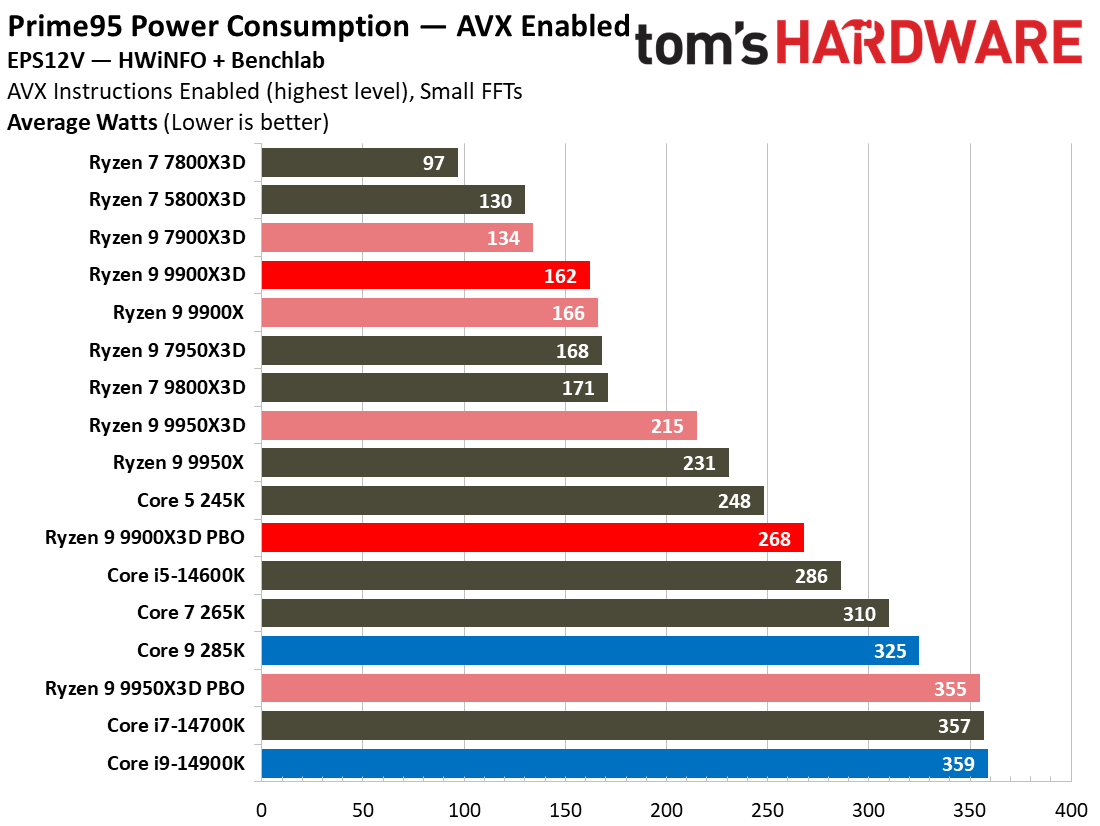
Overall, Intel has reduced its power consumption from meme-worthy to an acceptable level, but it still consumes more power than Ryzen. Still, in aggregate, AMD's 4nm chips either consume less power or provide much better power-to-performance efficiency.
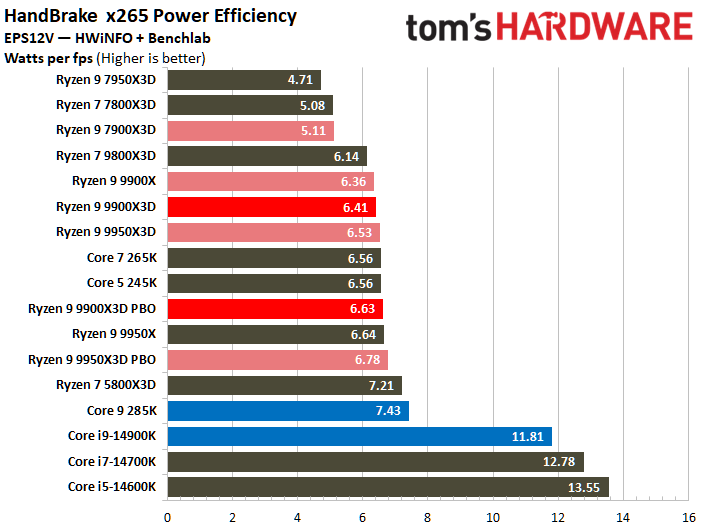
As you can see above, you'll get more work done per watt of energy consumed, which is a win-win, and AMD's cooling requirements aren't nearly as overbearing. Arrow Lake brings Intel more in-line with AMD, both when looking at peak power consumption and productivity efficiency. Even then, however, Intel’s latest offerings end up slightly ahead of AMD in overall power consumption, and slightly behind in over efficiency.
Winner: AMD. In judging AMD vs Intel CPU performance per watt, it's impossible to overstate the importance of having the densest process node paired with an efficient microarchitecture, and TSMC's 4nm and AMD's Zen 5 are the winning combination. The latest Ryzen processors consume less power than Intel on a power-vs-performance basis, even in the face of Arrow Lake.
Intel vs AMD CPU Overclocking 2025
There's no debate when you compare Intel vs AMD CPU overclocking. Intel offers the most overclocking headroom, meaning you can gain more performance over the baseline speed with Intel chips than you can with AMD's Ryzen processors. To learn more about overclocking, head to our How to Overclock a CPU guide.
Dynamic boosting algorithms and increasingly multi-threaded applications have offset some of the previous benefits of overclocking, at least for core clock speeds. With AMD’s current CPUs, and up to Raptor Lake Refresh for Intel, a modest all-core overclock generally won’t provide a performance benefit, and it could even reduce your performance, though only in lightly-threaded applications. The boosting algorithms can usually achieve higher speeds for these applications, with all-core overclocks running into a thermal wall before providing much of a boost.
However, for Intel, that changed with Arrow Lake. It ships with much higher thermal headroom than the last several Intel generations, shortening the gap between single-core boosts and all-core speeds. Intel now also provides more fine-grain control over clock speeds, with increments as low as 16MHz. Arrow Lake scales particularly well with high DDR5 speeds, offering a small performance edge if you’re able to secure a fast kit of memory.
AMD has taken a different approach. Rather than offering more granular control over overclocking, it has continued to invest in Precision Boost Overdrive (PBO) as a one-click overclocking solution. In addition, AMD offers Curve Optimizer and Shaper, which allow you to easily undervolt your chip with a voltage offset across the frequency range.
Intel has an edge in overclocking, but it comes with a caveat. In order to overclock an Intel chip, you need to purchase an unlocked K-series processor as well as a Z-series motherboard. H- and B-series motherboards only support memory overclocking. Meanwhile, AMD supports overclocking on all of its modern CPUs, short of the Ryzen 7 5800X3D and other Zen 3 chips sporting 3D V-Cache. AMD also supports CPU overclocking on B- and X-series chipsets, saving you some money.
Winner: Intel. Although CPU overclocking isn’t as prominent as it used to be, Team Blue holds the edge in this AMD vs Intel battle. You have more granular control over core overclocking, as well as additional fabric and memory overclocking features that can net higher performance on Arrow Lake. AMD has focused on making overclocking more accessible, but that also leaves enthusiasts with less room to play.
AMD vs Intel CPU Drivers, Software, and Firmware 2025
Over the past couple of years, both AMD and Intel have seen catastrophic firmware issues, which caused CPUs to fail, or in the worst cases, literally burn themselves up. In the most recent generation, we also saw hamstrung performance due to software issues from both AMD and Intel, though both have also released a string of microcode and driver updates to address these problems.
On the driver front, Intel and AMD are both stable. In the early days of Zen, we saw lopsided support for Intel’s latest architecture, and AMD’s smaller position in the market meant issues were more common and fixes took longer to arrive. That isn’t the case today. Broadly, Intel and AMD’s chipset drivers are stable, and issues that do arise are usually resolved through an update within a few days.
Firmware is a different story, and that’s been an unfortunate area of focus for AMD and Intel over the last couple of years. Intel was at the center of a years-long issue with instability on Raptor Lake and Raptor Lake Refresh chips, and in particular, the Core i9-13900K and Core i9-14900K. Reports of instability in games on these CPUs date back at least as far as early 2023, but Intel didn’t acknowledge them until mid-2024.
Intel released a microcode update in late 2024 that solved most instability problems, but as recently as September 2025, it’s continued to work on the issue.
In AMD’s camp, high-end Ryzen CPUs have burned themselves up in the socket, ruining both the chip and motherboard – twice, though for different reasons. In the first go, the Ryzen 7 7800X3D was operating at elevated voltages. An AGESA update shortly after reports started circulating capped the voltage at 1.3V, and there haven’t been any reports since.
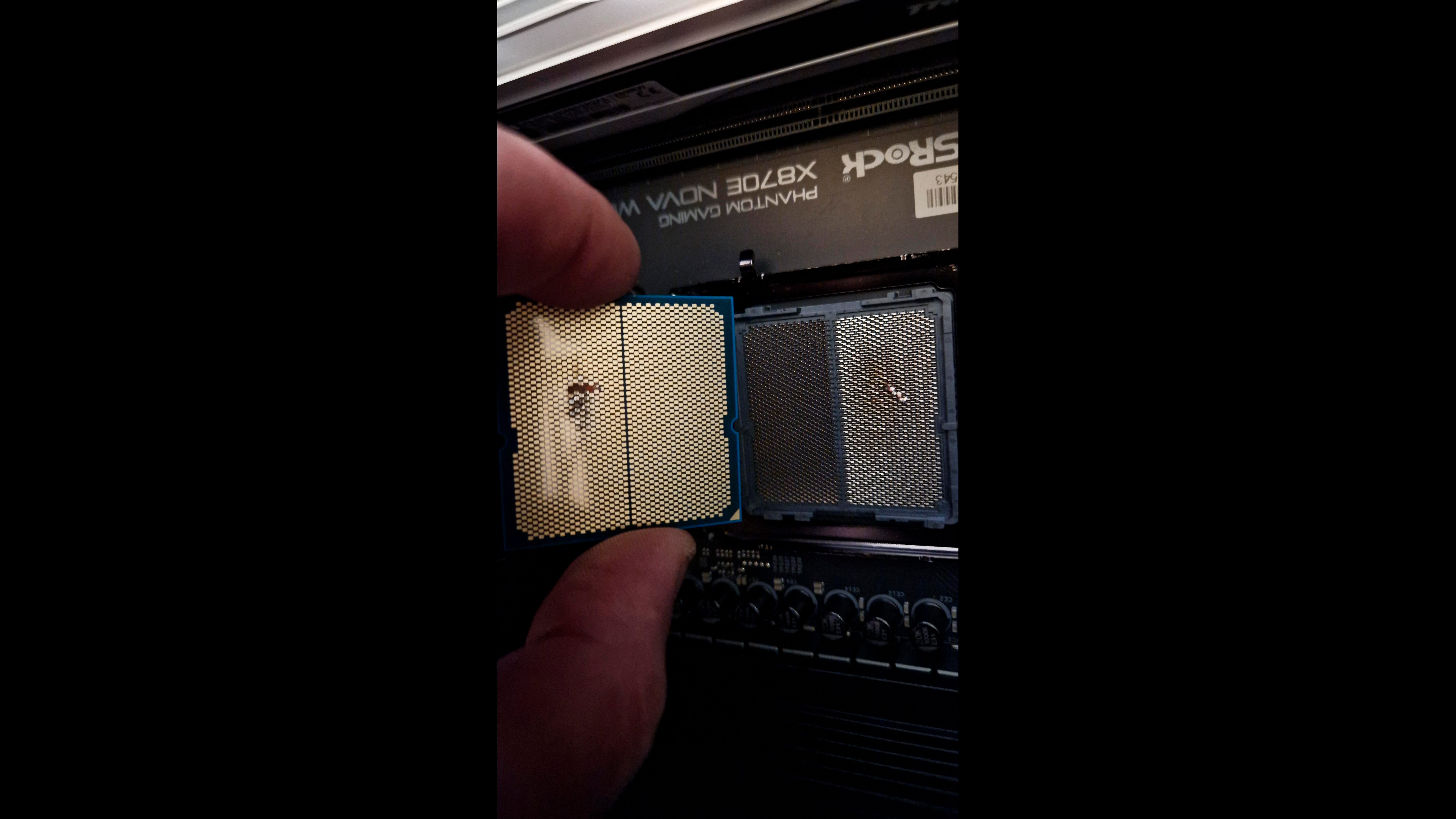
With the release of the Ryzen 7 9800X3D, a far larger number of reports started circulating, once again showing the burning on the CPU’s contact pads and in the motherboard socket. This issue was much messier than the original Ryzen 7 7800X3D, though the vast majority of reports came from the Ryzen 7 9800X3D paired with an ASRock motherboard. In this case, AMD shifted blame to ASRock. ASRock has reportedly solved the problem through BIOS updates, but new reports are still trickling out at a reduced cadence.
Winner: Tie. It’s hard to declare a winner in this category given the two major controversies Intel and AMD have faced over the past few years, both of which resulted in CPUs being ruined while supposedly operating within warrantied specifications.
Although it’s important to highlight these problems and the responses to them from AMD and Intel, they aren’t widespread issues. Neither triggered a proper recall.
AMD vs Intel Chipset and Socket Support 2025
An increasingly important aspect of choosing between Intel and AMD is the longevity of the chipset and socket of your motherboard. Although new generations bring new chipsets, AMD has set a new standard for socket support with AM4, which it appears to be carrying forward with AM5. Intel has responded in kind, supporting 12th-, 13th-, and 14th-gen chips on the same LGA1700 socket. However, it moved to the LGA1851 socket with the release of Arrow Lake, and it will move to the LGA1954 socket with the release of Nova Lake CPUs in late 2026.
AMD’s current commitment is to support the AM5 socket through 2027, but that timeframe could extend. With the release of Zen 4 and introduction of AM5, AMD originally only committed to support through 2025 before extending the timeframe with the release of Zen 5. With AMD’s current release cadence, that means we should see at least three generations, and possibly four, on the AM5 socket. If AMD once again extends the window, we’re likely looking at five generations of support.
It’s certainly possible that AMD will extend the timeframe. The AM4 socket set a precedent of longevity. It was originally introduced in 2016, and AMD has released new AM4 chips as recently as 2025; though, these chips are mostly rebranded versions of old silicon, or specific variants for different international markets.
For chipsets, AMD currently supports Zen 4 and Zen 5 CPUs across all chipsets with the AM5 socket. With AM4, AMD eventually brought support for Zen, Zen+, Zen 2, and Zen 3, though support varies based on manufacturer for older chipsets.
Intel has a more confusing lineup of chipsets and support, which alone spoils the reasoning for AMD winning this section. After three generations on the same socket, Intel moved to a new socket with the release of Arrow Lake. That socket (LGA1851) has seen Arrow Lake Refresh chips, and we don't expect it to see any more releases.
Intel also forces customers to its flagship Z-series chipset for CPU overclocking support; a line in the sand that it’s continued to maintain despite the fact that AMD supports CPU and memory overclocking on both B-series and X-series chipsets. Thankfully, the last several generations of Intel chipsets have opened up memory overclocking on B-series chipsets.
Winner: AMD. The AM4 socket brought about a new standard for drop-in CPU replacements, which AMD is bringing forward with AM5. Intel has made strides to support multiple generations on the same socket, but it has yet to demonstrate the ability to deliver support over several years like AMD has. Additionally, Intel continues to charge a premium for CPU overclocking by restricting the feature to flagship Z-series chipsets.
AMD vs Intel CPU Security 2025
The last few years have found security researchers poking and prodding at the speculative execution engine that's one of the key performance-boosting features behind all modern chips. The resulting research has spawned an almost never-ending onslaught of new vulnerabilities that threaten the safety of your system and private data. Unfortunately, these types of vulnerabilities are incredibly dangerous because they are undetectable—these tactics steal data by using the processor exactly as it was designed; thus, they are undetectable by any known anti-virus program.
The rash of fixes required to plug these holes also continues to grow, and many of them resulted in reduced performance initially. AMD and Intel have recognized the cost of such updates during the Spectre and Meltdown era, and more recent patches come with little to no impact on performance. It’s possible that could change with a future vulnerability, but we haven’t seen chart-breaking changes in performance from security updates in the past couple of generations.
Intel still has more known vulnerabilities, but in the years following Spectre, it’s become clear that both AMD and Intel are vulnerable to this family of attacks. At the time of writing, Intel recently patched over 30 security bugs, and AMD confirmed a critical security vulnerability in its random number generator on Zen 5 CPUs, which it plans to address with an AGESA update.
Winner: Tie. Similar to firmware, it’s hard to say anyone is a winner here. Intel claims it surfaces and addresses vulnerabilities more proactively than AMD does, but both brands chase the constantly evolving world of threats and offer driver and/or firmware updates in response. In addition, both maintain a bug bounty program to incentivize security researchers to find and surface exploits.
FAQ: Frequently Asked Questions
◼ Is AMD or Intel better for gaming?
As we outlined in our AMD vs Intel gaming section above, AMD's Ryzen 9000 X3D processors, namely the Ryzen 7 9800X3D, Ryzen 9 9900X3D, and the Ryzen 9 9950X3D, are currently the fastest gaming chips on the market.
◼ What is the latest Intel processor?
The latest Intel processors for desktop PCs are named the Core Ultra 200 series. The newer Arrow Lake Refresh chips are noted as the Core Ultra 200S Plus series.
◼ What is the latest AMD processor?
The latest AMD processors for desktop PCs are named the Ryzen 9000 series.
- MORE: Best CPUs for Gaming
- MORE: CPU Benchmark Hierarchy
- MORE: Zen 4 Ryzen 7000 All We Know
- MORE: How to Overclock a CPU
- MORE: How to check CPU Temperature
- MORE: All CPUs Content