Enjoy our content? Make sure to set Windows Central as a preferred source in Google Search, and find out why you should so that you can stay up-to-date on the latest news, reviews, features, and more.
True to its word, AMD has deployed its FSR "Redstone" update to the public in the second half of 2025, with just a couple of weeks left in the year. It arrives as part of the AMD Adrenalin 25.12.1 driver package, and it's also available for developers in a new Redstone SDK.
AMD first mentioned "Redstone" as an upgrade to FSR 4 at Computex 2025, promising major machine learning upgrades to Super Resolution and Frame Generation.
Now that it's here, I must admit that it's a tad confusing. Along with the major Redstone updates (which only work on certain AMD GPUs), AMD has also rebranded some of its technologies. Here's what you need to know.
What is AMD FSR Redstone?
FSR is essentially AMD's answer to NVIDIA DLSS. They're both upscaling technologies that rely on AI to make your games run smoother, look better, and hit higher frame rates. Whereas NVIDIA has stuck with DLSS over the years, AMD is still organizing its naming conventions.
With this update, Redstone has become the umbrella term for all of AMD's ML-powered upscaling techniques. That means FSR 4 has been renamed as "FSR Upscaling," falling under the Redstone name as just another technique.
AMD has also cut the official "FidelityFX Super Resolution" moniker down to simply "FSR," bringing it in line with what we've all been calling it all along anyway.
With the Redstone launch, AMD says that more than 200 games now support "one or more" Redstone features. These include FSR Upscaling, FSR Frame Generation, FSR Ray Regeneration, or FSR Radiance Caching. Beyond that, there are 32 games — including Arc Raiders, Call of Duty: Black Ops 7, and Cyberpunk 2077 — confirmed to support FSR Frame Generation.
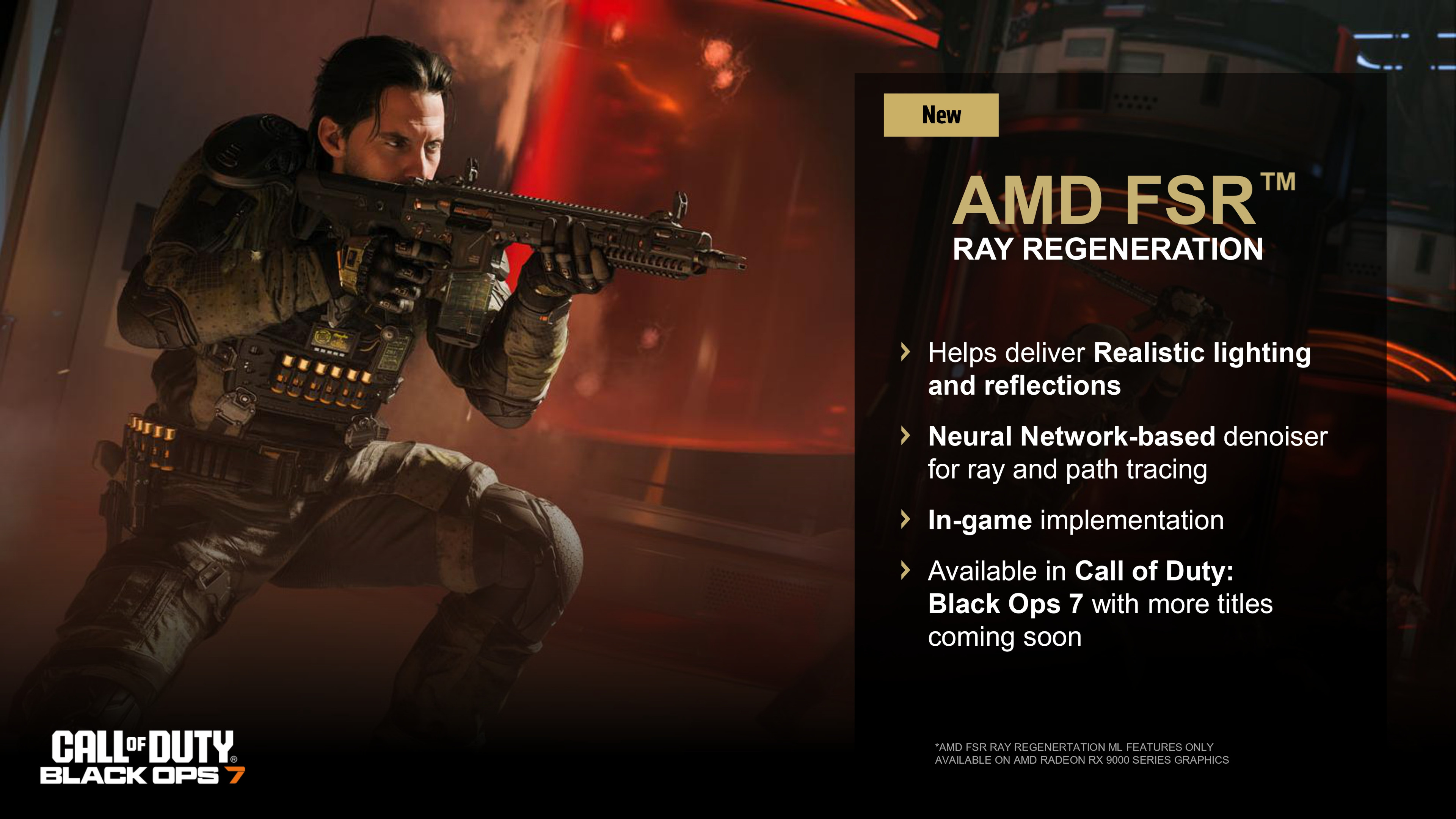
What about FSR Ray Regeneration? As far as I can tell, only Call of Duty: Black Ops 7 supports the feature. AMD's FSR Radiance Caching is still in its infancy, with AMD noting that it will come to developers sometime in 2026.
Unfortunately, this update is only available for owners of AMD's latest Radeon RX 9000 graphics cards that use the RDNA 4 architecture. There are some inferior FSR 3.1 fallbacks for Upscaling and Frame Generation on older hardware, but Ray Regeneration and Radiance Caching are strictly reserved for the latest AMD GPUs.
How does AMD FSR Redstone perform?
Our friends at PC Gamer were quick to test out AMD's Redstone update first-hand on a Radeon RX 9070 XT GPU.
The TL;DR? AMD's new Frame Generation is a big upgrade, pushing it up to compete with NVIDIA's DLSS. It still lacks 3x and 4x generation ala DLSS, but it's certainly better than it used to be. And although Ray Regeneration is only available in one game, it also seems to be a win.
AMD still has a long way to go if it wants to surpass NVIDIA's DLSS tech, but this seems like a solid step in the right direction for Radeon. I just wish it were all available on older AMD GPUs.

Follow Windows Central on Google News to keep our latest news, insights, and features at the top of your feeds!