Ambulance services in England are to test new response times for the most serious 999 calls in an effort to reach the most life-threatening cases more quickly and cut “wasted” journeys by ambulances and parademics.
Experiments in London and the south-west will see more cases being put in the most urgent category, known as Red 1, but will give call handlers more time to deal with less urgent but still life-threatening cases, Red 2.
The announcement on Friday coincided with more bad figures for A&E departments in England and Wales. Almost 2,500 operations were cancelled in England, including some emergency surgeries, while waiting times at A&E in Wales rose to the worst in five years.
Jeremy Hunt, the health secretary, said in a written Commons statement that he had agreed to the ambulance trials to see whether giving call handlers “very limited extra assessment time would ensure that ambulances are better deployed to where they are most needed and would allow a faster response time for those patients who really need it”.
Under the plan, responses to Red 2 calls will take slightly longer than at present. The eight-minute response time (the time from dispatch to a first responder reaching the patient) will not change, but the current one-minute maximum that call handlers have to determine the best course of action before the clock starts ticking will be extended to three minutes.
NHS England says less than 10% of 999 calls are for genuinely life-threatening conditions, yet ambulance services currently categorise around 40% of calls as such, partly because call handlers have only a minute to gather the information they need before an ambulance must be sent.
Ambulances will continue to be dispatched immediately to Red 1 calls – those involving people suffering cardiac arrest or who have stopped breathing. New categories of patient are being added to Red 1 for the trials: women in labour and about to give birth; people who have taken an overdose and are unconscious; and those with serious gunshot wounds.
Currently, to meet the target of reaching 75% of Red 2 patients within eight minutes, ambulance services frequently send vehicles before they have determined the exact nature of the problem. They also send more than one vehicle, such as an ambulance and a rapid responder.
On average, over a fifth of these journeys are cancelled before they reach the scene, wasting time and money and delaying treatment for other patients, NHS England says. Ambulance chiefs believe the changes will free more ambulances and allow 999 responses to be more properly targeted.
The A&E crisis this winter has meant that some ambulance trusts are struggling to meet targets. The leaking of documents from ambulance chiefs before Christmas caused concern that they were seeking to downgrade some emergency services.
Hunt said the pilots must demonstrate that there would be better outcomes for patients and less unnecessary use of ambulances.
One of the pilots is expected to begin next month, but Labour’s Andy Burnham appealed for experiments to be conducted later in the year, when there is less pressure on services. “This is the worst winter for years in England’s A&Es,” he said. “It is not the time for experiments, nor relaxing operational standards. This could mean patients waiting longer for ambulances.
“We’re not against the idea of a pilot, but it should be done in a quieter summer period. The government must urgently provide reassurance this can be done without putting patient safety at risk.”
The proportion of patients being treated in A&Es within four hours in England was 84.3% for the week ending 11 January, an improvement on the figure for the previous week, but still the third worst performance ever and well short of the 95% target.
Welsh government statistics showed only 81% of patients being treated within four hours. The Welsh Conservatives accused Cardiff’s Labour ministers of “an atrocious performance”.
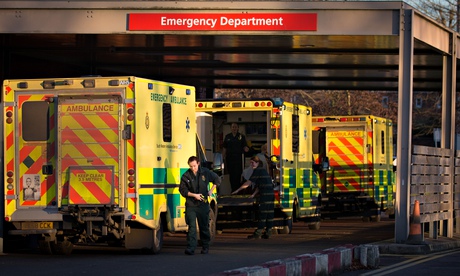
Statistics also showed instances of ambulances queuing outside A&E departments for at least 30 minutes, more than double the figure for the same period last year, and bed days lost due to delayed discharge of medically fit patients were higher than at any time over the last two winters.
Ambulances had to queue outside A&E departments for at least half an hour on 7,743 occasions, taking the total number this winter to 72,911, and there were 20,085 bed days lost to delayed transfer of care.