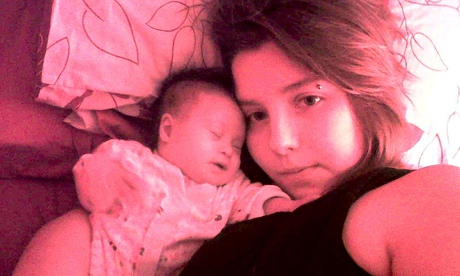
A baby who was discharged from hospital two days after a heart operation despite concerns raised by her mother became ill after arriving home and died after an ambulance crew failed to treat her case as an emergency, an inquest has heard.
Lacey-Marie Poton was born with a complex heart condition and underwent three operations at Bristol Royal hospital for children. The day after the final procedure, in July 2013, the four-month-old girl, who also had Down’s syndrome, suffered a bout of vomiting but doctors judged that she was fit to leave 24 hours later.
Her mother, Emma Norley, 21, said the girl became shivery, shaky and pale on the way home. She called the hospital but was told to take her to see her GP. The GP’s receptionist refused to schedule an appointment as Lacey-Marie seemed so unwell, and her parents took her back to the children’s hospital.
There, Norley and her partner Jhonny Poton were informed that Lacey-Marie had gastroenteritis and would be discharged with the rehydration treatment Dioralyte. Ten minutes after returning home once more, Lacey-Marie went into suspected cardiac arrest and Norley performed CPR while an ambulance was called.
The inquest heard that the ambulance crew did not use blue lights on the hospital journey. Lacey-Marie died in her mother’s arms around four hours later.
Norley said: “The paramedics did not think there was anything wrong with Lacey-Marie. I told them I had just performed CPR but they did not seem to understand why I had had to.
“Despite having told the operator on the phone that the patient was a baby, the ambulance did not seem to be properly equipped. She was not treated as an emergency and no blue light was used throughout the journey even though Lacey-Marie was still crying and grunting.”
Norley said hospital staff shouted at the paramedics when the ambulance arrived as they had not been told Lacey-Marie was coming. CPR was administered as the girl had stopped breathing again but a cardiologist did not arrive for around 15 minutes, the inquest heard.
“I was crying my eyes out and begged [the cardiologist] to save her,” Norley said. “I ran into intensive care and held Lacey-Marie in my arms as she passed away.”
A report by South Western ambulance service found that “the crew did not recognise the time-critical nature of the incident and therefore conveyed the patient at normal road speed without a pre-alert to the hospital”.
The inquest in Flax Bourton, near Bristol, heard that the ambulance took 22 minutes and 19 seconds to transport Lacey-Marie to hospital. Adrian South, deputy clinical director of the ambulance service, told the inquest that the journey would usually take 25 minutes by car. “The blue lights were not on but the ambulance was not going slowly,” he added.
But paramedic Nicholas Stock said using blue lights on the journey to hospital would have made a difference. He said: “We didn’t have a formal discussion of how she would be transferred to hospital and we just left. I feel I was probably a bit blinkered and I didn’t raise the issue of whether we would drive with blue lights or not. We arrived at the hospital 22 minutes later.
“A patient with cardiac history with a query cardiac arrest that is pale and floppy should be blue-lighted. I appreciate there has been talk that blue lights wouldn’t have made much of a difference but they would have made some difference so that should have been done.”
Paediatric cardiologist Tatjana Rjabova said she believed the baby had gastroenteritis after examining her when she first returned to hospital. “Mum was happy to try Dioralyte and go home if that was successful,” she said. “I went over the plans with A&E staff. I said she could go home if she looked well and mum was happy, and if not she should be admitted.”
The hearing is the latest in a string of inquests into the deaths of young heart patients. An inquiry has been launched after bereaved families expressed concern over how their children were treated.
The inquest continues.