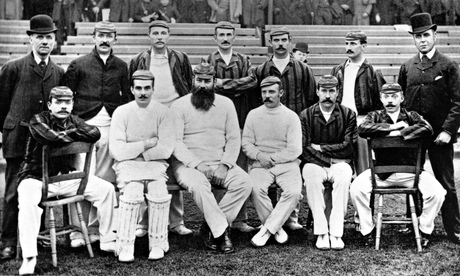
WG Grace’s achievements still boggle the mind. He scored nearly 55,000 runs in first-class matches and took more than 2,800 wickets. None of his contemporaries got anywhere near either total, and the runs have been exceeded by only four men in the game’s history, the wickets by only five. Less than two weeks after his 18th birthday in 1866, he scored 224 not out, the highest score in first-class cricket since 1820, playing for England at London’s Oval cricket ground against Surrey.
He once scored 839 runs, including two triple centuries (nobody had made even one before), in just eight days. He had 50 first-class centuries by the time he was 27, more than the next 12 most successful batsmen managed between them in the same decade. As Richard Tomlinson observes in this meticulous and absorbing biography, “He performed this feat at a time when pitches were so poor, and cricket gear so flimsy, that batsmen risked their lives whenever they took guard.” Indeed, after one Grace century at Lord’s, a batsman in the same match was hit on the head and killed.
To a great extent, therefore, Grace deserves the nostalgic adulation he so often attracted. When he died in October 1915, as German zeppelins launched air raids across eastern England, Alfred Gardiner, editor of the London Daily News, remembered him as the “genial tyrant in a world that was all sunshine”. He bears the same relation to English cricket as William Tyndale does to English prose and Shakespeare to English drama. In the words of KS Ranjitsinhji – who succeeded Grace as the premier pre-1914 English cricketing celebrity – he turned the bat from “the one-stringed instrument” of the early 19th century “into a many-chorded lyre”.
Without Grace’s star quality, rivalled in Victorian England only by that of Charles Dickens, cricket might never have become England’s main summer game, still less a game that would one day captivate Australia, South Africa and the entire Indian subcontinent. As the Caribbean Marxist CLR James put it in one of the best books written about the game, Grace “incorporated” cricket “into the life of the nation”.
But what was also incorporated, in the course of Grace’s career, was the snobbery, falsehood and hypocrisy that would disfigure the game well into the 20th century and prevent it, in England at least, from achieving the mass appeal that football was already developing before the end of the Victorian era.
When Grace arrived on the scene, the distinction between unpaid amateurs and paid professionals was already in place; the Gentlemen v Players (that is, amateurs v professionals) match had been played since 1806. The division corresponded exactly to the Victorian class system. The Gentlemen were mostly aristocratic landowners who didn’t need to work for money. The Players were mostly small tradesmen and independent artisans – tailors, carpenters, bakers, blacksmiths, tanners, wheelwrights and, in the north, handloom weavers, but very rarely unskilled labourers – who needed regular financial support if they lost working time to cricket. They usually undertook the hard physical labour of bowling, chasing the ball to the outfield and holding an end up while an amateur showed off his elegant batsmanship. Sitting uneasily between the two were the rising middle classes, too conscious of their fragile status to be professionals, not rich enough to be genuine amateurs.
That was the problem for Grace and his two cricket-playing brothers. Their father earned a decent income as a doctor, but owned no property. Cricket’s ruling body, the Marylebone Cricket Club (MCC) was an exclusive private club of landowners, packed with dukes, earls and honourables. It employed professionals as “ground staff” to raise standards in matches and give members batting practice. “Staff” was the operative word: they were, in effect, servants whom MCC members treated in roughly the same way as the gardeners, gamekeepers and grooms on their country estates who had formed the backbone of 18th-century teams. Most county clubs at the time operated on similar lines.
It was unthinkable for the upwardly mobile Graces to accept “staff” status, particularly as their paternal grandfather had been a butler. The family had already wangled MCC membership and therefore “amateur” status for WG’s elder brother EM, though he was undoubtedly in practice a professional who accepted substantial fees as “expenses”. Though the MCC hesitated over WG – perhaps, Tomlinson suggests, because EM had got in partly by accident and the club didn’t want to admit it had set a precedent – it was then concerned about losing control to freelance professional XIs that were attracting huge crowds on their tours, mainly in the expanding northern towns. It could not allow the biggest box-office draw of the age to get away, though WG frequently turned out for professional XIs (for money, naturally) after he became an MCC member. His recruitment helped the MCC and the elite to tighten their grip on cricket and establish the pettifogging rules and social practices that would eventually turn so many away from the game.
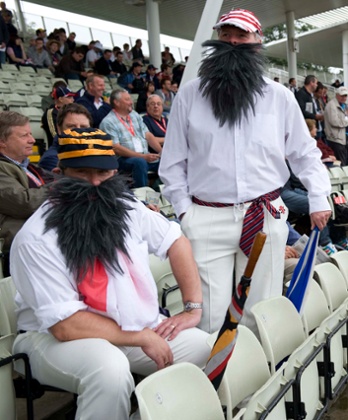
Shamateurism on a small scale had already begun in the 1860s. WG took it to a quite different level. In 1873-4, he charged a fee of £1,500, plus expenses for his fiancee, to tour Australia. At the time, an English professional would make barely £100 over the summer, from which he had to pay his own expenses. For another tour in 1891-2, Grace charged £3,000, plus expenses for himself, his wife and two children and the cost of a locum for his medical practice. That amounted to one-fifth of the entire cost of the tour, leaving the professionals with £300 each.
The rewards were not in themselves unreasonable. The biggest sporting stars – and Grace was capable of emptying offices in any town when news got around that he was batting – will always get significantly more money than their less gifted teammates. The scandal lay in the pretence that Grace was an amateur, and in the treatment of professionals who stayed in separate hotels, ate separate meals, changed in separate dressing rooms and walked on to the field through separate gates to the amateurs. Shamateurism became so integral to the system that, from the 1890s, nearly all counties had an “amateur” player as a paid secretary alongside an assistant secretary who did all the work. By 1963, when the distinction was belatedly abolished, the term “amateur” had long ceased to mean anything except that its holder was of elevated social status.
The long survival of class consciousness turned English cricket into a joke from which it has never quite recovered. Yet for all those years, cricket was the only major sport where the social classes – in the form of amateurs and professionals – played together on the same field in the same competitions under a single authority. Athletics, tennis, rugby, boxing and football all separated amateurs and professionals in one way or another.
Cricket didn’t, but developed rigid, offensive and hypocritical practices to maintain the social hierarchy. Grace, the biggest popular hero of the Victorian age, could have challenged all that; many, inside and outside cricket, would have supported him. He chose not to do so. It is a measure of his greatness that, while we should salute him for making the game so beautiful and so popular, we must also condemn him for helping to create its uglier side.
• To order Amazing Grace for £20 go to bookshop.theguardian.com or call 0330 333 6846. Free UK p&p over £10, online orders only. Phone orders min p&p of £1.99.