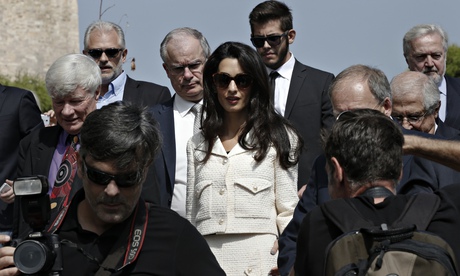
In its relatively short life, the New Acropolis Museum in Athens has welcomed celebrities through its doors with some regularity. Some may go unnoticed. But that was not the case on Wednesday when Amal Clooney, the human rights lawyer and wife of George Clooney, attempted the same passage.
“It was like Moses parting the sea,” said David Hill, an Australian campaigner who was next to her in a group at the centre of a media circus. “There were five security guys, us in the middle, Professor Norman Palmer leading us through like a rugby league prop, and a thousand media people swooping in. Never before have I seen anything like it.”
Since flying into Athens with Palmer and Geoffrey Robertson, both QCs and experts in cultural restitution, to advise the Greek government on how best to try to retrieve the Parthenon marbles from the British Museum, Clooney has been the subject of hot pursuit.
“For the past two hours I’ve been trying to get a shot of her,” said Dimitris Lambropoulos among a throng of photographers gathered at the museum’s entrance. “Right now I just snapped her,” he said, long lens trained on the giant glass window of the restaurant area where Clooney lunched after touring the institution that would house the sculptures if London ever agrees to relinquish them. “Not since the museum opened [in 2009] have we seen anything like this.”
It is Clooney’s first work trip since getting married in Venice last month. When she was asked whether her husband would be taking a more active role in the dispute (he has already spoken out in favour of the marbles’ return to Greece), the answer was an unambiguous “no”. “I hope that even at this very early stage of the marriage, I’m wise enough to know that it’s up to my husband to decide which causes to support,” she told reporters with a smile.
Palmer said he had been taken aback by the celebrity furore but Clooney had not seemed distracted. “She has profound and unwavering intellectual focus that has enabled her to keep her head on. And that allows her to say: ‘I am here to do a job,’ because that after all is what we are doing, marshalling arguments and deploying them in this case for the marbles.”
In many ways the media attention may have diverted focus from the mission. But for those who have long fought to reclaim antiquities that were carted off to England at the turn of the 19th century, Clooney’s fame is an asset. “Her participation has been amazing,” said Hill, head of the International Association for the Reunification of the Parthenon Sculptures. “Because what it has done, in a flash, is make this issue known globally.”