For a while, I hung out with a brilliant young horticulturist in New York. She was cool, wore long red socks, beat-up boots, tiny shorts and slung her Felco secateurs round her hips as if she were a cowboy. As far as I could tell, everyone wanted to go to bed with her. I’m a little wary of that kind of hip, so I hid in the cool of the alpine house instead. Every now and then, she’d swing by and tease me about the uptight alpines. At some point, she came up with this game where you had to write your lonely heart entry as if you were a plant. Mine went something like: “Shy, shade-loving perennial seeks similar woodlander”. Hers went something like: “Bright annual that appears only after heavy showers, flowers, sets seed and is off again. Seeks similar ephemeral”.
Brilliant annuals do have a part to play in everyone’s life, even if it is brief. They provide a burst of colour that is great for filling gaps in new gardens or as a flight of fancy you can change every year. Some of the best are accidents. Lettuce left to flower, for instance, can make a wonderful statement, especially the red-leaved sort. All lettuces tower when flowering, so are suited to the middle or back of beds. Once they are up, they are crowned in a flurry of bright yellow flowers that go on and on. You can attempt to let the seed set, but they look mostly tattered by this stage. Radishes are good in flower, too; a little unruly, perhaps, but worth it for the inflated seedheads, which are both interesting to look at and edible.
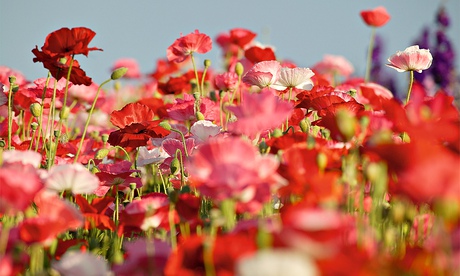
Shirley poppies (above) are another wonderful bit of froth; they look good mixed with corn cockles (Agrostemma githago). Reverend Wilks’s Shirley poppies are the loveliest. They come in the softest shades often with picotee edges. They need light soils and like sandy conditions in sun or partial shade. This is the last moment to sow them, or wait and sow in autumn for early flowering next year.
If you want something with more stature, try opium poppies (Papaver somniferum). Chiltern Seeds has some truly brilliant fully double cultivars that look like pompoms and come in every shade, from tasteful to not.
For something more bold, go for apple of Peru or shoo-fly (Nicandra physalodes – it is said to deter whitefly). It is huge, up to 1.2m tall and just as wide, with flat blue flowers and Chinese lantern-style seedheads in green and black. It often appears unannounced in the garden, deposited by birds (some would call it a weed) and it stays for a number of years before disappearing. If you’ve composted the plant, it will return of its own accord.
Tobacco plants, nicotiana, particularly N. sylvestris, with its sweet heady evening scent, or N. langsdorffii, with green-yellow flowers, are worth growing. Slugs can be a problem, particularly if the plants are grown in too much shade. They do best on recently composted soils. It’s too late for seed, so buy healthy plug plants from the garden centre.