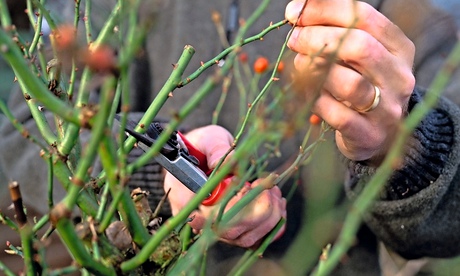
On those rare winter days when the sun shines and everything is bathed in rose gold, get outside and prune. Pruning requires an optimistic state of mind, and the sun helps. It seems an unnatural habit, but you are just behaving as a herbivore. Plants have adapted to be eaten a little here and there, or to be whipped by the wind and broken off. Losing a little of themselves this way often boosts productivity, meaning more flowers and fruit, but do it wrong and you will get the opposite effect.
Always go slowly when pruning. Too little is hardly a sin; too much and the plant responds with a flurry of the wrong sort of growth. Heavy pruning drastically reduces its ability to photosynthesise, so it has to rectify that fast; or, if it’s a really drastic prune, very, very slowly, as it ekes out resources from its roots to regrow.
The first cuts are to remove anything that is dead, damaged or diseased. Never cut without good reason. When it comes to where new growth will appear, plants are strict on hierarchy. The top bud rules; this is called apical dominance. When a stem is cut or broken, stopping the sap flow, apical dominance in the top bud is lost. The new shoots will sprout from the buds immediately below the wound. Pinching out or pruning to make something bushier uses this principle.
Apical dominance is driven by vertical growth, so if you take a rose stem and tie it down to grow horizontally, you slow down the sap and that top bud starts to lose its dominance. Often this results in more growth and more fruits and flowers. This is the technique employed when tying climbing plants along a trellis or training cordon, espalier or stepover fruit trees.
Select a strong, outward-pointing bud to cut back to (or one growing in a direction that does not cross or crowd other growth). If you are cutting a stem with buds arranged alternately – roses, apples and pears, say – make a slanting cut just above the bud, so rainwater will run off away from the bud, discouraging disease. If you have a pair of opposite buds, such as a hydrangea, make a straight cut as close to the buds as possible.
If you are cutting off a large branch on a tree, make sure you cut back to the branch collar, meaning you cut slightly proud of the trunk. It’s a waste of energy for the tree if you leave anything more than a couple of inches. With a large branch, it’s vital that you make an undercut beneath the branch before you cut, or you will rip the bark.
• Follow Alys on Twitter.