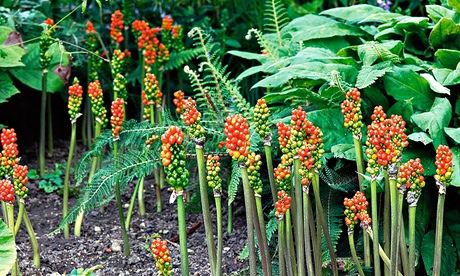
In a garden full of food, it’s good to have something a little sinister, an antidote to the idea that everything is about the stomach. Below my favourite apple tree there are thick spikes of poisonous berries, the same shade as the apples above. These belong to the Arum italicum, often known as the Italian lords-and-ladies. It hails from Europe and is most at home in the scrubby woodlands of Turkey, Morocco and Tunisia.
We’ve been cultivating it since the late 17th century, and it’s easy to see why. It’s as if someone has taken a fat italic fountain pen and drawn a line in the palest silver grey ink around the leaf margin, the ink sinking and bleeding into the glossy green, marbling its way across the leaf.
In rich, damp woodland soil, it grows big and bold, each leaf reaching up to 30cm. The flowers appear in spring and are impressively odd. The spadix is upright and surrounded by the spathe, a bract drawn up like a collar on a windy day.
Its many colloquial names are said to reference its phallic nature (lords-and-ladies either being a polite Victorian convention or a distinctly rude one, as in the lord’s and the lady’s).
Once the flowers appear, the leaves fade quickly and are gone by May. The flowers are followed by seedheads. The berries are green at first, then turn orange and finally brilliant red. These are very poisonous and appealing to small people: saying that, I survived a garden full of them and played endlessly in woods full of its native relative, cuckoopint (A. maculatum). My mother’s tales of poisonous plants were as good as any fairytales, so I’m not suggesting you should rip them out just because you have kids, just add a cautionary tale.
The orange-red berries are at their best around late August, though they often persist until the first new flush of leaves appear in October. This plant’s genius is to thrive when most other things are going to bed for winter. It looks particularly good planted with some early narcissus, perhaps with a few emerging ferns and a scattering of Welsh poppies. Or just on its own in a dark, gloomy corner.
The underground tubers are very starchy. In fact, the tubers of A. maculatum produced Portland starch, which was used in creating stiff ruffs worn in the 16th century. All this starch means they are sometimes dug up by badgers and rabbits, so if necessary cover with netting or cloches, until the leaves are established.
You can still buy tubers to plant now: bury them deeper than you’d expect, three times the depth of the bulb. They are best in moist shade, though they will grow in full sun. If happy, and given time, they will make excellent ground cover.
• Follow Alys on Twitter.