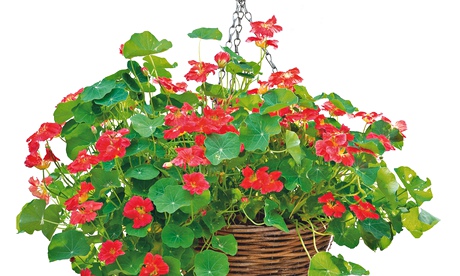
Great hanging baskets work because they look abundant: a cascade of colour, a fountain of flowers and little indication that the poor plants are sitting in a cage. But this is achieved only by a meticulous watering and feeding regime. Hanging baskets are not for the forgetful, so if you are that, go with something perennial and drought-tolerant instead; you won’t win awards, but at least you won’t have the hanging basket of gloom.
Hanging baskets can be a bit of an ecological disaster. Frilly, flamboyant or gaudy, the plants that are offered up are often bred so all the good stuff – pollen and nectar – is left out, or it’s inaccessible to our native bees, or it’s drenched in pesticides. Pity the poor pollinator who lands on the average basket, thrusting its head vainly into a bouquet of petals to find no supper. Still, there are plenty of plants that – though they may not be the most obvious – will work well.
Traditionally, one of the reasons petunias, geraniums and lobelias and their like are favoured for hanging baskets is because they repeat flower. Often, naturalistic planting has a peak moment and may flower if cut back, but it may not. There have been many attempts to come up with native hanging basket mixes, but few stand up to a whole season. A project between Bristol Botanic Garden and the city’s council suggested that two of the better native plants were autumn hawkbit (Scorzoneroides autumnalis) and greater bird’s-foot trefoil (Lotus pedunculatus). I’d add Geranium pratense ‘Mrs Kendall Clark’ to that list, because its far tougher than it looks and will hold its own when not in flower.
Nasturtiums are incredibly useful, because they trail and are cheap and easy. They are suited to sunny sites and work well with marigolds, snapdragons, geums, chives or short-stemmed salvias such as Salvia roemeriana – the dwarf sage. Likewise, Bidens ferulifolia is another trailer that works well in hot conditions, as do trailing fuchsias; both go down well with all sorts of bees. Fuchsia is particularly useful, as the pendant nature of the flower protects the nectar from rain.
Short-stemmed nicotiana, such as the cultivar ‘Lime Green’, can look fantastic, and will attract moths and other night flyers. However, you will need to make sure that you are buying bedding plants that haven’t been treated with pesticides. Or aim next year to raise your own from seed (try Chiltern Seeds). Heucheras flop just enough to work in hanging baskets and are easy to please in sun or dappled shade. Perennial candytuft (Iberis sempervirens), sage, thymes, lysimachia and aubretia all work for perennial pots.
If you want the lazy option, I’ve yet to kill a sedum. S. spurium and its variants (which tend to have plum-purple leaves), S. sieboldii (interesting variegation, but must be brought in over winter) and S. ewersii var. homophyllum ‘Rose Carpet’ are lovely in or out of flower, and will take more shade than you’d expect.