
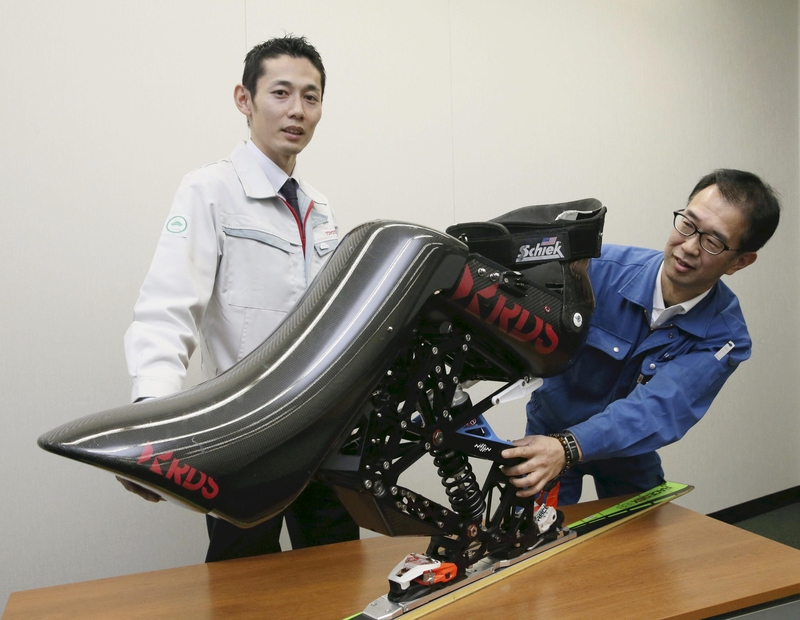
Alpine skier Taiki Morii, 37, has a partner in his quest for gold at the Pyeongchang Paralympics -- a sit-ski developed by a team of company engineers, including Morii's firm of Toyota Motor Corp., who applied automotive technologies to its design.
The sit-ski was developed to enable quick turns while maintaining its speed, the team said.
Morii's first event at Pyeongchang was the men's sitting downhill on Saturday. He failed to pick up speed in the first half of the race, but recovered and won the silver medal, telling himself, "I'm riding on the fastest sit-ski anyone has got."
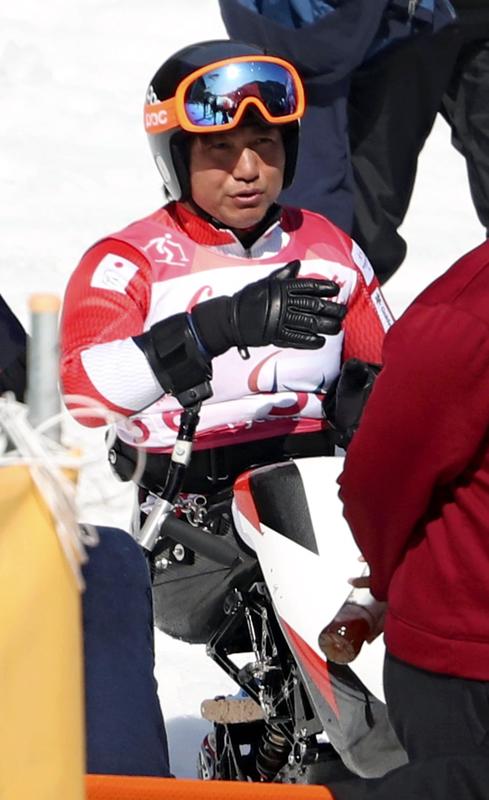
Morii joined Toyota in the summer of 2014, shortly after the Sochi Games, and asked the automaker to develop the world's best sit-ski with Toyota technology. About 40 people, including Toyota engineers, gathered to develop the equipment with Nissin Medical Industries Co., an Aichi Prefecture-based company that has developed sit-skis.
"All possible 'excess fat,' such as the width and thickness of components, was removed," said Tomohito Enomoto, a 35-year-old Toyota employee in charge of designing the sit-ski.
To enable quick turns, it was essential to trim the weight of the sit-ski as well as reinforce its rigidity to prevent it from bending under a heavy load. Enomoto said the development involved "work to balance two contradicting elements."
The team examined precisely how force is applied to the components by having Morii ski downhill with sensors attached to him. It used computer software for automobile development in its analysis, and worked diligently to find "fat" that could be removed while maintaining rigidity.
About two years after the team started development, it had successfully reduced the weight of the sit-ski by 15 percent from a conventional model and increased the rigidity to three times the standard.
Nissin employee Yoshihisa Yamada, 43, said, "It's significant that specific indicators were identified through Toyota's analysis."
Before the Pyeongchang Games opened, the team received a message from Morii, saying, "I can compete without any worries." Enomoto said, "I want him to give courage to people with similar challenges [to Morii's]."
Read more from The Japan News at https://japannews.yomiuri.co.jp/













