Nearly three million people in the U.S. have gotten sick from the flu so far this season, new data shows.
The Centers for Disease Control and Prevention released its latest round of weekly flu data on Thursday. The agency revealed 2.9 million people have become sick from the virus so far this season, while more than 127 million doses of the flu vaccine have been distributed. The CDC says that everyone six months and older should get an annual flu vaccine.
The CDC’s data indicates there was an 8.1 upward trend in infections last week, as Americans returned home after traveling for the Thanksgiving holiday.
The agency also updated its weekly influenza surveillance report, indicating which states may have been hit the hardest by the virus. The system monitors visits for respiratory illnesses that come with a fever and a cough or sore throat, according to the CDC website.
As of December 6, multiple states had “high” levels of activity, including Colorado, Louisiana, New Jersey and New York, according to the CDC.
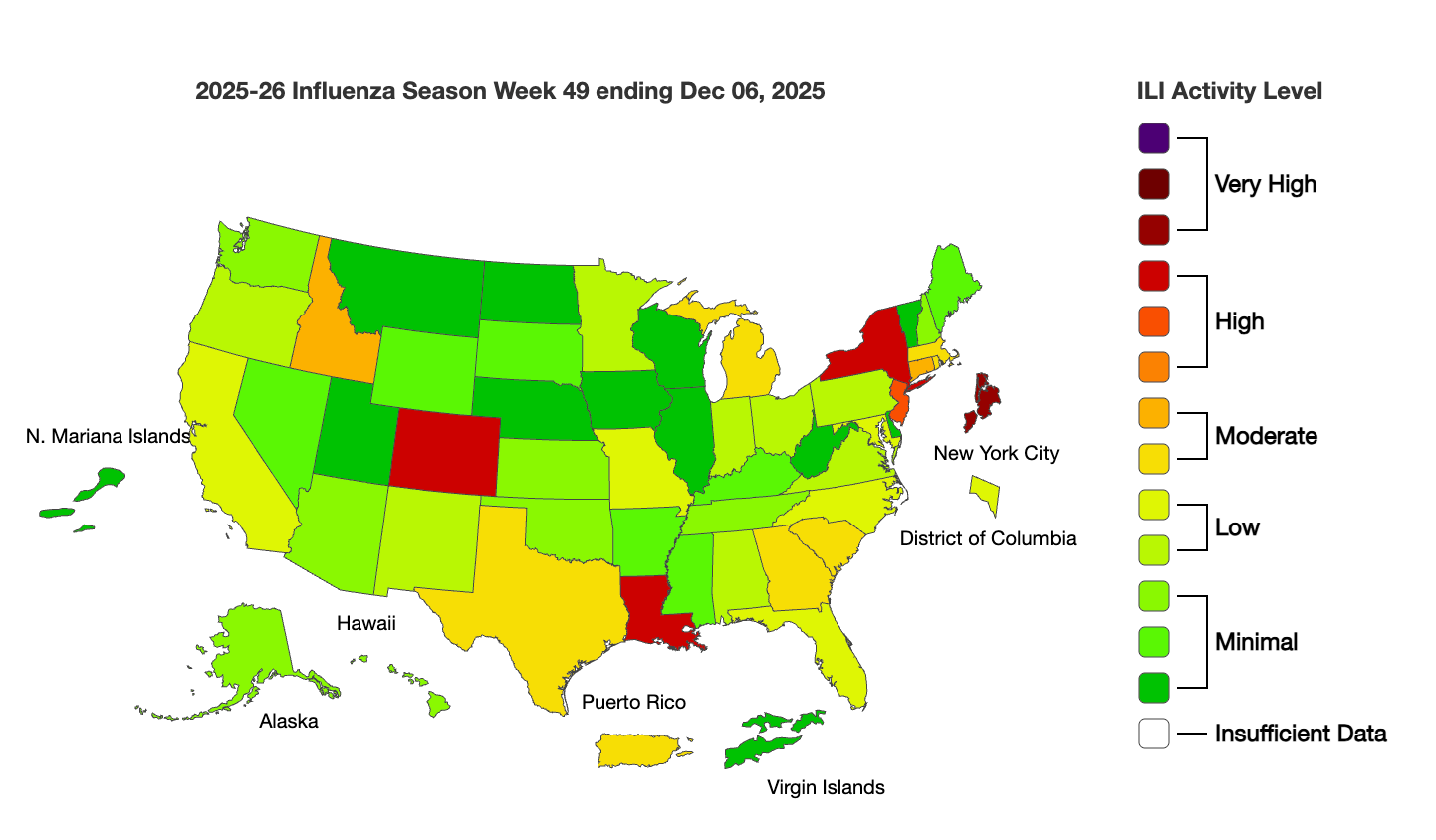
New York City alone saw “very high” levels of activity, the agency indicated.
More states fell into the “moderate” range, including Connecticut, Georgia, Idaho, Massachusetts, Michigan, South Carolina and Texas. Others were labelled “low,” including California, Missouri and Virginia.
Meanwhile, some states are faring even better. Illinois, Montana, Nebraska, North Dakota, Washington and Wyoming were all included in the “minimal” category.
In addition to the 2.9 million infections, there have been 30,000 hospitalizations and 1,200 deaths from the flu, the CDC said. This includes two pediatric deaths reported last week, according to the agency’s data.
This data comes as schools across the nation brace for a fast-spreading flu variant: the H3N2 subclade “K” strain.
The strain has led to difficult early flu seasons around the world, including in Japan, Canada and the U.K., according to UCHealth, a health care system based in Colorado.
This strain is particularly unpleasant for some patients, experts have warned.
"You'll usually develop [symptoms] about one to four days after being exposed, and it feels like being hit by a truck," ABC News chief medical correspondent Dr. Tara Narula said last month. "It's different from a cold, so you're going to have fever, muscle aches, headaches, chills, sore throat, cough, runny nose, stuffy nose, maybe even vomiting and diarrhea."
Dr. Michelle Barron, UCHealth’s senior medical director for infection control and prevention, said in a statement that patients shouldn’t skip the flu vaccine this year, even though it may be a “mismatch” for the “K” strain.
“It’s never too late. Now that we’re seeing an uptick in flu cases, it’s a great time to go get your vaccine because the numbers will continue to rise,” Barron said. “You’re going to need that extra level of protection as more people get sick and as more people will be traveling or having visitors.”
Streeting warns doctors’ strikes could collapse NHS amid flu surge
Schools forced to close as teachers and children hit by flu outbreak
Do you have the super flu – or just a cold? Here’s how to tell the difference
Aid cuts have caused large number of deaths around world, Bill Gates warns
‘There were clear warnings’: Readers on the NHS ‘flunami’ crisis
Major breakthrough in vaccine development for deadly virus with 75% fatality rate