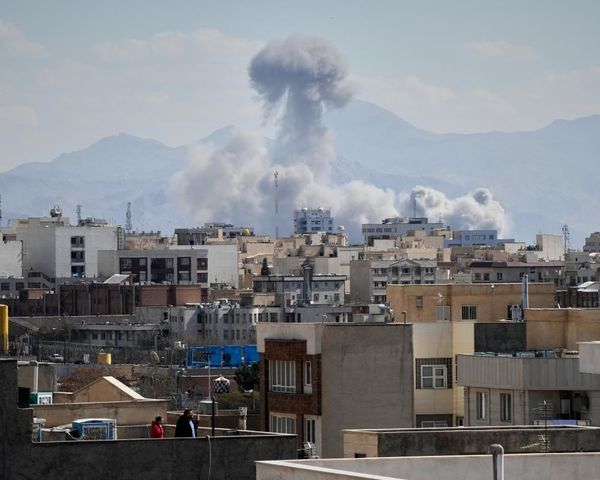
BEIRUT _ A rebel-held suburb just outside the Syrian capital of Damascus witnessed some of the deadliest fighting of the country's long-running civil war Tuesday, even as the United Nations issued a plea to end the "senseless human suffering" in the enclave.
The bombardment, believed to be a prelude to a large-scale assault aimed at routing the rebels from eastern Ghouta, left at least 194 people dead and hundreds more wounded over 48 hours, activists said. The uptick in violence comes as the government of President Bashar Assad presses its advantage and tries to reassert control over all of Syria.
Eastern Ghouta, immediately east of the capital, is one of the opposition's last remaining bastions in the country. The U.N. estimates that it is home to some 393,000 residents.
The Syrian Observatory for Human Rights, a U.K.-based watchdog that relies on a network of activists in Syria, reported that 144 people had been killed Monday, while a fresh round of violence on Tuesday had left 50 more dead.
That would make it the highest death toll since a suspected alleged sarin gas attack struck eastern Ghouta in 2015, killing hundreds. That attack brought the U.S. to within a hair's breadth of pulling the trigger on cruise missiles targeting the seat of power in Damascus.
Ghouta residents described an apocalyptic scene, with at least a dozen towns in the suburban region struck by a lethal combination of artillery, mortars and airstrikes "that hasn't stopped for two days," said Abu Khaled, a 30-year-old former teacher who was hiding in a basement with members of his extended family, in a video interview via the Whatsapp messaging service.
"The Ghouta has never witnessed such an escalation. Before you had bombs and strikes, sure, but it wasn't this hysterical targeting we're seeing now," said Abu Khaled, adding that most of the people hiding in the basement with him had not been able to leave for three days.
His camera showed a grungy space, with a rock-strewn dirt floor and no bathroom, where Abu Khaled and 34 other people, mostly women and children, had taken shelter. The sounds of the ferocious barrage could be heard in the background.
"You just sit in the basement and you feel like it's going to collapse on your head at any minute," said Abu Khaled.
Siraj Mahmoud, spokesman for Syrian Civil Defense, a team of first responders known as the "White Helmets," said the bombardment campaign had been relentless in targeting civilian areas.
"Warplanes are attacking schools, markets, with all types of weapons ... and it's methodical. It's a catastrophe," he said in a phone interview Tuesday.
Among Tuesday's victims, Mahmoud continued, was one of their own: a first responder named Firas Jumaa, who was in what the group called a "double tap" attack in the town of Beit Sawa. (In a double tap strike, a second attack hits the same target after people and first responders have gathered to help victims of the first attack.)
Mahmoud said the death toll was likely to rise significantly because of a severe shortage of medicines. Medical centers were also targeted by the strikes, with at least five hospitals rendered inoperative, according to activists. The U.N. confirmed several had been hit.
"There are no safe areas whatsoever in eastern Ghouta," said Mahmoud.
Horrific videos and images ricocheted through social media. Some depicted rows of corpses wrapped in ceremonial white shrouds; others showed first responders and panicked residents running through a fog of dust as they search for survivors among the rubble. One video shows the scene inside a basement, with a chorus of frightened women and children shouting when the camera begins to shake from the effects of a bomb.
Pro-government activists also took to social media to show the massing of troops for the impending ground incursion that Watan, a pro-government Syrian daily, said would happen some time next week while reinforcements arrived from all over the country.
The army's 3rd and 4th divisions, the Republican Guard, Russian forces, tribal fighters and pro-government irregulars are expected to take part in the offensive, pro-government activists said.
It will also include the Tiger Forces, an elite government unit whose commander, Gen. Suhail Hassan, released a video this week vowing to bring the fight to the rebels in Ghouta.
"I promise you I'm the one who will teach them a lesson in combat and fire," said Hassan. "And if I light the fire, then I say to them, await its hell.... You will see it with your own eyes."
Many in Damascus welcomed the campaign on Ghouta. Rebel units have long peppered Damascus' center with mortars and rockets. Syrian state news operator SANA reported five people were killed and 20 others wounded in militant shelling of residential neighborhoods in the capital.
"These terrorist attacks come at a time when some Western officials and others are conducting a campaign that can only described as direct support to those terrorists," said the Syrian foreign ministry in a letter to the U.N., employing Damascus' customary description for the opposition.
The U.N.'s Panos Moumtiz, the regional humanitarian coordinator for the Syrian crisis, said in a statement Monday that the humanitarian situation in Ghouta, already made dire by a yearslong siege, was "spiraling out of control."
Malnutrition rates had reached unprecedented levels, while an acute shortage of flour had pushed bread prices to 22 times the national average, said Moumtiz.
"It's imperative to end this senseless human suffering now. Such targeting of innocent civilians and infrastructure must stop now," he said.
Linda Tom, a Damascus-based spokeswoman for the U.N.'s Office for the Coordination of Humanitarian Affairs, said in a phone interview Tuesday that things "have always been bad in eastern Ghouta ... but the last couple of hours have been particularly bad."