
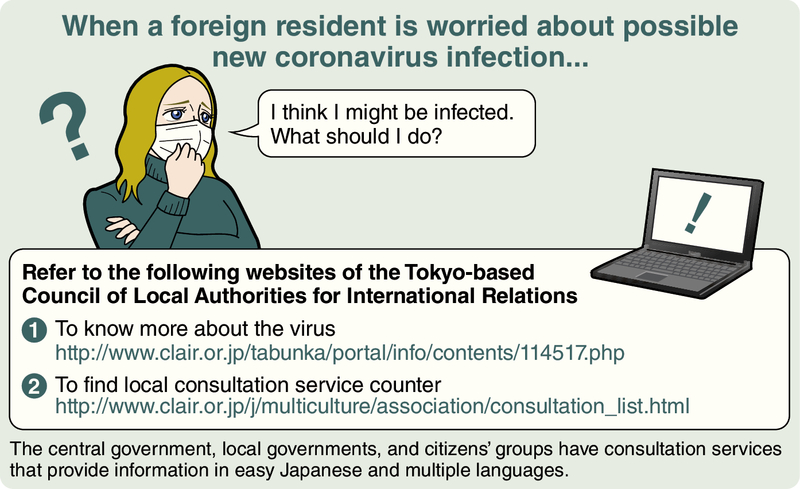
With foreign residents seeking information on the coronavirus, The Yomiuri Shimbun's medical website YomiDr. took up the issue in a regular column that runs in the newspaper. Yuko Takeda, professor at Juntendo University, and a representative from the Council of Local Authorities for International Relations offered their views in an interview with Yomiuri Shimbun staff writer Yohei Takei.
Q: A foreign acquaintance of mine is worried about becoming infected with the new coronavirus. He worries about his Japanese ability. "If I feel sick and want to get tested, what should I do," he asks.
A: How well can he speak Japanese?
Q: He can get by with say, everyday shopping. But if hard words are used or the conversation gets complicated, he seems to get lost. It might be tough when medical terminology comes up.
A: Actually, information about the coronavirus specifically for foreigners not familiar with Japanese is available from the central government, prefectures, and civic groups that promote international exchanges. The website of the Council of Local Authorities for International Relations (CLAIR) is well organized and easy to read.
Q: That's great. What information is on the website?
A: For explanations of the illness, materials have been translated into 18 languages, from English and Chinese to Burmese and Khmer. It also provides links to websites useful for foreigners of other organizations.
Q: Can a foreigner consult with someone by phone?
A: The council's website has a list of consultation service counters located in each prefecture and major cities.
Q: He's very worried whether he'll be able to understand what he's being told when he is tested.
A: That's true. But recently, medical facilities and public health centers have started to try to use "easy Japanese" and avoid using difficult technical terms as much as possible.
Q: How "easy" is it?
A: For example, when taking a PCR test, the staff doesn't say, "I'm going to collect a specimen with this test kit." Instead, a cotton swab will be shown and the person will be told, "I'm going to put this in your nose." After the test is finished, all that is said is: "We'll have the result tomorrow. We will call you."
Q: I see.
A:The key points of "easy Japanese" are: 1) shorter sentences, 2) use Japanese words with kun-yomi readings that upon hearing are easily understood, and 3) hold the medical device in hand and indicate it as "this" without giving an explanation. If you do a search for "easy Japanese PCR test" on YouTube, videos can be found designed for training medical personnel. Those can help in the preparation for PCR testing.
Read more from The Japan News at https://japannews.yomiuri.co.jp/








.png?w=600)



