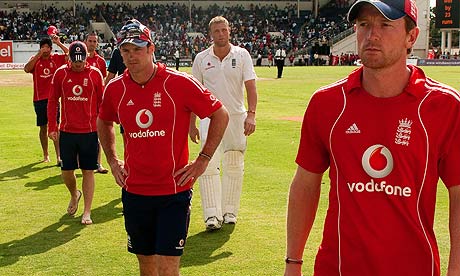
England have been this way before. It was 11 months ago in sleepy Hamilton that against the odds they lost the first Test of their series against New Zealand. They were not so spectacularly inept as they were on Saturday but that was still an alarmingly tepid performance.
Yet England went on to win the New Zealand series by claiming victory in Wellington and Napier. That might be some sort of consoling parallel for a side still bewildered by Saturday's collapse. But the parallel is not close enough for comfort.
New Zealand were, and still are, a mediocre Test team. In that series their batting leant upon a relative novice, Ross Taylor, and a fading veteran, Stephen Fleming. Provided England performed moderately well there was every chance that they could recover from the debacle at Hamilton.
The same criteria do not apply in the Caribbean even though West Indies had won only two of their previous 30 Tests before arriving at Sabina Park. Even during their slump West Indies have had three or four supremely talented cricketers in their side, of whom Shivnarine Chanderpaul alone has done justice to his talent in the last couple of years. Their potential, if not their performances, has always been greater than New Zealand's, but for too long they had the most frustrating of combinations: good players, poor team.
But now there is the scent of something special happening in the Caribbean. Leading the renaissance at an amble, of course, rather than a gallop, is the captain Chris Gayle. According to the Delphic oracle of the Caribbean, Tony Cozier, there were only two men who five years ago spied the leadership qualities of Gayle. They were Brian Lara and Steve Waugh, not the worst of referees.
Most of the rest dismissed Gayle as a self-indulgent cricketer of prodigious talent who was disinclined to harness his ability. In the field, barely moving a muscle, he often looked disinterested; when batting he appeared without remorse when one of those swipes failed to come off.
Yet now Gayle is the undisputed catalyst for the revival. Along with the captaincy his batting has matured beyond measure though fortunately he still allows himself the odd spectacular shot – such as driving Andrew Flintoff's second delivery into the George Headley Stand. For England his is the most coveted wicket on this tour.
Gayle speaks more readily now; until appointed captain he was often monosyllabic in public. But there is not too much of the modern psychobabble in his observations. "We are not into too much talking, too much meeting but we understand each other a bit more," he says. "We aim to play simple, basic cricket."
Gayle's second match-winner after Jerome Taylor was Sulieman Benn, who before the match was yet another West Indian spinner on trial. Gayle has handled him neatly: "He was under a lot of pressure in this match but Benn didn't know that – because I didn't tell him."
The new Gayle can be pragmatic. In the wake of the victory he seemed especially proud of the fact that on the third day his West Indies side only added 192 runs, a gritty, often tedious and distinctly un-Caribbean way of playing the game but, in hindsight, a crucial phase of the match. "The expectations are huge now," he said, "and we are not going to be lackadaisical." In the past Gayle did not seem to have the energy to be lackadaisical.
So where now for England and can they learn from past calamities? After the Trinidad humiliation in 1994 (46 all out) captain Mike Atherton defiantly picked exactly the same team for the next Test in Barbados and somehow England contrived to win in Bridgetown for the first time in six decades.
In Melbourne two years ago they hit rock bottom against Australia. In two innings with the same first six that played at Sabina Park England mustered 320 runs in two innings and were defeated in three days by an innings and 99 runs. Ten thousand angry English punters prowled the streets of Melbourne wondering what to do. What did the ECB do? Well they set up a committee, of course, under the chairmanship of a fine Scottish golfer. And they dropped Matthew Hoggard.
Neither of these responses seems to fit this time. Picking the same team, as Atherton did, can scarcely be an option. The late Eighties and early Nineties was an era of scattergun selection and Atherton was eager to make the point that there would be more stability in his regime. But in 2009 England are now suffering from their constipated approach to selection. They have grown terrified of any movement.
Moreover it is a little early to set up another committee to review how English cricket is run in order to placate the swelling band of critics. And sadly Hoggard is not here. So we can't drop him.