In 2026, voters will decide six ballot measures related to criminal sentencing, penalties, and bail requirements. Each would make criminal justice policy more punitive by increasing penalties or expanding the circumstances under which courts could deny or restrict bail.
Four of the measures concern bail policy. Voters in Alabama approved Amendment 1 on May 19, allowing bail to be denied for defendants charged with certain weapon-discharge offenses or solicitation, attempt, or conspiracy to commit murder. Voters in Indiana, Louisiana, and Tennessee will decide three additional bail-related measures on November 3:
- Indiana : Allow bail to be denied for individuals charged with crimes when the proof is evident or the presumption is strong, and when the accused poses a substantial risk to another person or the community.
- Louisiana : Prohibit post-conviction bail, also known as an appeal bond, for defendants convicted of aggravated offenses against minors.
- Tennessee : Remove the right to bail when the presumption of guilt is great, and the defendant is accused of acts of terrorism, second-degree murder, aggravated rape of a child, grave torture, or any other offense for which a convicted individual would be required to serve at least 85% of their sentence before release.
The other two measures, both in Colorado, would increase criminal penalties. One would increase penalties related to fentanyl offenses. The other would require life in prison without parole or release for persons convicted of human trafficking a child for sexual servitude.
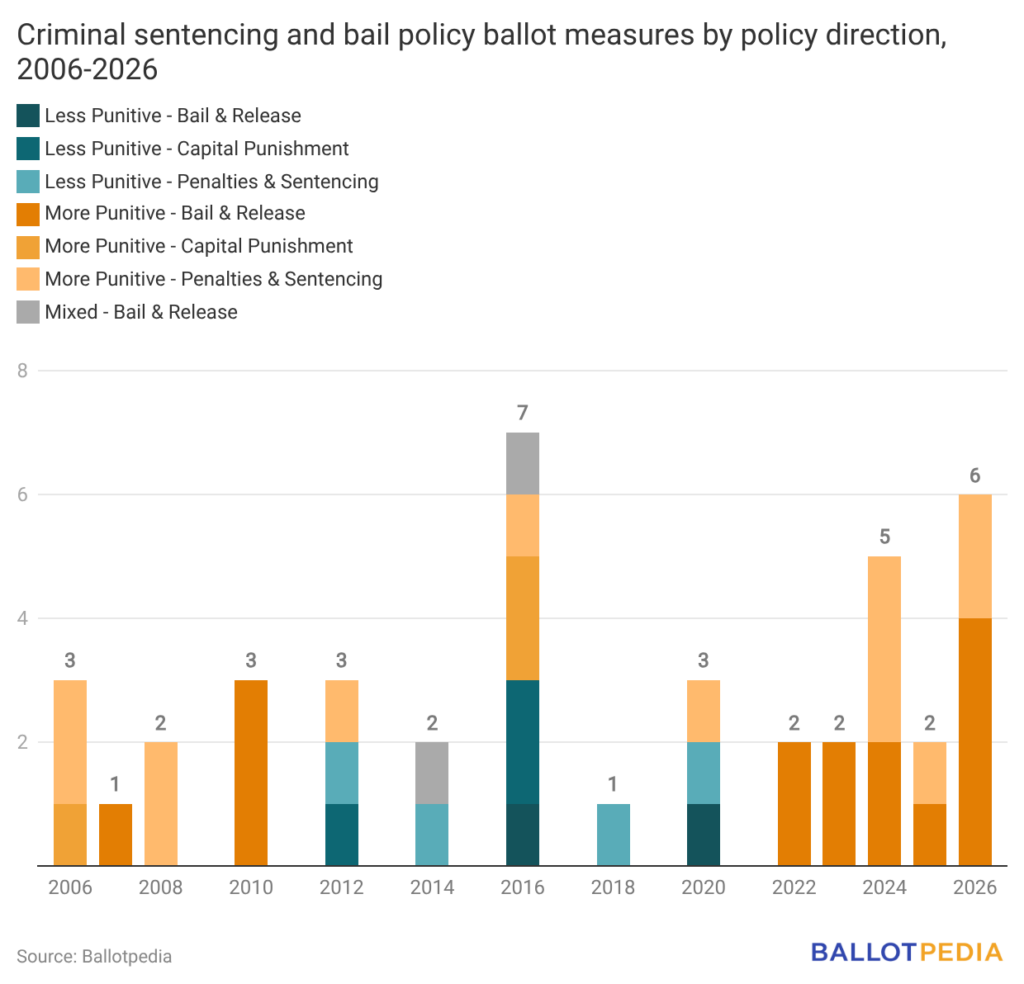
The ballot measures are part of a broader shift in criminal justice ballot measures since 2022. Between 2012 and 2020, ballot measures proposing less punitive policies outnumbered those proposing more punitive ones: 11 measures decreased or proposed to decrease penalties or bail restrictions, while five increased or proposed to increase them.
From 2022 through 2026, that pattern reversed. All 16 measures related to these topics were classified as more punitive, with most (12 of 16) focused on expanding the circumstances under which bail could be denied.
Support and opposition
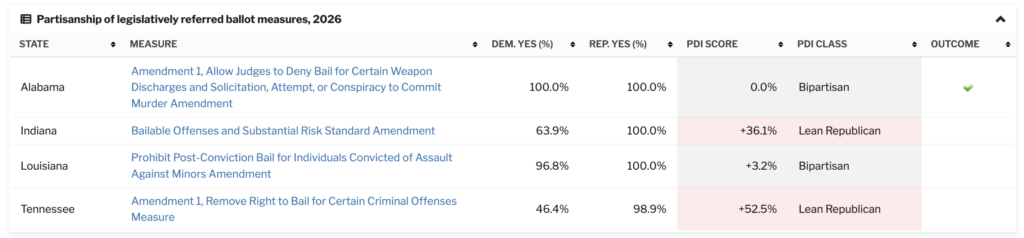
Of the six ballot measures, state legislatures referred four to the ballot. Alabama Amendment 1 received unanimous support from legislative Republicans and Democrats. The Louisiana Prohibit Post-Conviction Bail for Individuals Convicted of Assault Against Minors Amendment received support from legislative Republicans, and 96.8% of Democrats (one voted "No"). The constitutional amendments in Indiana and Tennessee received more divided support—63.9% of Democrats supported the amendment in Indiana, while 46.4% supported the amendment in Tennessee. Republicans supported the amendment in Indiana, and 98.9% (one voted "No") supported the amendment in Tennessee.
The other two ballot measures, both in Colorado, are citizen-initiated statutes. Advance Colorado, a nonprofit organization that describes itself as opposing "liberal special interest groups and politicians have turned Colorado into a testing ground for some of the most liberal policies and plans in the nation," is leading the campaign in support of the Penalties for Fentanyl Sale and Possession Initiative. Coloradans for Real Safety Solutions is leading the campaign against the initiative, with funding from the Signal Behavioral Health Network.
Protect Kids Colorado is leading the campaign in support of the Require Life in Prison for Human Trafficking of Minors Measure, with funds from the Protect Kids Colorado 501(c)(4). Currently, there is no campaign against the ballot initiative.
Historical context
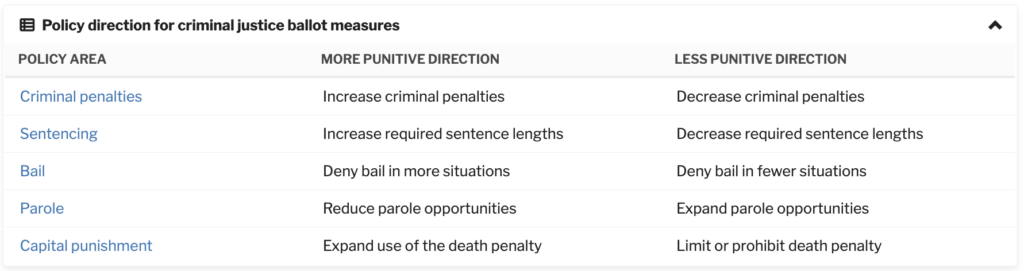
Between 2006 and 2026, 42 state ballot measures concerned criminal sentencing, penalties, and bail and release policies—31 (74%) made policies more punitive and nine (21%) made policies less punitive. Two (5%) were mixed, with some provisions moving in a more punitive direction and others in a less punitive direction. Those defined as more punitive would increase criminal penalties, expand circumstances under which bail can be denied, or reduce parole opportunities. Those defined as less punitive would decrease criminal penalties, limit circumstances under which bail can be denied, or increase parole opportunities.
Similar terminology has been used in criminal justice research and policy analysis to compare sentencing, incarceration, and penalties across time periods, states, and regions. Other terminology is used in political contexts. Some conservative-aligned organizations and officials describe these policy differences using terms such as tough-on-crime versus soft-on-crime. Some progressive-aligned organizations more often contrast policies using terms like investment, rehabilitation, and diversion versus punishment, criminalization, and incarceration.
The following table defines policy direction for criminal justice ballot measures by policy area:
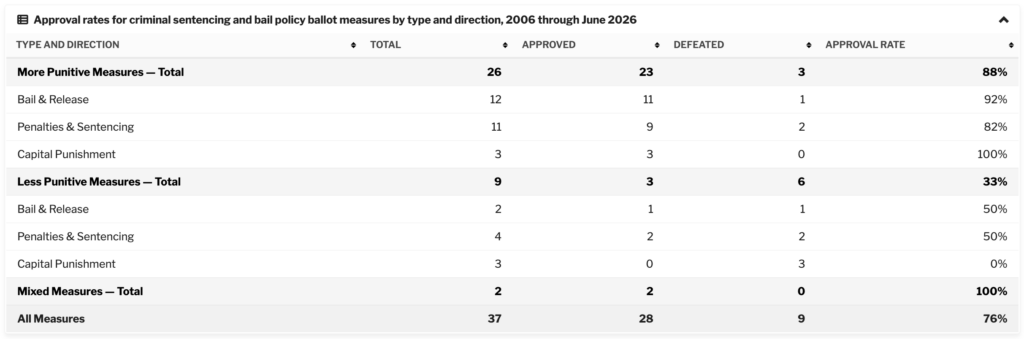
More punitive measures have been approved at a higher rate than less punitive measures. Voters approved 23 of 26 more punitive measures, or 88%, compared to three of nine less punitive measures, or 33%. Voters also approved both mixed measures.
Approval rates also varied by policy type. Among more punitive measures, voters approved 11 of 12 bail and release measures (92%), nine of 11 penalties and sentencing measures (82%), and all three capital punishment measures (100%). Less punitive measures were approved less often. Voters approved one of two bail and release measures (50%) and two of four penalties and sentencing measures (50%), while all three capital punishment measures were defeated (0%).
Additional measures
These six measures will likely be the only 2026 ballot measures concerning criminal sentencing, penalties, and bail. One initiative was approved for signature gathering in Oregon, but its campaign has reported only 1,351 of the 117,173 required signatures to state election officials. The deadline is July 2, 2026. All six certified measures would increase criminal penalties or expand the circumstances in which bail could be denied or restricted, continuing a pattern that began in 2022 and reached its highest number of measures in 2026.
Additional reading