
If you’ve been playing Overwatch and are yearning to try out competitive play, then you should consider investing some time in the Competitive game mode. This mode is for players who always want to communicate with their team and try their hardest to win.
Many factors determine what rank you’re placed into, how you can increase your rank, and the ranked rewards you’ll earn. To make things easier to understand, here is everything you need to know about the rank system in Overwatch.
Table of contents
Overwatch Competitive ranking system, explained
Ranks
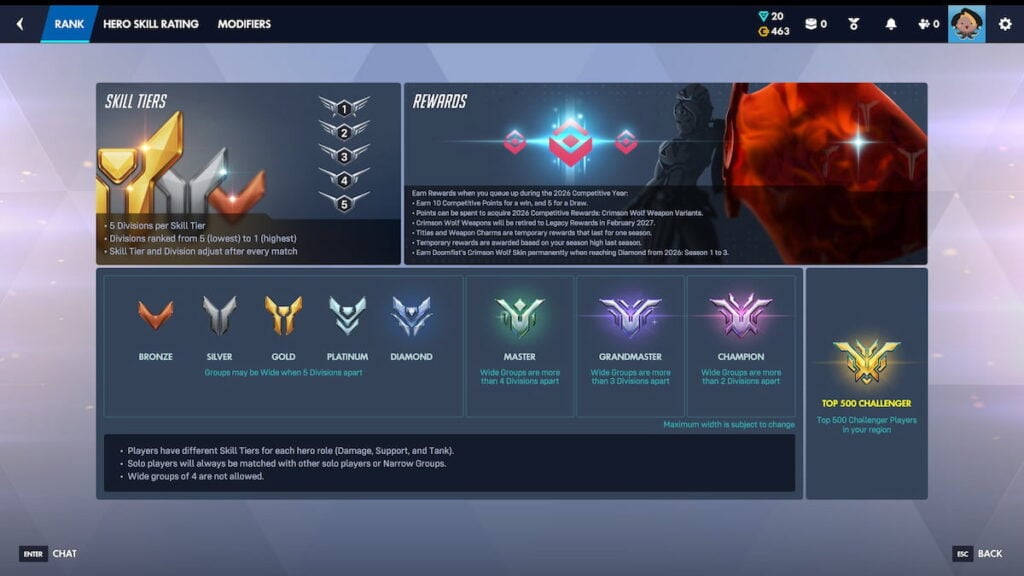
There are a total of nine ranks in Overwatch, with Bronze being the lowest and Champion the highest. All of these ranks are further split into five divisions that indicate your skill level within each rank.
Here is a table that details all the Overwatch ranks and their divisions:
| Rank | Lowest Tier | Highest Tier |
|---|---|---|
| Bronze | Five | One |
| Silver | Five | One |
| Gold | Five | One |
| Platinum | Five | One |
| Diamond | Five | One |
| Master | Five | One |
| Grandmaster | Five | One |
| Champion | Five | One |
| Top 500 Challenger | N/A | N/A |
While the Top 500 Challenger is included in the table, this tier operates differently from all other ranks. Top 500 is more like a title than a rank, and it designates the best 500 players in your specific region. Rankings among the Top 500 players are typically updated every day and are extremely competitive.
Placements
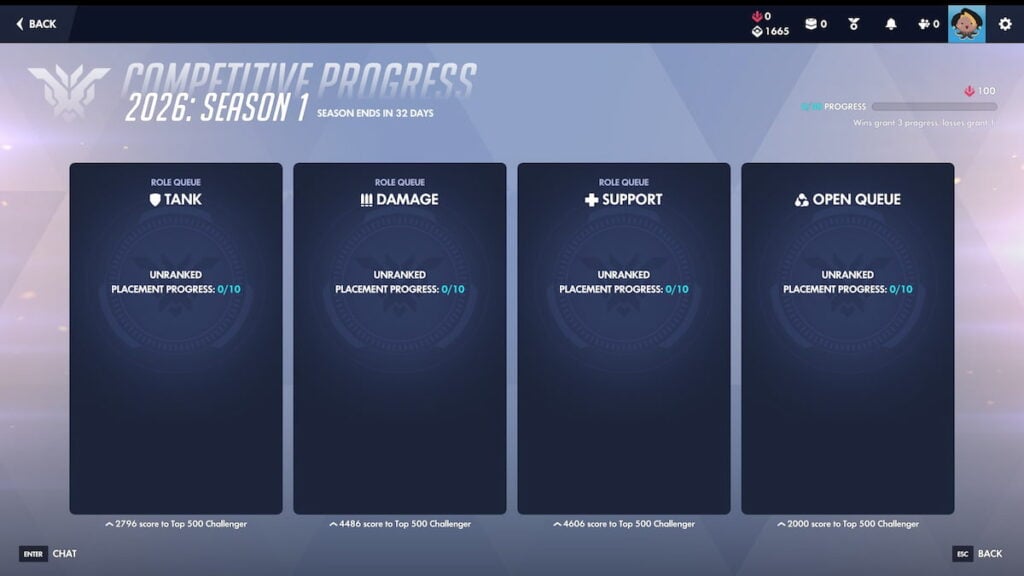
When you first start Competitive, you need to play 10 matches to get your first rank. As you continue to win or lose games, you earn Ranked Progress after each match that changes your placement within divisions and ranks.
Since there are different roles and queues within Overwatch, you get independent ranks for each role (Tank, Damage, and Support) and the Open Queue. This means that your Support rank could be Grandmaster, while your Tank rank is only Bronze.
Your rank resets twice per year, but you’ll still have to do placement matches after each ranked season. Your MMR (invisible rating that leads you towards your rank) may also slightly decay if you take a prolonged break, but it will quickly catch you up to the right rank.
Modifiers
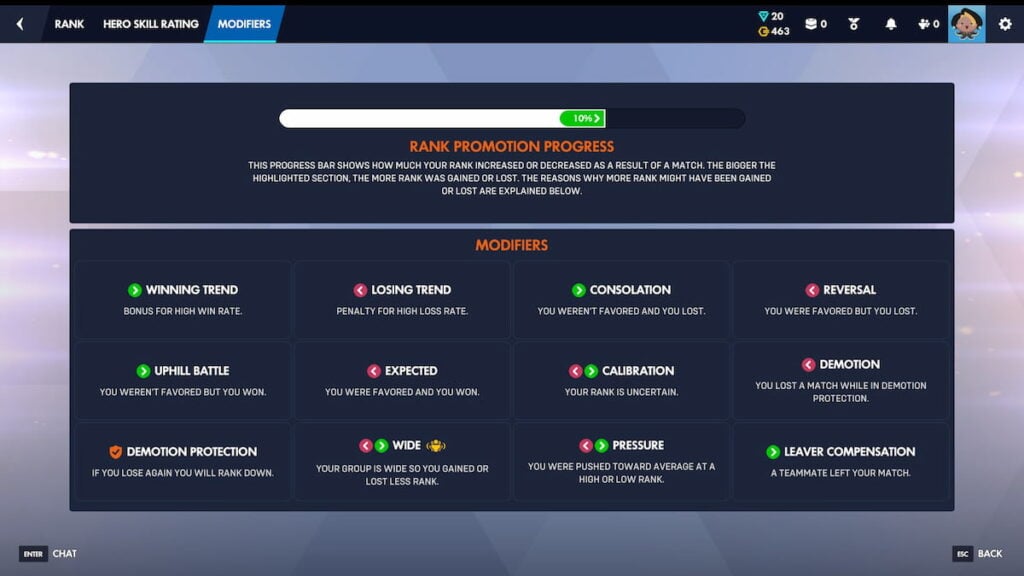
As if gaining and losing Rank Progress wasn’t hard enough, you also have to contend with different Rank Modifiers after every ranked match. These modifiers directly affect the amount of rank promotion progress you gain or lose, so it is important to understand what each status entails.
Here is a full breakdown of all the Rank Modifiers in Overwatch:
| Modifier | Explanation |
|---|---|
| Winning Trend (Positive) | Bonus for winning many games in a row. |
| Losing Trend (Negative) | Penalty for losing many games in a row. |
| Calibration (Positive or Negative) | Your rank is still uncertain. You may see drastic gains or losses in Rank Progress. |
| Uphill Battle (Positive) | You weren’t favored, but you won the game. |
| Reversal (Negative) | You were favored to win, but you lost. |
| Leaver Compensation (Positive) | A teammate left your match. |
| Consolation (Positive) | You were favored to lose, and you lost. |
| Expected (Negative) | You were favored to win, and you won. |
| Demotion (Negative) | You lost your match while in Demotion Protection. |
| Demotion Protection (Positive) | Losing the next match will not demote you. |
| Wide (Positive or Negative) | Your group is considered wide, so you gain or lose less rank. |
| Pressure (Positive or Negative) | You gain less progress at the top of the ranked ladder and more at the bottom tiers. |
All of these Rank Modifiers last for different amounts of time, depending on what triggers the specific effects. For example, win or loss streak modifiers last until the streak is broken, while reversal or expected modifiers are only applied to a singular match.
It’s fruitless to seek out specific modifiers while climbing the ranked ladder, but it’s important to know how this system works if you want to calculate how much progress you’ll gain or lose.
Group restrictions
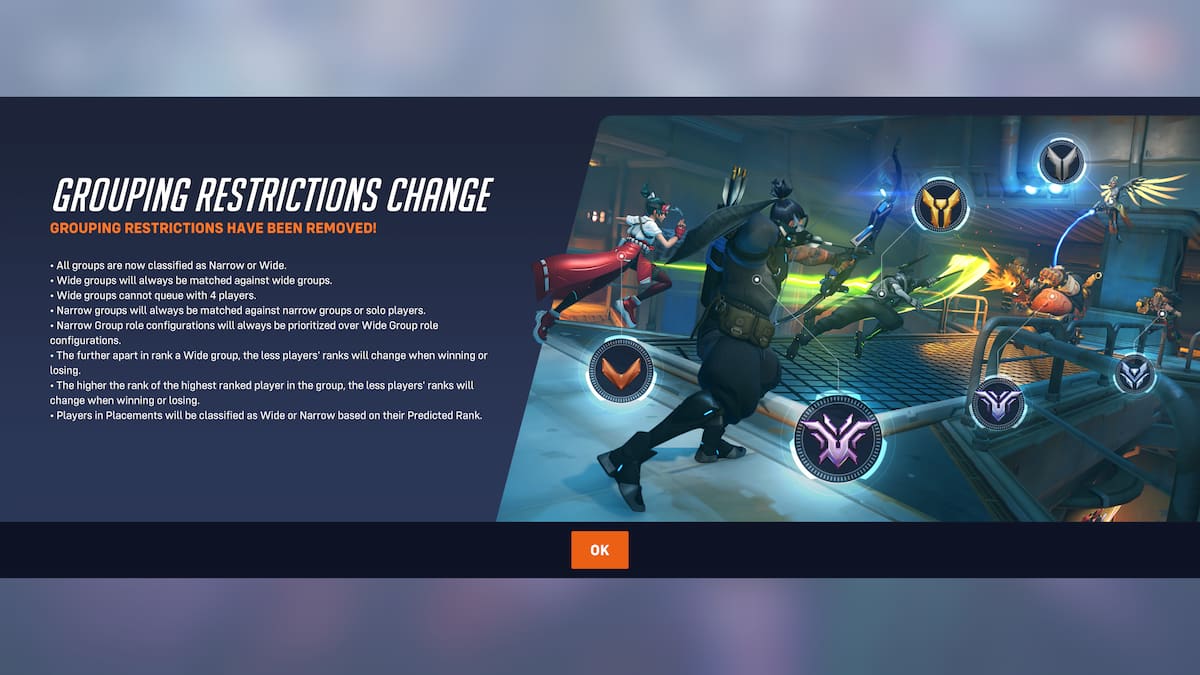
There are no longer any grouping restrictions in the ranked gamemode, meaning that players of almost any rank can play together. Competitive groups are classified into two different categories: Narrow and Wide, depending on the rank disparity.
Here’s what may be considered a Wide group in every rank:
- Bronze to Diamond: Five divisions apart
- Master: Four divisions apart
- Grandmaster: Three divisions apart
- Champion: Two divisions apart
Wide groups are affected by the Wide modifier, which affects the rank progress, while Narrow groups get priority when it comes to their role selections. It’s important to note that Wide groups of four players are not allowed.
Overwatch Stadium Competitive ranking system, explained
Ranks
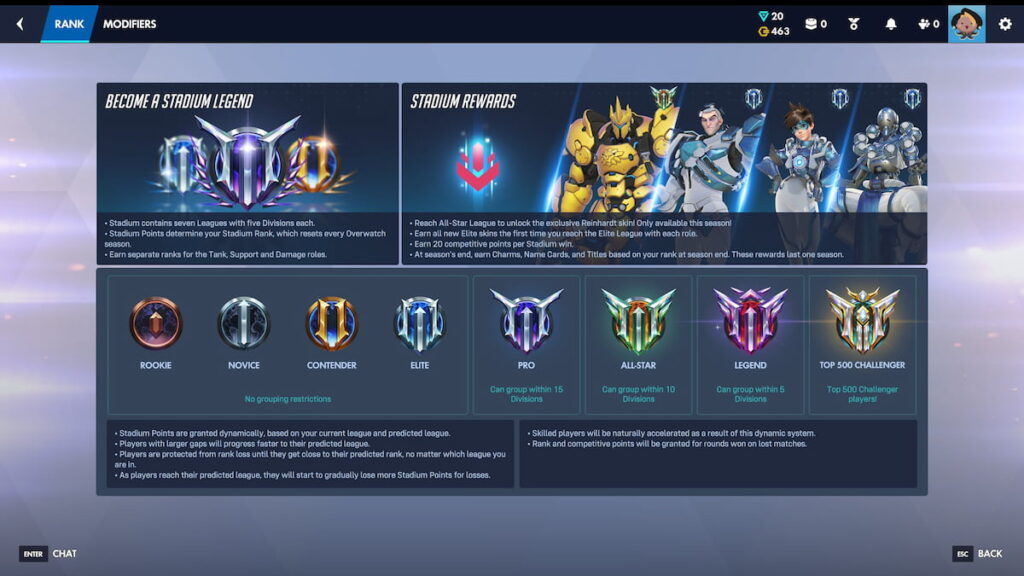
The rank system in Stadium mode is more streamlined compared to regular Competitive. There are seven ranks, ranging from Rookie to Top 500 Challenger. Similarly, every rank (except for the Top 500) has five divisions for you to climb through.
Here is a table that details all the Overwatch Stadium ranks and their divisions:
| Rank | Lowest Tier | Highest Tier |
|---|---|---|
| Rookie | Five | One |
| Novice | Five | One |
| Contender | Five | One |
| Elite | Five | One |
| Pro | Five | One |
| All-Star | Five | One |
| Legend | Five | One |
| Top 500 Challenger | N/A | N/A |
Placements
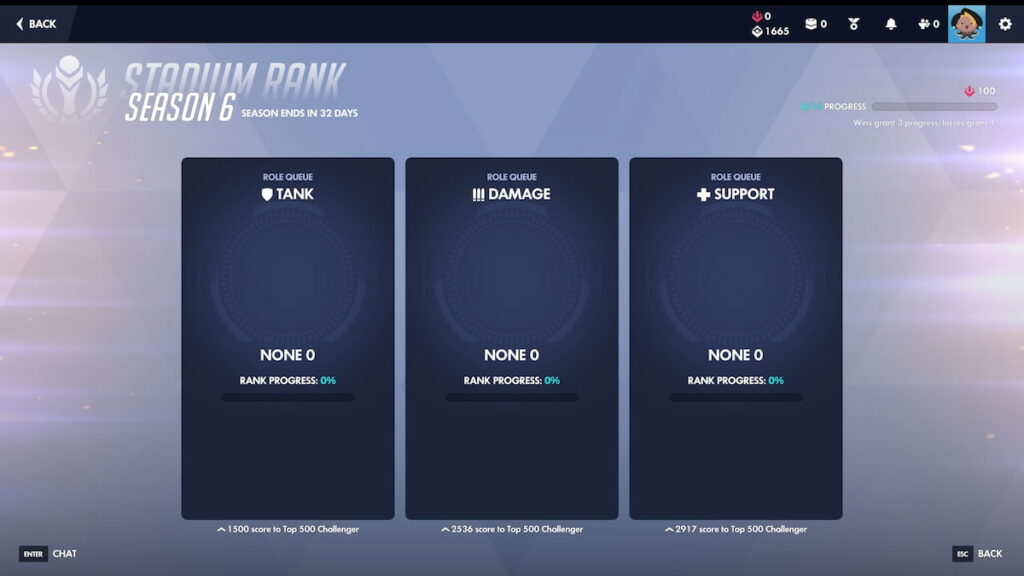
Unlike regular Competitive, Stadium doesn’t have a specific number of games you must play to get your rank. Everyone starts as a Rookie and climbs as high as possible throughout the season, but the game adjusts the gains and losses based on your predicted rank. The game also protects you from rank loss until you get close to the predicted rank.
Modifiers
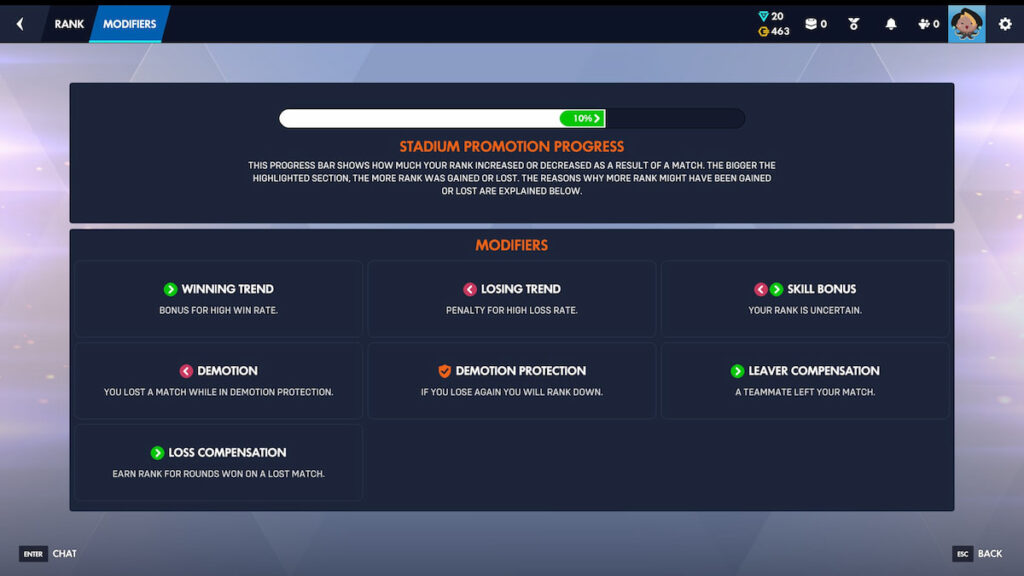
Stadium also has fewer modifiers that affect your promotion progress. It doesn’t have modifiers like Expected, Consolation, and others that set an expectation for you to win or lose and then adjust your progress based on the result.
Here is a full breakdown of all the Rank Modifiers in Overwatch:
| Modifier | Explanation |
|---|---|
| Winning Trend (Positive) | Bonus for winning many games in a row. |
| Losing Trend (Negative) | Penalty for losing many games in a row. |
| Skill Bonus (Positive or Negative) | Your rank is still uncertain. |
| Leaver Compensation (Positive) | A teammate left your match. |
| Loss Compensation (Positive) | Earn rank for rounds won in a lost match. |
| Demotion (Negative) | You lost your match while in Demotion Protection. |
| Demotion Protection (Positive) | Losing the next match will not demote you. |
Group restrictions
Narrow and Wide groups don’t exist in Stadium. Instead, the game mode has traditional restrictions on division disparity in a single lobby. If you and your friends are too many divisions apart, you won’t be able to play together.
Here are the group restrictions in Overwatch Stadium:
- Rookie to Elite: No restrictions
- Pro: Can group within 15 divisions
- All-Star: Can group within 10 divisions
- Legend: Can group within five divisions
How to rank up in Overwatch
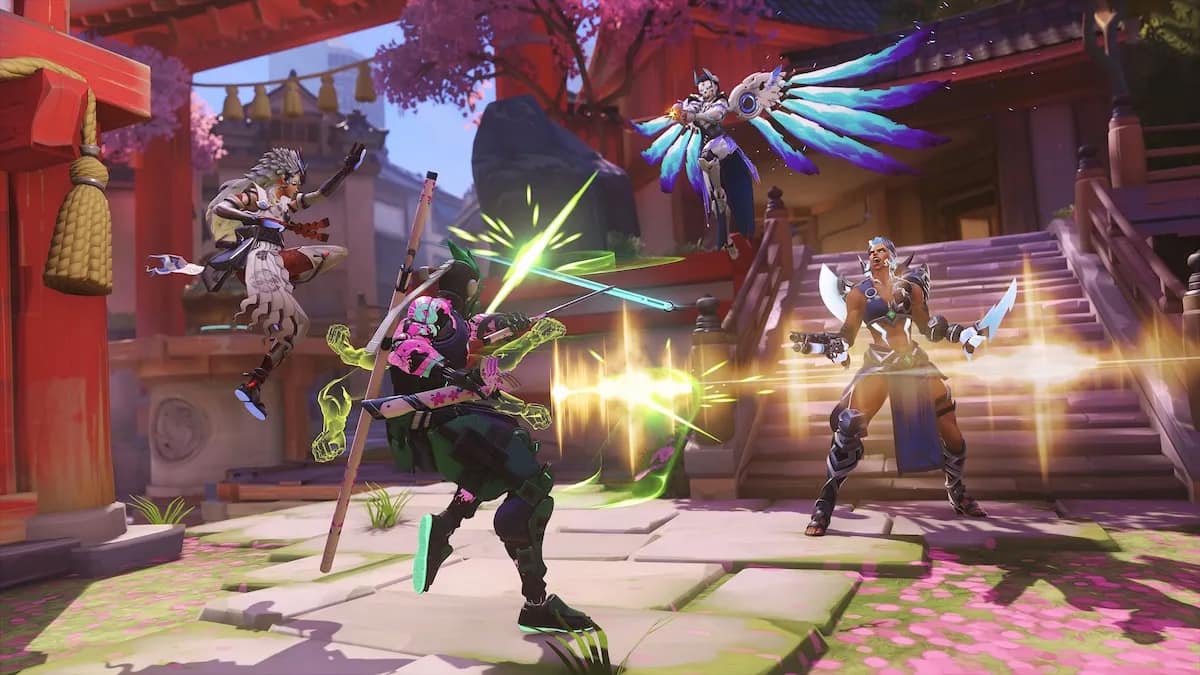
To put it simply, if you want to rank up in Overwatch, then you’ll have to win your ranked games. While you can’t guarantee a victory after every match, there are some tips you can follow to become a better player and teammate.
Play with friends
Competitive games become significantly easier when you have people you can depend on. If you and your friends are at similar skill levels, queue up with them.
Playing with people you already know means that you’re more likely to communicate with them, thus increasing your team’s overall chances of success. Keep in mind that if you and your friends have drastically different ranks, you can still play together at the risk of gaining less Rank Progress.
Communicate with your team
Using the ping system to mark enemies’ locations, encourage the team to group up, and coordinate ultimates drastically increases the team’s coordination. Ideally, you might also want to use voice chat for quicker communication.
Practice makes perfect
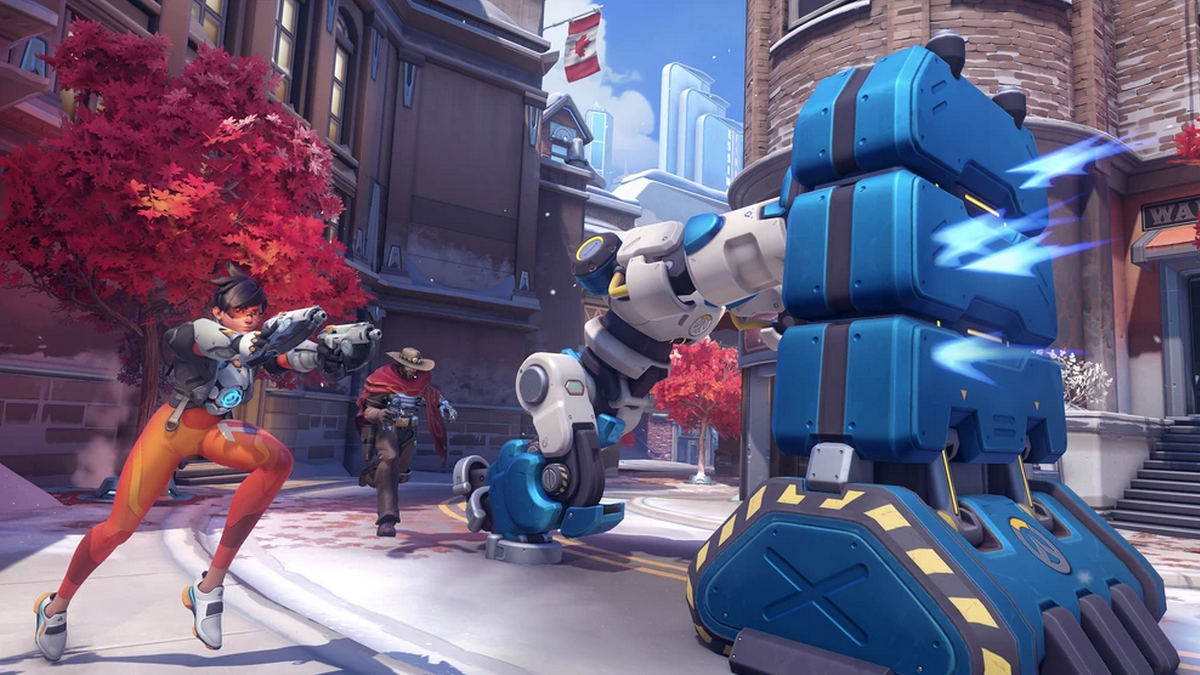
Certain heroes in Overwatch require more mechanical skill than others. You improve it by practicing your aim and skill combos in the practice range, or by simply playing more games. Competitive environment can be quite different from regular Quick Play, so you need more time to adjust to the new hero.
Take a break
Sometimes, it’s better to step away from ranked and play some quick matches, or even an entirely different game. If you find yourself on a significant loss streak, your mental outlook on ranked can turn sour quickly, thus negatively impacting how you play your matches.
All Overwatch Competitive rewards
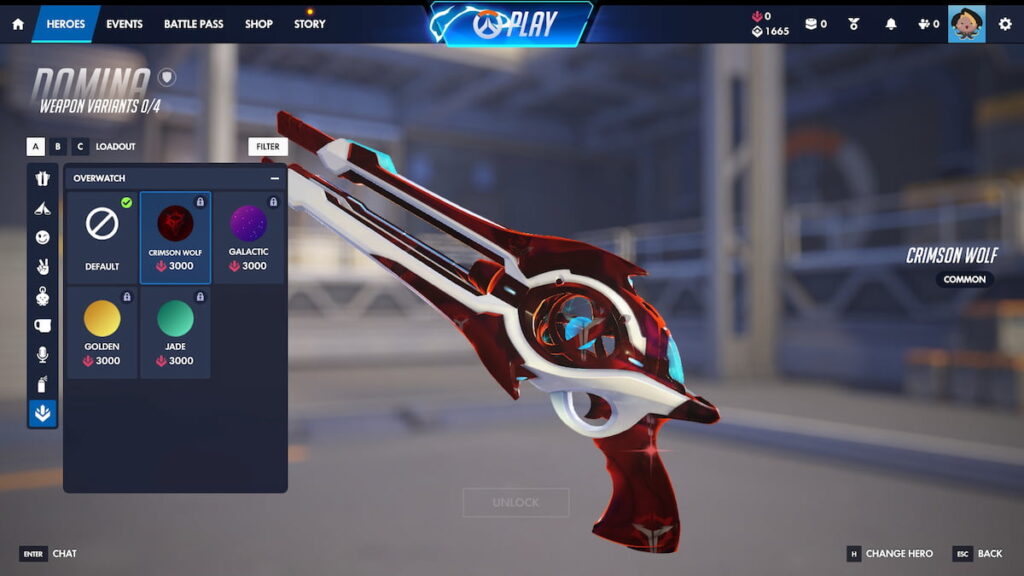
As you play Competitive games, you earn Competitive points that you can use to unlock cosmetic rewards. These points are automatically converted to Legacy Competitive Points at the end of every Competitive year.
Here is a breakdown of the Competitive Points you can earn while playing Competitive:
- Win: 15 CP
- Draw: Five CP
- 30 progression points (you get three per win, one per loss): 100 CP
Here is a breakdown of the Competitive Points you can earn while playing Stadium Competitive:
- Win: 20 CP
- 15 progression points (you get three per win, one per loss): 100 CP
Currently, you can spend 3,000 Competitive Points or Legacy Competitive Points to purchase any Golden, Jade, Galactic, or Crimson Wolf weapon skin. However, you can’t use a mixture of these two currencies to purchase them.
There are other rewards you can earn by playing Competitive game modes. You get a title for every rank, starting with Gold (Elite in Stadium), and a charm for every rank, starting with Platinum (Rookie in Stadium). In Stadium, reaching Elite and All-Star also grants exclusive skins.
Charms from regular Competitive as well as titles from both modes are temporary rewards that reset every season.