A trip to Castle Cary market reminded me of a retired dairy farmer who told me, years ago, that long before websites and complications like milk quotas or the common agricultural policy, his only paperwork had been a cheque book and a paying-in book, and, once a week, he had hitched his horse to the wagon and driven the family into Castle Cary on market day.
There has been a market in the town since the 14th century, and now, on a market day in 2015, and on the cobbles outside the market house, I met another farmer. This one has a regular stall where her range of sausages, charcuterie, soups and pies drew my greedy eye. I joined the queue and she told me that the bulk of her sales these days were made online. Later, on her website, I read of her rare breed pigs, sheep and cattle ranging free in nearby fields.
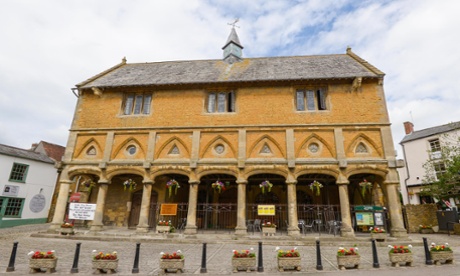
Behind the market house’s arcade and Tuscan columns, I went into the enclosed space called the shambles, where a butcher’s block survives from the days when animals were slaughtered nearby and butchered here.
The market house, mostly dating from 1855, has proved, like the local farmers, adaptable to changing times. On the ground floor, the shambles area became at one time the police house, with a cell for malefactors, but now has been transformed, with glazed roof and underfloor heating, into a space for meetings, lectures or concerts, while the undercroft, open to the street, is an overspill area and site for market stalls.
A winding stair leads to the museum, and I spotted, from Bailey Hill, behind the market house, the fire escape that leads to a small door in the top floor. I remembered my friend telling me that, as a young schoolboy and wartime evacuee, he and his fellows would creep up that fire escape into the room where weekly film shows were held – a few minutes late so as to avoid paying.