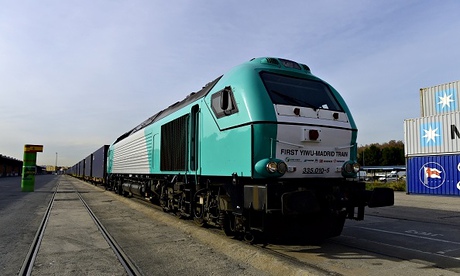
Everyone loves a train journey, but the longest railway journey in the world might just be the most unromantic one, too. It would be snide to call it the Plastic Tat Track, but the new route connecting eastern China with Spain is hardly a civilisation-changing Silk Road.
A freight train bringing 82 containers of Christmas decorations and plastic trinkets to Madrid from the city of Yiwu, famed for its booming “small commodities market”, has belatedly returned home at the weekend with an appetising cargo of jamón, olive oil and red wine for China’s chorizo-munching classes.
The 8,077-mile, 21-day route across Kazakhstan and through Russia, Belarus, Poland, Germany and France comfortably outstrips the Trans-Siberian railway – which connects Moscow to Vladivostok on Russia’s east coast – and is a striking example of China’s grand vision for global railways.
There are already two regular direct freight trains to Germany, the experimental Yiwu-Madrid route is planned to run twice a month and China is reportedly building or planning high-speed rail links in at least 20 countries.
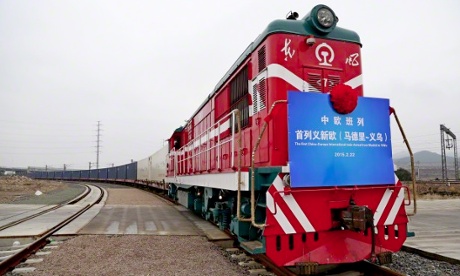
Supporters of the jamón journey say Chinese products will become even cheaper (Yiwu is the world’s largest small commodity market; Madrid is Europe’s biggest) because the train is significantly quicker than sea routes, which take up to six weeks, and cheaper than air travel. It is also far more environmentally friendly than lugging the stuff by lorry, reducing CO2 emissions by 62%.
But there are a few snags, as Trans-Siberian patriots in the Russian media were quick to point out. Changes in track gauge mean the freight has to be loaded onto different wagons at the border towns of Dostyk (Kazakhstan), Brest (Belarus) and Irún (Spain). On the inaugural journey, the engine also had to be changed every 500 miles. Meanwhile, El Pais reports that the train’s return to China – originally planned in time for Chinese new year on 19 February – was delayed because of high costs (it is 20%-30% more expensive than sea travel) and the chilly Russian winter, with sub-zero temperatures imperilling the precious cargo of red wine. Today’s monster-ships also carry up to 18,000 20ft containers, which is an awful lot of trains.
Given that Yiwu’s exports and imports increased by 28% in 2014, according to the Chinese state news agency Xinhua, the record-breaking railway may yet fly. It is certainly an epic monument to the lengths we will go to meet our unfulfillable desire for things we don’t need.