Afternoon summary
- Alistair Carmichael, the Lib Dem Scottish secretary, has told MPs that the political parties should build “the broadest possible consensus” as they develop plans for devolution to England. His comment, an implicit rebuke to his Conservative coalition colleagues, who have made it clear that they intend to exploit the “English votes for English laws” issue for party political purposes, came as he delivered a statement about the government’s command paper on further devolution for Scotland.
-
Ukip support has surged after its strong showing in two byelections last week, causing particular problems for the Conservatives’ ratings, according to a Guardian/ICM poll. As Tom Clark reports, Ukip has bounced up five points on last month, with 14% of those polled now saying they would vote for the party. Labour remains at 35% and much of the advance made by Nigel Farage’s party appears to come at the expense of the Conservative party, which drops back two points to 31%. The telephone poll was conducted after Douglas Carswell’s victory for Ukip in the Clacton byelection last week. A poll for Lord Ashcroft published this afternoon puts Labour on 32% (up 2 points from last week), the Conservatives on 28% (down 4), Ukip on 19% (up 2), the Lib Dems 8% (up 1) and the Greens 5% (down 2).
That’s all from me for tonight.
Thanks for the comments (especially with those persevering when Beta is on the blink.)
Labour’s Chris Bryant asks what analysis Carmichael has made of “English votes for English laws”. Wouldn’t it be odd if Scottish MPs were barred from voting on English-only laws, but Scottish peers were allowed to carry on voting on English-only laws.
Carmichael says, when parliament has devolved, it has devolved to bodies using a system of proportional representation.
He says it is hard to devolve within the legislature without devolving within the executive.
And that’s it. The statement is over.
I’ll post a summary soon.
Carmichael says he cannot stress too often “the importance of building the broadest possible consensus” for constitutional reform. That has happened in Scotland, he says, and it has taken decades. He suggests it needs to happen in England too if parties want to address the English question.
Sir James Paice, a Conservative, says the Scottish parliament effectively have representation without taxation. It needs tax raising powers, he says.
Carmichael says he has told Lord Smith that he will get any resources he needs to allow his commission to do its work.
Crispin Blunt, the Conservative MP, says Carmichael has no mandate from him to devolve further powers to Scotland while expecting his constituents to bankroll it, and while England itself is not getting further powers.
Carmichael says he can understand the need for a discussion about English devolution. But that discussion cannot and will not hold up further Scottish devolution, he says.
Carmichael says, if the SNP do not make it clear that they accept the referendum result, they will suffer.
Carmichael says further Scottish devolution will not be tied to progress on the English question. Few things would be worse for politics than the three main parties reneging on their promise to Scotland, he says.
The DUP’s Ian Paisley says he welcomes the decision of his Scottish “kith and kin” to vote to stay in the UK. Will the Smith commission consider what is in the best interests of the UK as a whole too?
Carmichael says Paisley can make a submission to the Smith commission. But the commission will not make recommendations about Northern Ireland.
Labour’s Gregg McClymont asks Carmichael if he will bring forward the publicity campaign intended to tell Scots about the impact of the new tax powers that Edinburgh is going to get under the Scotland Act 2012.
Carmichael says he will consider this.
Carmichael says the SNP leadership should make it clear that they will not be revisiting the independence argument again.
Pete Wishart, the SNP MP, says three quarters of Scots want devo max, everything devolved apart from defence and foreign affairs.
Carmichael says he welcomes the fact the SNP is taking part in this process. But 60% of people in Wishart’s area rejected independence. If the SNP tries to “subvert” this process by trying to get independence through the back door, the SNP will pay a price for that, he says.
Liam Fox, the Conservative former defence secretary, asks about the need to address the English votes for English laws issue. There is already an anomaly with Scottish MPs voting on English health measures, but not Scottish health measures.
Carmichael says the government is committed to giving Scotland further powers. If there are proposals for further devolution in England, that can be addressed separately, he says.
Alistair Carmichael is responding to Margaret Curran.
He welcomes her cooperative tone. It was an interesting experience working with people from other parties in the Better Together campaign, he says. He says he thinks in future it will be important again for the parties in Scotland to work together.
Margaret Curran, the shadow Scottish secretary, pays tribute to those who campaigned for a no vote, especially Alistair Darling and Gordon Brown.
She says Labour will participate in the process set down by the government. It will take its decisions on the basis of what respects the results of the referendum, and what is in the best interests of Scotland.
She asks about the role of civil society in developing further plans.
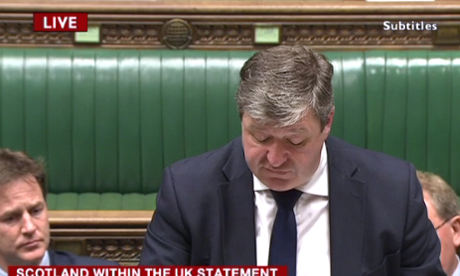
Alistair Carmichael's statement on further Scottish devolution
Alistair Carmichael, the Scottish secretary, is making his statement now.
Earlier he published the government’s command paper about plans for further devolution.
He says the referendum result was clear, and that it is important that everyone accepts it.
The vow made by the prime minister, and deputy prime minister and the leader of the opposition is being put into practice, he says.
The Smith commission is already up and running.
By St Andrews Day (30 November) heads of agreement will be published. And by Burns night (25 January) draft legislation will be published.
Today’s command paper provides a clear summary of the proposals for further devolution published by the three main parties.
The command paper is without prejudice to the work of the Smith commission, he says.
For the first time all Scottish parties are participating in a process to consider further devolution.
Douglas Carswell, newly elected as a Ukip MP, has taken his seat in the Commons.
(Rather, he has now literally taken his seat. When he “took his seat” earlier, at 3.39pm, in Commons terminology, he was just taking his oath.)
First tweet from my seat on the opposition benches in HoC as a #ukip MP
— Douglas Carswell MP (@DouglasCarswell) October 13, 2014
He’s chosen a slot on the opposition benches, but on the front bench below the gangway.
@AndrewSparrow @DouglasCarswell pic.twitter.com/dOm7BY9kO4
— Edward Sumner (@EdwardSumner96) October 13, 2014
He’s not far from where Dennis Skinner sits. That will make for an interesting conversation when they’re both in the chamber together.
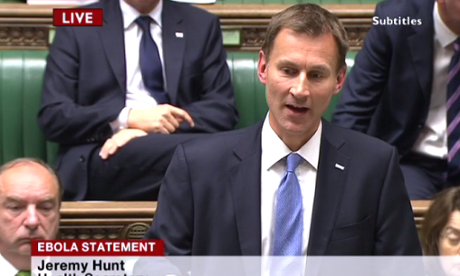
Jeremy Hunt's Ebola statement - Summary
Here are the key points from Jeremy Hunt’s statement. And here’s the full text.
-
Hunt said the government expects “a handful” of Ebola cases in the UK by Christmas.
The chief medical officer [Dame Sally Davies], who takes advice from Public Health England and the scientific advisory group for emergencies, has this morning confirmed that it is likely we will see a case of Ebola in the UK, and this could be a handful of cases over the next three months.
-
He said the risk to the UK was “low”. But the government was still taking additional protective measures, he said.
[Davies] confirms that the public health risk in the UK remains low and measures currently in place – including exit screening in all three affected countries - offer the correct level of protection.
However whilst the response to global health emergencies should always be proportionate, she also advises the government to make preparations for a possible increase in the risk level.
-
He said screening of passengers coming to the UK from Liberia, Sierra Leone and Guinea, including temperature testing, would start tomorrow.
Rapid access to healthcare services by anyone who may be infected with Ebola is important, not only for their own health but also to reduce the risk of transmission to others. Whilst there are no direct flights from the affected region, there are indirect routes into the UK.
So in the next week, Public Health England will start screening and monitoring UK-bound air passengers, identified by the Border Force, coming on to the main routes from Liberia, Sierra Leone and Guinea. This will allow potential cases arriving in the UK to be identified, tracked and given rapid access to expert health advice if they need it.
These measures will start tomorrow at Heathrow, which receives around 85% of all such arrivals across the airport, beginning with Terminal 1. They will be expanded by the end of next week to arrivals into Gatwick and on the Eurostar which connects to Paris and Brussels-bound arrivals.
Passengers will have their temperature taken and complete a questionnaire asking about their current health, recent travel history and whether they might be at potential risk through contact with Ebola patients. They will also be required to provide contact details.
If neither the questionnaire nor the temperature reading raises any concerns, passengers will be told how to make contact with the NHS should they develop Ebola symptoms within the 21 day incubation period, and allowed to continue on their journey. It is important to stress that a person with Ebola is only infectious if they are displaying symptoms.
Any passenger who reports recent exposure to people who may have Ebola, or symptoms, or who has a raised temperature will undergo a clinical assessment and, if necessary, will be transferred to hospital.
-
He said these screening measures would not reach 100% of people coming to the UK from the affected areas. To reach these people, posters will be on display at ports and airports advising people to get themselves checked.
We expect these measures to reach 89% of travellers we know have come to the UK from the affected region on tickets directly booked for the UK.
But it is important to note that no screening or monitoring procedure will be able to identify 100% of the people arriving from Ebola-affected countries, not least because not all passengers leaving the countries will immediately take connecting routes to the UK.
So today I can announce that the government will ensure, working with the devolved administrations, that there is highly visible information displayed at all entry points to the UK asking passengers to identify themselves in their own best interests if they have travelled to the affection regions in the last 21 days. This information for travellers will be available by the end of this week.
- He said NHS 111 call handlers were being asked to ask callers with respiratory symptoms about their travel history, and that alerts were going out to doctors.
-
He said there 26 Ebola beds available in the UK.
If [people] test positive for Ebola they will then be transferred to the Royal Free Hospital in North London, which is the UK specialist centre for treating the most dangerous infectious diseases. We also have plans in place to surge Ebola bed capacity in Newcastle, Liverpool and Sheffield, making a total of 26 beds available in the UK.
We will always follow medical advice as to whether any measures we adopt are likely to be effective and are a proportionate response to risk. However, I do believe that we are amongst the best and most-prepared countries in the world.
- He said the government had co-funded trials of a possible Ebola vaccine.
- He said there have been been “4,033 confirmed deaths and 8399 confirmed, probable and suspected cases of Ebola recorded in seven countries, although widespread transmission is confined to Liberia, Sierra Leone and Guinea.” Cases are doubling every three to four weeks, he said.
- He said the UK was the second biggest donor to the international effort to tackle the Ebola crisis in west Africa.
With the World Health Organisation, we are training more than 120 health workers a week, and piloting a new community approach to Ebola care to reduce, and hopefully stop, the transmission rate. We are also building and providing laboratory services, and supporting an information campaign in-country.
We are now deploying the Royal Navy’s RFA Argus and its Merlin helicopters along with highly-skilled military personnel bringing our military deployment to 750. They will support the construction of the Kerrytown Ebola treatment centre and other facilities, provide logistics and planning support, and help establish and staff a World Health Organisation-led Ebola training facility to increase training to health workers.
Taken together, the UK contribution stands at £125 million plus invaluable human expertise and is the second highest bilateral contribution after the US.
Updated
Jeremy Hunt is responding to Andy Burnham.
He says the three countries worst affected each have a partner country helping them. The UK is helping Sierra Leona, the US, Liberia and France, Guinea.
He says the UK is setting up a treatment centre to help health workers in Sierra Leone.
He says he agrees with Burnham about the need to be totally open with the public.
He is using the phrase “a handful” because it is difficult to be precise. He would not have used that phrase if he thought the number of cases arising in the next three months was going to run into double figures.
If that changes, Hunt says he will say so.
He says the government changed its stance on airport screening because advice from the chief medical officer changed.
Hunt says the government would like to continue using ZMapp for people affected with Ebola in the UK. But that will be subject to international availability.
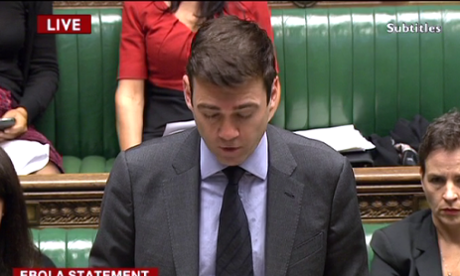
Andy Burnham, the shadow health secretary, is responding.
He says Labour wants to be constructive. But he does have to subject Hunt’s plans to scrutiny.
Burnham says “a handul” is not a scientific term. Will Hunt be more precise? Burnham asks for the full range of figures, and he asks about the worst case scenario. He says, when he was health secretary, he remembers agonising about whether to release worst case scenario figures for swine flu. He says openness is best.
Turning to screening, he asks how many people will be screened? Have Border Force been briefed? And why is there only partial coverage of ports of entry.
Are there enough hospital beds available?
What are the symptoms?
The nurse infected with Ebola was treated with ZMapp on an experimental basis. Is there enough in the UK?
Hunt says the international community has shown before it can handle pandemic threats, such as those from Sars and pandemic flu.
Hunt says people at 111 call centres have been told about the dangers of Ebola too.
A great deal of planning has gone into dealing with potential Ebola cases, he says.
All ambulances are equipped with protective equipment.
Any Ebola cases will be taken to the Royal Free Hospital in north London. Additional capacity is available in Newcastle, Liverpool and Sheffield, he says.
Dame Sally Davies, the chief medical officer, has confirmed that it is likely that we will see a case of Ebola in the UK. There are likely to be a handful of cases in the next few months, Hunt says.
The general risk is low, he says.
But it is wise to take precautions. Therefore he is putting in place these measures.
First, Public Health England will start monitoring people coming to the UK from Liberia, Sierra Leone and Guinea.
These measures will start tomorrow at Heathrow terminal one. They will be expanded to other airports, and Gatwick and the Eurostar.
Passengers will be asked about their health, and about their exposure to Ebola. Their temperature will be taken, and their details will be taken.
Anyone with a raised temperature will be assessed. If necessary, they will be taken to hospital.
Higher-risk individuals will be contacted on a daily basis.
Hunt says these measures will reach 89% of travellers coming to the region. But no screening process will be able to identify 100% of people coming from affected areas.
So highly-visible information will be available at airports telling people to identify themselves if they are from affected areas. That is in people’s best interests, he says.
Hunt says the UK is contributing £125m to countering Ebola in west Africa. It is the second highest donor, he says.
Jeremy Hunt's statement on Ebola
Jeremy Hunt is making his statement on Ebola now.
He says there have been 4,033 confirmed deaths from Eboloa, and 8,3999 confirmed, probable or suspected cases of it in seven countries. The countries worst affected are Liberia, Sierra Leone and Guinea.
PoliticsHome’s Paul Waugh says it was surprising to see Sir Peter Tapsell introduce Douglas Carswell.
Strange. When I informed Sir Peter Tapsell of Carswell defection, mins after it was announced, he sd: "Who is he? Where's his constituency?"
— Paul Waugh (@paulwaugh) October 13, 2014
And on being told Carswell constit was in Clacton, Sir Peter sd "that's a long way from Lincolnshire..". Clearly a big fan now
— Paul Waugh (@paulwaugh) October 13, 2014
Updated
Carswell has now disappeared so those desperate to find out where he plans to sit will have to wait a while longer
— Isabel Hardman (@IsabelHardman) October 13, 2014
And now Douglas Carswell takes his seat.
Bob Russell has been bumped. Carswell is introduced by Sir Peter Tapsell, the father of the House (and a Eurosceptic Conservative), and Zac Goldsmith.
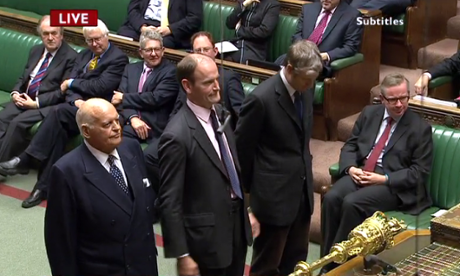
Commons not often silent. But for the entrance of @DouglasCarswell you could barely hear a breath in there
— Chris Ship (@chrisshipitv) October 13, 2014
Updated
Liz McInnes is now taking the oath.
"you're a natural Liz," jokes Stephen pound as McInnes walks up
— Isabel Hardman (@IsabelHardman) October 13, 2014
Updated
Before William Hague’s business statement, Liz McInnes, the new Labour MP for Heywood and Middleton, and Douglas Carswell, the former Tory re-elected as a Ukip MP for Clacton, will take their seats.
Carswell is being introduced by a Conservative and Lib Dem.
Douglas Carswell tells me he will be introduced to the Commons by Zac Goldsmith and Bob Russell - a Tory and a Lib Dem.
— Laura Pitel (@laurapitel) October 13, 2014
Carswell describes Goldsmith (whose father, Sir James Goldsmith, founded the Eurosceptic Referendum party) as a close friend. I’m not sure how close he is to Russell, but Russell’s Colchester constituency is near Clacton.
Jeremy Hunt will be making his Commons statement about Ebola shortly.
It will start just after 3.30pm. William Hague, the leader of the Commons, has to make a business statement first about tomorrow’s debate on Scotland, but that should only take a few moments.
For background, here is an extract from the statement that Hunt put out on Thursday about the measures being taken to protect people in Britain from Ebola. Here’s an extract.
The UK is continuing to monitor the outbreak of Ebola closely, including the protection of the UK against people travelling here who may be infected.
Airport screening at airports in Liberia, Sierra Leone and Guinea has been in place for some weeks to ensure all passengers leaving affected countries are checked.
Further screening has been kept under review throughout this period and advice from the Chief Medical Officer today is that enhanced screening arrangements at the UK’s main ports of entry for people travelling from the affected regions - Liberia, Sierra Leone and Guinea - will offer an additional level of protection to the UK.
Enhanced screening will initially be implemented at London’s Heathrow and Gatwick airports and Eurostar terminals and will involve assessing passengers’ recent travel history, who they have been in contact with and onward travel arrangements as well as a possible medical assessment, conducted by trained medical personnel rather than Border Force staff. Passengers will also be given advice on what to do should they develop symptoms later.
As the Chief Medical Officer’s advice makes clear, these measures will help to improve our ability to detect and isolate Ebola cases. However, it is important to stress that given the nature of this disease, no system could offer 100% protection from non-symptomatic cases.
David Cameron posed with some blacked-up Morris dancers at the weekend, according to the Telegraph.
David Cameron pictured posing with blacked-up Morris dancers at Banbury Folk Festival http://t.co/q20Lfxcqm2 pic.twitter.com/bljGPRhU4n
— Telegraph News (@TelegraphNews) October 13, 2014
The Telegraph says there is an innocent explanation.
In April Jack Straw’s son Will, who is standing as a parliamentary candidate in next year’s general election, caused a stir when he posed with a similar group, with some people branding him “racist” on Twitter.
According to the founder of the Foxs Morris dancers, the tradition of blacking up in Border Morris dancing dates back to the 16th century, when out of work farm labourers would beg for money, covering their faces in soot to avoid being recognised because begging was illegal at the time.
Martin de Vine, founder and Squire of the Foxs Morris dancers, said: “David Cameron was having a coffee and we saw him and just asked if he would have a picture taken.
“We dance in the style of Border Morris, and we black our faces because farm labourers who were out of work in the winter months would go around begging, performing a dance in return for money.
“They blacked their faces with soot because it was illegal to beg and they didn’t want to be recognised. It was a disguise, in the same way that the leader of the troupe wears a top hat and is called the squire to take the mickey out of the local squire.
“It’s not racist and offence is never taken. People from other cultural backgrounds don’t see it as that at all. We have had an Arab person dancing with us in the past - it’s not seen as racist.”
Green party says it's taking legal advice over its exclusion from TV debates
The Green party says it is taking legal advice about its exclusion from the proposed TV debates.
This is from the Green MP Caroline Lucas.
Taking legal advice over Green exclusion from TV debates. Apparently "messy" to have too many candidates. Democracy IS messy - sort it out!
— Caroline Lucas (@CarolineLucas) October 13, 2014
Miliband welcomes broadcasters' TV debate proposals
Here’s the full quote from Ed Miliband on the leaders’s debate proposal.
I hope David Cameron is not going to put up false obstacles to these TV debates happening. He should be saying they will happen, they must happen during the campaign. For my part, I’m going to make sure they do.
I think they are a good basis for moving forward. I think the most important thing is to give the public what they are entitled to, which is these TV debates. They happened at the last general election, we must make sure they happen in this general election too.
Ed Miliband has reacted to the leaders’ debate proposal.
Labour leader welcomes broadcaster's plans for 4;3;2 TV election debates. "I think they are a positive set of proposals" - @Ed_Miliband
— norman smith (@BBCNormanS) October 13, 2014
"I hope David Cameron is not going to put up false obstacles to these TV debates happening" - @Ed_Miliband on TV election debates
— norman smith (@BBCNormanS) October 13, 2014
Looks like @Ed_Miliband is the only party leader who is happy with the broadcasters' plans for the TV election debates
— norman smith (@BBCNormanS) October 13, 2014
Updated
Douglas Carswell, the new Ukip MP, has arrived at the House of Commons, where he will take his seat this afternoon.
.@DouglasCarswell says he is "reinvigorated" to be back in parliament as a Ukip MP - "democracy works" he says. pic.twitter.com/hgmAu02XAF
— PoliticsHome (@politicshome) October 13, 2014
Philip John has launched a petition at change.org saying the broadcasters should hold televised leaders’ debates with the leaders of the UK’s top six political parties (Conservatives, Labour, Lib Dems, SNP, Ukip and the Greens). You can find it here.
Nigel Farage is offended by David Cameron comparing Ukip to the Greens. (See 1.19pm.)
Cameron's response to plans about the Leaders' Debate is perhaps unsurprisingly focused on my inclusion
— Nigel Farage (@Nigel_Farage) October 13, 2014
Cameron comparing UKIP to the Green Party devalues the support of the millions of those who have placed their trust in UKIP this year alone
— Nigel Farage (@Nigel_Farage) October 13, 2014
Lunchtime summary
-
David Cameron has raised doubts about a joint plan unveiled today by broadcasters for televised leaders’ debates during the general election campaign. The Liberal Democrats and the SNP have also strongly criticised the plans, which would involve Nick Clegg being excluded from the first debate and Nigel Farage included in the final one. Here’s Nicola Sturgeon, Scotland’s deputy first minister.
Dear broadcasters - what about UK's third biggest political party, @thesnp? Farage invited on leaders' TV debate http://t.co/vBztiDQUSj
— Nicola Sturgeon (@NicolaSturgeon) October 13, 2014
That’s a reference the fact that the SNP’s membership has overtaken the Lib Dems’ UK membership.
- Jeremy Hunt, the health secretary, has said Britain must be prepared for the Ebola outbreak to worsen. He will be making a statement to the Commons about this shortly after 3.30pm.
-
The Lib Dems have criticised plans announced by David Cameron today for regional school commissioners to be given extra powers to intervene with failing schools. A Lib Dem spokesman said:
This new Conservative policy on schools seems to have been cobbled together on the back of a fag packet. The idea that you can support and challenge 24,000 schools on the basis of eight commissioners responsible for covering thousands of square miles of territory in vast regional bureaucracies is a nonsense.
We need to ensure that there is a proper local source of high quality challenge for schools, capable of intervening swiftly when needed, and having a proper mandate to change leadership and governance when necessary.
-
Philip Hammond, the foreign secretary, has been in Iraq for talks with its new prime minister, Haider al-Abadi, on combating Islamic State.
In #Iraq today meeting Prime Minister @HaiderAlAbadi to discuss support to GoI in fight against terrorism + need for national reconciliation
— Philip Hammond (@PHammondMP) October 13, 2014
I welcomed #Iraq PM @HaiderAlAbadi’s commitment to inclusive gov’t: vital that all communities unite to fight #ISIL pic.twitter.com/6ONftxox6Q
— Philip Hammond (@PHammondMP) October 13, 2014
Cameron raises doubts about TV debates proposal
Here are the full quotes from David Cameron on the broadcasters’ proposal for TV leaders’s debates.
I’ve said many times I do favour the idea in principle, and that’s why we had debates at the last election. I will have a look at this proposal. I think there are some questions over it.
Why have all the debates inside the election campaign, rather than spreading them out over a longer period? And also, why include some parties and not other parties?If you have one person [Nigel Farage], then the Greens have an MP as well, so you have to think these things through.
It’s an interesting proposal. None of us had seen it beforehand. I’m sure we’ll study it and I’m sure there will be other proposals along before long.
I’ve always been in favour of TV debates. I’m in favour of TV debates, but you’ve got to make sure you come up with a proposal that everyone can agree to, and I can’t see how you can have one party in that has an MP in parliament, and not another party.
I’m sure clever people can get together and sort these issues out, but they do need to take these sorts of points into account.
So, Cameron has raised two objection to the proposals (the timing, and the exclusion of the Greens) and downplayed their significance (“I’m sure there will be other proposals along before long”). It’s a classic example of Westminster foot-dragging.
I probably need to firm up my earlier assessment. (See 10.57am) Will the leaders’ debates happen? If you are talking about these specific plans (without modification), no. They must be dead already (because Cameron and Nick Clegg have dismissed them as unacceptable).
And as for any leaders’s debates? The chances are looking slim ...
Updated
David Cameron has responded to the broadcasters’ proposal.
PM "In favour of TV debates" cites timing/ Greens as problem w/proposal: "Can't see how you can have one party with one mp and not another"
— Faisal Islam (@faisalislam) October 13, 2014
PM specifically questions the timing of debates: why they are within the campaign period... Wants them spread out... Ie earlier
— Faisal Islam (@faisalislam) October 13, 2014
Updated
Electoral Reform Society criticises broadcasters' debate proposals
The Electoral Reform Society, which campaigns for democratic reform, has criticised broadcasters for proposing to exclude smaller parties from the TV election debates. This is from Katie Ghose, its chief executive.
The format suggested by the broadcasters doesn’t really reflect the fact that we are now firmly in a multi-party era. It’s difficult to see how to justify the exclusion of smaller parties from the debates. And having a two-party duel between Labour and the Conservatives simply doesn’t reflect the way people see politics these days. Democracy is about hearing from everyone, not just from the two men most likely to be prime minister.
People have changed since the heyday of the two-party system, and they want to hear a variety of voices in politics. The debates should be an opportunity to hear from the leaders of all parties which command a significant amount of support.
Her full statement is here (pdf).
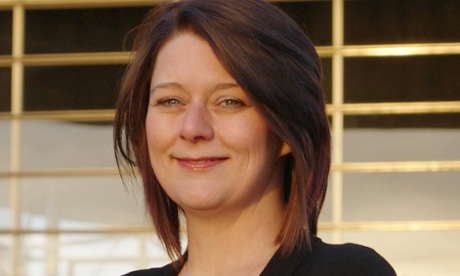
And here is Leanne Wood, the leader of Plaid Cymru, the Welsh nationalist party, on the broadcasters’ debate proposals.
The age of two-party politics is over and these debates should be a true reflection of the choice facing people in all corners of the UK at the general election.
Broadcasters have shown themselves to be out of touch by clinging on to the notion that there is no alternative to the tired Westminster elite.
Plaid Cymru will be going into the general election with ambitious policies to improve public services and strengthen the Welsh economy.
The people of Wales deserve nothing less than to hear what all parties have to offer them and we will be taking immediate steps to ensure that this happens.
SNP says debate proposals are 'utterly unacceptable'
Angus Robertson, the SNP’s leader at Westminster, has put out a statement on behalf of his party about the proposal from broadcasters for televised leaders’ debates. He says the plans are “utterly unacceptable”.
These proposals will be utterly unacceptable to any democrat.
What the London-based broadcasters’ are proposing fails in their duty to their viewers in Scotland, and simply doesn’t reflect the reality of politics across the UK today.
The broadcasters have the cheek to say that their proposed format factors in ‘changes in the political landscape’ to justify including Ukip - entirely ignoring the fact that the SNP are now by far the third largest political party in the UK.
Current Westminster voting intentions put the SNP in the lead in Scotland, and it is clearly wrong that the leader of the third biggest political party in the UK should be shut out of these network debates.
Yet they are proposing to include Ukip, despite the fact the SNP won six seats at the last general election to Ukip’s none - and with the SNP at 40 per cent in Scotland for the general election, to Ukip’s 4 per cent.
Despite the experience of the referendum campaign, the network broadcasters have once again forgotten their responsibility to Scotland. The BBC in particular as Scotland’s public service broadcaster should hang their heads in shame - under their proposals, the Tories and Labour would be included in four debates, the Lib Dems three, and the SNP just one. That is simply unfair to Scotland’s electorate.
This looks like yet another cosy Westminster carve-up, and we need to know what discussions the broadcasters have had with the other parties, and why there has been absolutely no discussion with the SNP.
These proposals are clearly inappropriate for Scotland, and cannot stand.
Number 10 lobby briefing - Summary
Here are the key points from the Number 10 lobby briefing.
- The prime minister’s spokesman refused to say how David Cameron would respond to the proposal from the broadcasters for televised leaders’s debates. Dismissing the story as “broadcasters talking about broadcasting”, he said the prime minister’s views were well known.
-
Number 10 confirmed that, if the Commons does vote in favour of tonight’s motion saying the government should recognise the state of Palestine, it will ignore it. Government ministers were under orders to abstain, the spokesman said. Asked why the government did not support recognising Palestinian statehood now, the spokesman said:
We think what we should be doing is everything that we can that is supportive of a successful and sustainable outcome based on a two-state solution.
- Downing Street rejected Boris Johnson’s claim that promising to get net migration below 100,000 was a “great deception”. The spokesman said that migration from outside the European Economic Area was at its lowest level for 20 years. The spokesman also refused to endorse Johnson’s proposal for quotas on migration from existing EU member states. However, the spokesman also declined invitations to say anything critical of Johnson.
- The government’s Scotland command paper will be published at 2.30pm.
- Number 10 confirmed that Cameron was not expected to open the Commons debate on Scotland this week. Asked if this could be seen as a dereliction of duty, the spokesman stressed all he had done to campaign for Scotland to stay in the UK.
Updated
I’m back from the lobby briefing. I’ll post a summary shortly.
In the meantime, here’s a bit more on the televised leaders’ debate proposal.
Natalie Bennett, the Green party leader, said the proposal from the broadcasters to exclude her party showed how out of touch they were. In a statement she said:
With these statements the broadcasters are demonstrating just how out of touch they are with the public mood, and how ridiculously they cling to the idea that the future of politics looks like the past.
It is clear from votes and polls that the public are fed up with the three business-as-usual parties and are looking around for alternatives. That is also demonstrated by the soaring membership of the Green parties of England and Wales and Scotland, now exceeding 27,000. Those members, the fast-growing numbers of likely Green voters (matching Lib Dems numbers), and the majority who back Green policies like bringing the railways back into public hands and the living wage for all workers would be seriously shortchanged by debates from which we were excluded.
And it is worth recalling that this is not the only televised leaders’s debate proposal on the table. As we announced earlier this year, there is also a Guardian/Telegraph/YouTube plan to hold a debate. Here’s an extract from the story written at the time.
A proposal for a party leaders’ 2015 election debate to be staged on the internet is being launched by a unique alliance of YouTube, the Guardian, and the Telegraph.
The initiative for a debate broadcast through YouTube would break the monopoly of existing broadcasters and allow innovative forms of audience participation for the political parties. The proposal, using the hashtag #onlinedebate, has been in preparation for months and was sent to the main party leaders on Thursday following informal talks with politicians.
The cross-platform collaboration would put an online debate before the vast majority of the UK’s 55 million internet users, and would be aimed at engaging a younger and more interactive audience.
A live feed could be embedded on any media site and be carried by any broadcasters on traditional TV and radio.
Leaders' debate proposal - snap analysis
Leaders’ debate proposal - snap analysis: As Peter Kellner argues (see 10.37am), the broadcasters’ proposal for televised leaders’ debates quite cleverly accommodates the need to include Ukip, without giving them equal billing to Labour and the Conservatives. But will it ever happen? Or has the Lib Dem statement just killed it off?
First, these debates are not inevitable. Although you hear people say that they have become an established part of the election landscape, and that it would be democratically unthinkable not to have them, that is not the case. In the US, the first presidential debate was held in 1960, but the next one did not happen until 1976. It is relatively easy for a party, while pretending to be in favour of a debate in principle, to refuse to sign up to the details. Labour did this in 1997.
Second, David Cameron may say he favours a debate, but it is hard to see how it would be in his interests. The main beneficiary from these proposed debates would probably be Nigel Farage. That is why Lynton Crosby is opposed. (And one thing we’ve learned from the party conference season is that, what Crosby wants in Tory politics, he normally gets.)
Third, the proposal does not accommodate Cameron’s main objection to debates. He has said he is in favour, but that he does not like they way they dominate the campaign. He has suggested debates should take place before the short campaign starts. But these three debates would all take place in April, the month before polling day.
Fourth, Nick Clegg’s decision to reject the proposed format may give Cameron some cover. If one leader alone were to reject the proposed format, conceivably they could be “empty chaired” by the broadcasters (although I have not had time to check whether broadcasting law would allow this). But if two parties boycott the debates, they will be meaningless. Ed Miliband won’t want to debate Nigel Farage on his own.
So, will they happen? It’s too early to know, but I think it would be unwise to put money on it.
I’m off to the lobby briefing now.
Updated
The Labour blogger Hopi Sen thinks Nick Clegg should be grateful not to be included in one debate.
Also, I don't know why the LibDems want Clegg in all the debates. It's not like increased Clegg-visibility helps them.
— Hopi Sen (@hopisen) October 13, 2014
This helps to explain why the other party leaders might be reluctant to debate Nigel Farage.
Nigel Farage is 2/1 favourite to win any 4-way leaders' pre-election TV debate. 2/1 Farage 5/2 Cameron 3/1 Miliband 3/1 Clegg
— Ladbrokes Politics (@LadPolitics) October 13, 2014
Jenny Jones, the Green peer and member of the London assembly, says the Green party leader, Natalie Bennett, should be included in the debates too.
.@GuidoFawkes Mad not to include @TheGreenParty in the leader debates, if only to have at least one woman on the platform.
— Jenny Jones (@GreenJennyJones) October 13, 2014
Peter Kellner, the YouGov president, told BBC News a few minutes ago that he thought the broadcasters’ proposal was “very, very smart”. The key question was whether David Cameron would accept it, he said. (He was speaking before the Lib Dems put out their statement - see 10.32am.)
Cameron’s internal advice from Lynton Crosby, his strategic adviser, is to try and not take part in any debates at all because, if you give Nigel Farage an opening, that might [be counter-productive] and also Ed Miliband is sufficiently unpopular at the moment that the last thing David Cameron would want is to be seen on equal terms.
But that said, this is very, very smart. The last time we had three debates with the same cast of leaders. Since then the Liberal Democrats have done so badly, whether you look at opinion polls, or local elections, byelections or the European elections in May, it would be reasonable to say they don’t deserve the same ranking as last time. At the same time, Ukip have been top in the European elections, they are ahead of the Liberal Democrats in the polls, they now have their first elected MP in Westminster - I think it would seem to normal voters out there that it would be very, very odd to exclude Nigel Farage altogether.
Kellner said he hoped that, if one leader refused to take part, the broadcaster would “empty chair” him.
What I hope the broadcasters will say to [the party leaders] is: ‘This is our joint proposal, if one of you leaders doesn’t like it, tough, we will, if necessary, empty chair you’.
Updated
Lib Dems reject the broadcasters' proposal, saying they should not be excluded from first debate
The Lib Dems have said they would not accept being left out of one of the debates. This is from a party spokesman:
The Liberal Democrats have long argued that the debates last time round were of huge benefit to our democratic process and engaged millions of voters.
The Liberal Democrats therefore welcome the fact that the broadcasters are seeking to make progress to ensure that the debates happen again in 2015.
The Liberal Democrats, like the Labour party, have publicly said that we would be prepared to sign up to the same 3-3-3 system we had in 2010 [ie, three debates, with the three Conservative, Labour and Lib Dem leaders]
We do not accept the proposal that the Liberal Democrats, as a party of government, should be prevented from defending our record in one of the TV debates.
That is the case we will make strongly in the negotiations that will now take place and we urge the other parties to join us around the negotiating table without excuse or delay.
Updated
Farage says Ukip should be included in second debate too
Nigel Farage says the proposal is better than he expected, but that he would expect Ukip to be included in more than one debate.
Decision is better than it could have been. If political landscape continues to change we would expect and ask for inclusion in a 2nd debate
— Nigel Farage (@Nigel_Farage) October 13, 2014
Updated
No 10 to wait before deciding whether or not to accept the proposal
No 10 says it was not given prior notice of the announcement from broadcasters about their plan for televised leaders’ debate. It is going to wait before it decides whether to accept or reject it.
A spokesman said:
We note the request and we will respond accordingly.
Updated
Broadcasters propose joint plan for televised leaders' debates
Here is what they are proposing.
• One head-to-head debate between the two leaders who could become prime minister – Conservative and Labour. This debate will be co-produced by Sky News and Channel 4 and chaired by Jeremy Paxman. Kay Burley will introduce the programme and present the post-debate analysis. The whole programme will be carried live on Sky and Channel 4 and their digital platforms, as well as having a major presence across social media.
• One debate between the Conservative, Labour and Liberal Democrat leaders. This debate will be produced by the BBC and presented by David Dimbleby. It will be broadcast on BBC One with extensive live coverage on other BBC TV and radio networks and online.
• One debate between the Conservative, Labour, Liberal Democrat and Ukip leaders. This debate will be produced and broadcast by ITV. Chaired by Julie Etchingham, it will air on ITV’s main channel and online.
Updated
Labour MP Graham Stringer says Miliband's team is 'hopeless'
Ed Miliband isn’t the first Labour leader to turn on the radio to hear himself being denounced by the Labour MP Graham Stringer, but that doesn’t mean that he will be happy about the experience. Stringer was at it again on the Today programme this morning. Here are the key points he made.
-
Stringer said Miliband’s team was “hopeless”.
There is a problem that applies to Ed and the people round him that the Labour Party have recruited and appointed too many people who have very little experience of the world. They have been assistants to MPs, bag carriers for ministers, they’ve come through the system, they’ve been parachuted into seats where they’ve got no roots. It’s meant there’s been a disconnect with parts of the party - particularly the leadership - and what’s really happening in many of the communities we hope to represent ...
We have to improve the people around Ed. I would sack quite a lot of the people. I think the team is hopeless around him. They’re giving him very bad advice. The shadow cabinet are individually all decent, hard-working people; collectively, they don’t have the breadth of experience that Ed needs for advice.
-
He said the party was out of touch with voters’ concerns in Heywood and Middleton.
In the Heywood and Middleton by-election it was the line coming from the leadership that this was about the health service. You only had to knock on three or four doors in Middleton or Heywood to find that what people were talking about was immigration. You can’t hope to win elections if you don’t talk about what the people are talking about. We have a problem on both communications and credibility. People have to believe what we say and at the moment they simply don’t do that.
-
He said Miliband was unpopular with voters.
If you go on the doorstep, Ed isn’t an asset to us. I don’t think that’s even a controversial thing to say, rather sadly. They think he doesn’t understand the problems they are suffering.
Stringer was on the Today programme with another Labour MP, Yasmin Qureshi, who said she disagreed with his analysis.
I think that to suggest that Ed’s team is responsible for the difficulties in Heywood and Middleton, I think you’re wrong. I think what we have to remember [is] that in Heywood and Middleton the Labour vote actually went up and I think that’s really important. The Labour vote did not collapse and therefore to say that the Labour party is completely disconnected to voters and don’t understand their concerns, it is wrong.
I’ve taken some of the quotes from PoliticsHome.
Jeremy Hunt's morning interviews - Summary
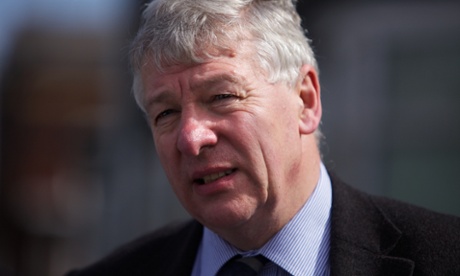
As I mentioned earlier, Jeremy Hunt has been giving a round of interviews this morning. They were largely about today’s strike by NHS hospital staff and midwives. My colleague Peter Walker is writing a separate live blog about that strike, and he has covered what Hunt has said about pay.
But here are the other key points that emerged from the interviews.
-
He rejected suggestions that screening for Ebola at airports was ineffective.
I think there are a lot of misunderstandings and that’s why it’s very important that we get the right training in place, put in place the right procedures. The main purpose of the airport screening that we are introducing is not actually to identify people who have Ebola, have the symptoms right now because most of them would have been prevented form flying by the checks that you have already in the airports at those countries.
The main purpose is to identify higher risk people because the virus incubates for 21 days and we need to make sure that anyone that is higher risk – we know their contact details, we are able to stay in touch with them, monitor their temperature on a daily basis so that if they do develop the symptoms we can get to them quickly. And that is better for them, that massively increases their chance of survival, but is also much safer for the public.
- He defended the government’s controversial Health Act which reorganised the NHS. This came when he was asked about a story in today’s Times (paywall) saying senior Tories now think the Act was their biggest mistake. Here’s an extract from the story.
David Cameron did not understand the controversial reforms and George Osborne regrets not preventing what Downing Street officials call a “huge strategic error”, it can be revealed.
One senior cabinet minister told The Times: “We’ve made three mistakes that I regret, the first being restructuring the NHS. The rest are minor.”
The prime minister and the chancellor both failed to realise the explosive extent of plans drawn up by Andrew Lansley, when he was the health secretary, which one insider described as “unintelligible gobbledegook”.
An ally of Mr Osborne said: “George kicks himself for not having spotted it and stopped it. He had the opportunity then and he didn’t take it.”
Asked about this, Hunt said he would not comment on the views attributed to Tory figures in the article. But he said that the NHS was now doing an extra 1m operations a year, and that this was only possible because of the savings obtained by bureaucrat posts axed as a result of the reforms. Asked about George Osborne’s views, Hunt replied:
I think if you talked to George Osborne, he would say exactly the same thing. The officially verified figures show that those reforms are saving the NHS more than £1bn a year. That is paying for a lot of doctors and nurses.
-
Hunt said he would not be taking the proposed 9% pay increase for MPs.
I’ve taken some of the quotes from PoliticsHome.
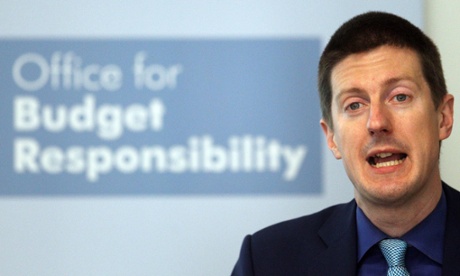
OBR boss says income tax revenues likely to be disappointing
Robert Chote, chair of the Office of Budget Responsibility, had some bad news for George Osborne on the Today programme this morning. He said income tax receipts were likely to be disappointing this year because wage growth was so low.
Fewer pence of revenue [are] coming in for every pound of wages and salaries that’s generated in the labour market and that’s one of the reasons why the receipts have come in weaker. Now, from the perspective of the public finances, that’s not particularly good news. The chancellor of the exchequer gets more bang for his buck if wages and salaries rise as a result of people’s earnings going up than if employment goes up – and that’s basically because if earnings go up you’re taking more people into higher income tax brackets, whereas if employment is going up you’re perhaps bringing more people in at the bottom.
This continued story of earnings growing less rapidly than expected and employment growing more rapidly than expected does perhaps suggest that we are more likely to be disappointed than to overachieve on income tax receipts this year.
One factor was the increase in self-employment, he said.
Quite a lot of the employment growth we’ve seen relatively recently has been self-employed people. And the evidence suggests that more of those than we expected have come in on relatively low incomes. So, for example, Revenues and Customs, the tax department, suggest that the proportion of self-employed people who are reporting incomes below the tax-free personal allowance has gone up from about 20% immediately prior to the crisis to about 35%.
Later Danny Alexander, the chief secretary to the Treasury, told the programme that the problem with tax revenues that Chote highlighted could be related to the government’s success at tackling youth unemployment.
One of the things we are seeing in the UK is a very large fall in youth unemployment. Young people at the start of their careers tend to earn significantly below the median income. That doesn’t mean that those are low-quality jobs. It does mean that those are people who are able to start out in life in the workplace, which is something that is hugely important.
I’ve taken the quotes from PoliticsHome and the Press Association.
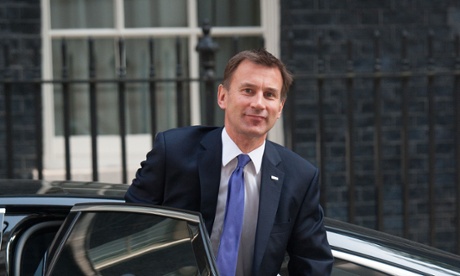
The first day when the Commons comes back after a recess is always busy and this afternoon there will be at least two important statements in the chamber. Jeremy Hunt, the health secretary, will tell MPs what is being done to prepare Britain for an Ebola outbreak. In interviews this morning, he gave a preview of what he is going to say.
What I am announcing today is measures to make sure that we do tighten our procedures across the whole of the NHS, whether its hospitals, GPs surgeries, ambulances to make sure that we are absolutely prepared. As I say. The clear advice we have got from the chief medical officer [Dame Sally Davies is that the protocols that we have got in place now are correct given the level of risk. She is talking about a handful of cases, if that, arriving in the UK in the next few months, but we need to be prepared and that’s why we need to make sure that they are tight ...
I hope when [people] hear my statement to the House of Commons this afternoon they will be reassured that we are taking all the measures that we need. This is not an airborne virus, you need an exchange of bodily fluids to catch it. But we need to make sure that everyone gets the training, everyone is reassured about what they need to do to stay safe.
We are also getting the publication of the government’s command paper for Scotland, setting out options for further devolution to Scotland. Alistair Carmichael, the Scottish secretary, will make a statement to MPs accompanying it.
Here’s the agenda for the day.
11am: Number 10 lobby briefing.
2.30pm: Theresa May, the home secretary, takes questions in the Commons.
3.30pm (?): Jeremy Hunt’s statement on Ebola.
Around 4.30pm (?): Alistair Carmichael’s statement on the Scotland command paper. (I’m assuming the Hunt statement will come first, but that has not been confirmed.)
Around 5.30pm: MPs begin a backbench debate on recognising Palestine. (I’m afraid this will probably fall out of my time.)
I will be focusig on the Ebola statement and the Scotland command paper, but, as usual, I will be also covering all the breaking political news from Westminster, as well as bringing you the most interesting political comment and analysis from the web and from Twitter. I will post a summary at lunchtime, and another at the end of the day.
If you want to follow me on Twitter, I’m on @AndrewSparrow.
Updated