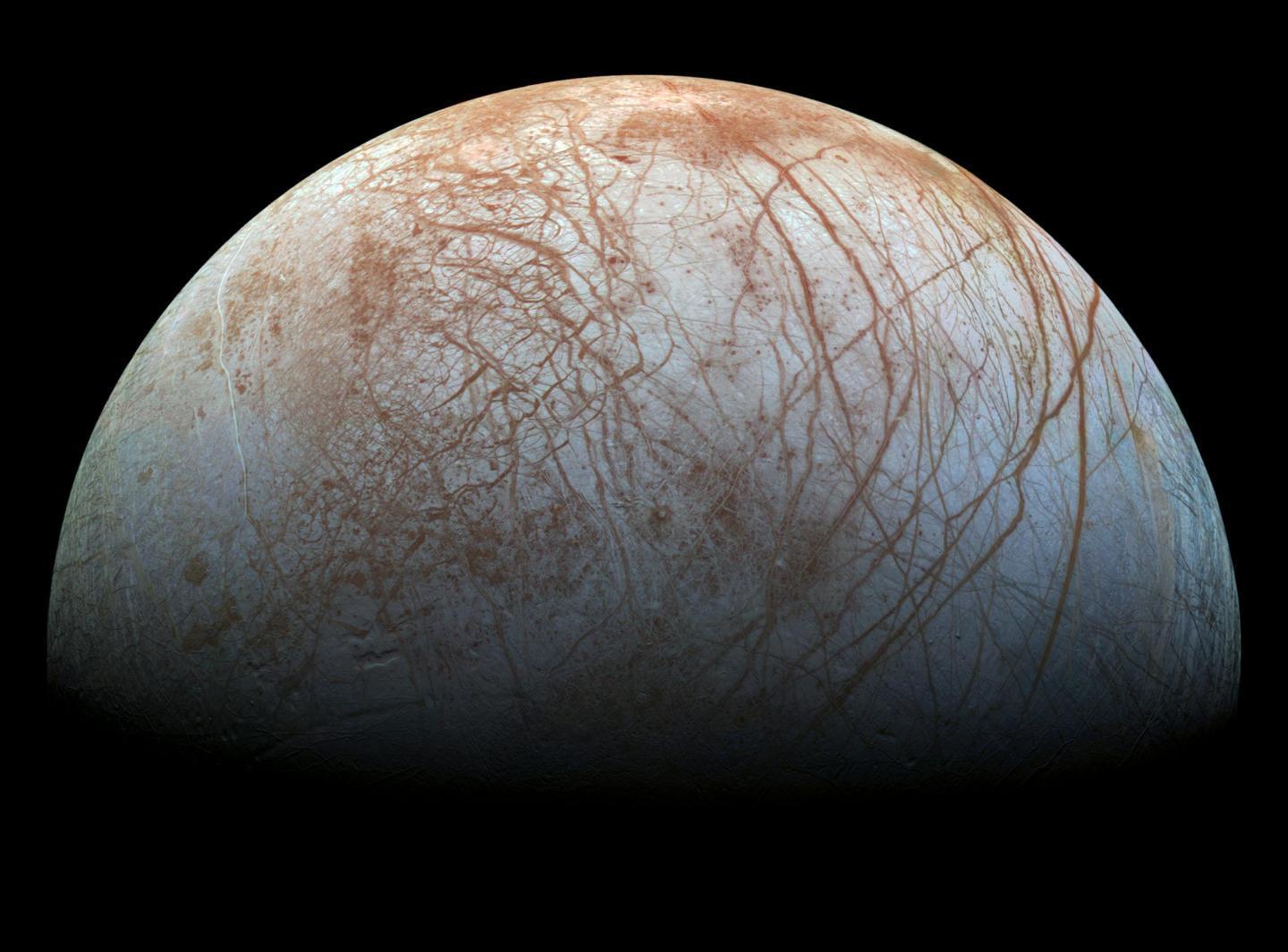
Traces of alien life might be hiding just a centimetre beneath the surface of one of Jupiter's moons, according to a new study.
The icy world Europa has long been one of scientists best hopes for finding traces of extraterrestrial life in our solar system. But the harshness of its world could make it impossible to actually discover, since it has been thought to have been hiding under the moon's impenetrable surface.
The new study claims that the amino acids that could be signatures of life would be able to stick around for as long as 10 million years, just one to three centimetres beneath the surface. They would not be wiped out by the harsh radiation they would be exposed to on the surface of the planet, the study suggests.
That means that engineers might not have to dig deep into the planet to discover traces of alien life. At the moment, such a feat would be impossible because space agencies like Nasa lack the capability to dig that deep.
Tom Nordheim, a Nasa scientist who is an expert on the habitability of icy worlds like Europa, said that Nasa instead needs to make sure that any visitor to the moon makes sure it lands in the right place.
So long as it dropped towards the top of the world, it could be able to dig just beneath the surface and find those importance traces of life.
Nasa is planning to send two missions to the planet: an initial flyby due to launch in 2022 that could explore best regions to land in, which could be followed by a lander that would roam over the surface. The agency has predicted it will find alien life in the next 20 years and has said that Europa is probably the best hope of doing so.
Europa is so exciting to scientists hunting for alien life because it is thought to contain a huge liquid ocean beneath the icy crust that surrounds it. Beneath that crust could be conditions to make the moon habitable, scientists have said.
Researchers had hoped that there might be signs of life on that surface. But it is being hit by huge amounts of radiation – the kind that covers our whole solar system, but which we are saved from by our atmosphere – and so scientists worried that could destroy all of those signs of life.
The key finding of the new paper, which is published in Nature Astronomy, is that the radiation does not penetrate as deeply into the surface as expected.