
And that's it!
That’s everything from Ali – many thanks to her, and to everyone who contributed questions. Be sure to join us next week, on Monday 29 September at 1pm, for the next in our Booker webchats, this time with Joshua Ferris.
Updated
dutchcapital asks:
My friend Cilla has just emailed to say she’s made some clootie dumpling. Isn’t the world lovely?
lalluna asks:
I love your writing. Question: what’s with death and ghosts? The dead mum, the ghost of the painter, the dead girl in Hotel World... do you find they have a special voice?
This is random but one time I walked by the second hand bookstore in Balham I saw a fly and thought of one of your short stories. And the next time I walked the bookstore was sadly selling all its stock and closing.
 Guardian contributor
 The thing about bookstores is that people will always love them, I think. When one closes, with any luck, somewhere else, someone else is taking a chance on opening a bookstore.
Maybe someone could write a story about the ghost of a bookshop. Imagine the voices. Imagine the cacophony. Imagine the strange harmony.
ksquared asks:
What is your writing routine? Do you get up early and write, do you write late at night? Do you write every day? All day? How do you feel about working in solitude?
Guardian contributor When I'm working on a book, time itself feels irrelevant. When I'm not, I'm very very lazy. Important to be ... both?
Edevhort asks:
Hello Ali, love your books!
Q: Do you think Will Self is full of shit?
Guardian contributor
EmilyBooks asks:
I love your comments on the Guardian podcast about adolescents being wide open to the world, not yet fixed. It reminds me of Philip Pullman’s daemons and the moment at which they stop changing form... But I wondered also what you thought of Penelope Fitzgerald’s novels? She too has some wonderful children as key figures in otherwise very adult narratives.
Guardian contributor I'm a Fitzgerald fan. For anyone who hasn't read At Freddy's, you have a great joy ahead of you. Her best novel about adolescents, I think, along with The Blue Flower. Thank you Emily.
LonesomeReader asks:
Can you describe why you have such an affinity for trees in your writing?
Guardian contributor I think it's because when you hold a book you're also holding a tree in one form or another, and that direct connection lets me know how important books are in the world. Pages are called leaves, a spine of a book comes from the spine of the animal whose skin was used in the first books as covers; everything about books refers us back to the physical world. Not that ebook readers aren't useful for those of us whose eyes are getting worse with age. But the reading of a book - a physical book - lets us know how time is passing, and how we are passing time, in something more than percentage numbers.
ilGatto asks:
I love your blethering North of Scotland style, you are the only person who writes like I speak.
Also ‘Look upon the world with love’ is my favourite quote from your stories.
Which book do you wish more people knew about?
Guardian contributor Oh easy! You'll know this one. Lewis Grassic Gibbon, A Scots Quair. It went into me like goodness when I was in my teens, a work whose rhythms are heart rhythms, whose politics remakes the novel, and whose originality still sustains me every time I read it.
ilGatto also asks:
Also what’s the strangest thing that’s ever happened to you?
Guardian contributor Updated
Jordan Knowles asks:
Were you ever afraid that the alternating seconds of the novel would be taken as a gimmick, and people wouldn’t get it? How have you found the reactions so far?
Guardian contributor When I first suggested it to my editor (I had to check it would be technically possible), it immediately enthused all three people I spoke to. They responded with incredible warmth and I was very surprised. So when I got the go-ahead I had some of that warmth as accompaniment, and that welcoming openness has characterised people's response to this book. I'm still surprised and incredibly glad. People seem really to take to the dimensional aspect - the notion that no story travels alone, that there's always at least one accompanying story, without which you're only getting half.
Updated
leonzos wrote:
I’ve been trying to write metafictional stories but something is missing. It can easily come across as literary masturbation or self involved showiness. Is the secret humour, lightness, being quick on your feet?
Do you ever worry that you exhaust your readers or put too much demand upon them?
Guardian contributor Hello leonzos. My advice would be: stop trying to write metaphysical stories and instead, just write a story. That way any metaphysics will kick in on its own terms. There is no secret you know - it's a straightforward contract between writer and thing written - the only real concern for anyone writing a story is the story itself.
JoeInTurkey asks:
When writing from the perspective of a modern teenager (like George in How to be Both) how worried are you about getting their patterns of speech and slang right? From what I have seen (and remember from when I was that age) kids talk differently among themselves than they do to adults.
Guardian contributor It's probably the closest thing resembling research I ever do (except for this last book, which took more traditional research) - listen to speech patterns. They're everywhere, on the train, in the street, in the shops, on TV, wherever you are. And yes, everyone's speech pattern changes depending on where and to whom they're talking. Ears open. Literally. (which is the word said about sixty times in five minutes by a group of teenagers sitting further up the train from me on my way here).
Updated
836125 asks:
Can you guarantee that your books will not undermine the LGBT message by providing a positive portrayal of the heterosexual so-called nuclear family?
Guardian contributor
dutchcapital asks:
Do you mind that I’ve photocopied a page of There but for the and put it in my toilet scrapbook as I think people would like it? will I go to jail?
Guardian contributor I'm honoured. And if you ever go to jail I'll come and visit and send you books. And if they're still not allowed into prisons, a la Chris Grayling, I'll do my damnedest to smuggle boxloads in.
Updated
HORRORMONES asks:
What was your reaction to the first rejection to your first submitted story? What advice would you give to emerging writers being rejected?
Guardian contributor
BeforeSokolsky asks:
I’m definitely paraphrasing, and I haven’t gone back to the source, but my recollection of Grayson Perry’s, Reith Lecture, was that art has been done and if it is not quite dead yet, there’s a rattle.
You obviously have faith that with the novel there’s life in the old dog yet, but, to completely stretch the metaphor beyond its sell by date, you are determined to teach it new tricks.
Does it ever get you down that say, after At Swim-Two-Birds, it had all more or less been done?
And another thing, the fact that the novel is an internal, atomised form, do you fear that at its very heart it is on the side of the neo-liberal project?
Guardian contributor Haha! Of course you're right, it's all been done before since the very beginning. The novel was born in Sterne's fantastically playful Tristram Shandy, up against Fielding's rollicking picaresques, Richardson's titillating blueprints for the novelette and Defoe's seeming realisms - all ways of working the form. And we're still doing it. On goes life, endlessly swapping new stories for old, endlessly renewing all over again. I don't think the novel is an internal, atomised form, you know. I think it's a communal and revelatory form, one that's always signalled our shifts and social changes in its own revolutions - I think it's revolutionary at its very heart - but that its heart and core are often muffled by the conventions which muffle all of us every single day.
Updated
sojomo asks:
How long does it take you to write a novel? How do you maintain focus during that time?
Do you find novels or short stories easier to write? What would you say is the difference between writing short stories and writing a novel?
Guardian contributor Hmmm. In my experience a novel takes about four years but can be very fast in the writing, which for me usually happens towards the end of those years. And focus maintains itself. In fact the problem is focussing on other things, like living and doing the dishes and getting some sleep without the novel waking you. But also in my experience, stories are much tougher to write, much more draining. They take less time. But they take a different energy, one that feels closer to the bone.
HarryCockburn asks:
The Accidental is the book I’ve bought most times, as I think it makes a great gift.
But which work of yours do you think it should be?
Guardian contributor That's nice of you. I can't answer this about myself, though, except to say I tend to give folk Elizabeth Bishop's Complete Poems, anything by Nicola Barker, and anything by Giorgio Bassani (translated by Jamie Mckendrick). And the book I give most to people is Italo Calvino's Six Memos for the Next Millennium.
sohini_b asks:
Your short stories (esp those in First Person & Other Stories) are simple and yet so playful when it comes to using pronouns, stories about storytelling, and sometimes have such exquisite lyrical moments (eg “Writ”). How do you conceive a plot for those kinds of short stories? And how do you not run out of ideas?
Guardian contributor Ideas never stop, dear S, they're everywhere, in everything - all we have to do is be open to them. And stories tend to arrive with their plots intact and reveal the plots in the writing. Often you think you've got a plot only to find, once you start writing, it's doing something else altogether. And the short story is the form most suited to the spatial moment, which is why it so touches us as a form, I think, with our lives so made up every day of the momentousness of the ordinary moment.
Meoble asks:
Is there a process you have followed every time you write a book? For example, do you always begin with a particular image or character you’d like to pursue further - or has your experience of writing changed depending on the book?
Guardian contributor If it's a novel it usually starts with a sense of structure, a sensing in the dark of something that will hold firm. Then a visual, or a phrase or two - you know, it's different every time, but something sparks off or interacts with that structure, then there's a kind of ignition, and off it goes on its way.
gorky1 asks:
I really enjoy your books and I have always felt you are the contemporary Virginia Woolf. A great writer who I studied at Uni. What would you say is your most challenging book in terms of narrative style?
Guardian contributor Hello Gorky1
Thank you. I'm going to pretend I can't hear that though. And I just don't think anything I've written is that challenging, stylewise. Fictionally I feel very challenge-lite. What is it someone said in Marie Claire or Elle: "An experimental novelist even your mother could love". Good! Especially if your mother happens to love Woolf.
CathrineinNorway says:
Thank you for years and years and pages and pages and words and words of enrichment. Very grateful for you in the land of book :-) ! You have gifted me so much joy and inspiration.
Thank you for teaching us to play and reminding us that we must leaf ... live :-)
Love,
Cathrine.
Guardian contributor
Caroline Derbyshire asks:
Did studying and analysing literature at university (I was there in the Sedgwick library too) inhibit or liberate you as a writer?
Guardian contributor Hello Caroline. Both.
We need both - something to fight against and something to protect. But god, the afternoons in that library - I was meant to be reading Eliot and I read Henry Miller and all of Scott Fitzgerald and a shelf-ful of late 70s feminist novels and Candide and whatever I found on whichever shelf I happened to be sitting next to.
TheBoyo asks:
Why is a duck?
Guardian contributor Duck is a duck is a duck is a duck. (G Stein)
A duck's a duck for a' that (R Burns)
It's deep water, that's why a duck.(G Marx)
Charlotter asks:
Have you read any of the other books on the Booker shortlist? Do you have a sneaky favourite or would you rather not say?
Guardian contributor I'm going to read them all next week. But I'm already a fan of Neel Mukherjee.
Ema B. O’Connor asks:
In your podcast with Guardian you talked about Lewis Carroll, time and nonsense. I was just wondering how important ‘nonsense’ is in your writing, and how it corresponds to the nonsense, or maybe just the disjunction, of time.
Guardian contributor Lovely question. I think nonsense raises two human urges. One: to be playful, be curious and curiouser, and 2: to make meaning out what seems to have none. Or flaunt having none. And since everything we do, being human, is up against time, nonsense is panacheful, cocks a snook at all the rules and regulations and reminds us of our freedoms up against the clock.
MythicalMagpie asks:
I was wondering how you feel about Scotland remaining connected to the rest of the UK in the wake of the Referendum? Having spent the first half my life in Scotland and the second half in England, I will admit to a wholly self-centred sense of relief at not being cut off from my roots.
Guardian contributor My brother in Edinburgh sent me a text the day after: "I am 54% happy this morning. But 46% very sad." Me too. I was torn. I didn't have a vote and I spent a lot of time in the run-up feeling piqued that I didn't and I abhorred the divisive tactics of both campaigns. But the incredible electoral turn-out was only the most visible manifestation of something truly uncynical happening - and how the notion of hope entered the tired old political discourse was to my mind near miraculous. You only have to look at any Scottish literary heritage to know that the Scottish psyche (they call it Caledonian antisyzygy!) is, in one way of looking at it, a split state, and in another way of looking at it, always more than one thing, multiple. I have a lot of hope for the future. The politicians had better deliver. If they don't, I think the people will.
giorgiasensigraziani says:
I’m not going to ask you any questions, my name’s Giorgia and I’m from Ferrara, it was a pleasure to read How to be both not only because it’s a great book but because of what you say about Ferrara (the city, the cyclists, the atmosphere) I don’t know how long you stayed but you just got the spirit of the place. Thank you.
I hope many more people will visit Schifanoia now and will want to know more about Francesco del Cossa. I just want to add that we met in January 2005 at the British Council Conference in Walberberg, Jackie Kay was there too and I had recently translated her collection The Adoption Papers..Congratulations and best wishes (in bocca al lupo for the Man Booker).
Guardian contributor I'm glad, dear Giorgia. I loved my visits to Ferrara. What a gracious place.
paper_boat asks:
I wanted to ask how much control do you feel you have over what you write? Once you’ve started writing do you know instinctively what happens next and the voices of the characters, or is it something you consciously make decisions about?
Guardian contributor I think it's a 50/50 mix of instinct and edit - seeing what comes instinctually then editing it with an eye to where it wants to go. So it's both a letting go of control and a wisdom as to where your writing wants to be taken. Both.
AntipodeanDream asks:
I wanted to ask you about the way you approach telling a story in two parts like this. Did you jump between the two narratives, or find that you wrote heavily on one, and then came back to the other?
The reason I ask, is that it seems to me that the ripples in the puddle that the young artist was fascinated by became, for me, a metaphor for the whole book, in that each story rippled out, disappeared into, and eventually became the other. I suppose I’m asking how you did that! (Perhaps it isn’t in two parts at all, depending on how you look at it.) How To Be Both just astonished me. So thank you very much!
Guardian contributor Thank you back! Each half produced the other, which meant I was in the dark for a lot of the writing process. It was like throwing a ball in a game of catch played in a pitch-black night with someone you can't see - nothing but the faith that someone or something will catch it. Each section was full of the seeds for the other though. I had to be pretty light on my feet to work out how and why.
Updated
Ali is answering your questions now
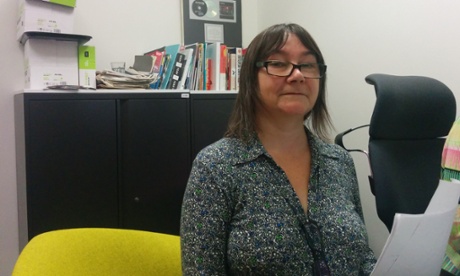
Ali is in the building and getting stuck into your questions. Feel free to post more as the chat moves along...
 Guardian contributor
Post your questions for Ali Smith
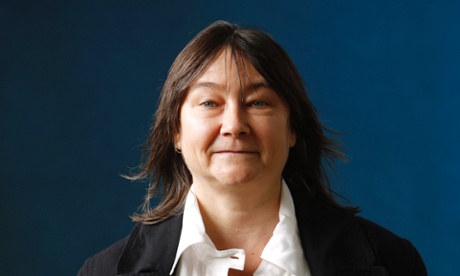
Ali Smith is one of fiction’s great enthusiasts – a teacher and champion of other writers’ work as well as an award-winning novelist, as demonstrated by the series of events she curated at this year’s Edinburgh International book festival.
Her latest Booker-shortlisted novel, How to Be Both, vaults centuries and genders to present two stories that can be read in either order. Is it the story of a 21st-century teenager obsessed with a little-known Renaissance artist, or a tale of a Renaissance artist haunting a girl from the future? It depends which version you happen to pick up and, in a sleight of publication to match Smith’s thrillingly disorientating storytelling, there’s no way of telling which you’re getting until the book is in your hands.
How to Be Both marks Smith’s third shortlisting for the Man Booker prize - after Hotel World and The Accidental - and is joint favourite to win, according to bookmakers Ladbrokes.
Reviewing it in the Guardian, Laura Miller wrote: “It may sound dauntingly experimental, but the hallmark of Smith’s fiction is that she approaches her formal adventures with a buoyant, infectious warmth and her feet planted firmly on the ground. How to Be Both feels like a frolic ... until its depth, heart and intelligence are revealed.”
Smith will join us live online from 1-2pm BST on Friday September 26, to answer your questions – post them below and she’ll endeavour to answer as many as possible.
Updated








Yes it is. I hope you get the sixpence.