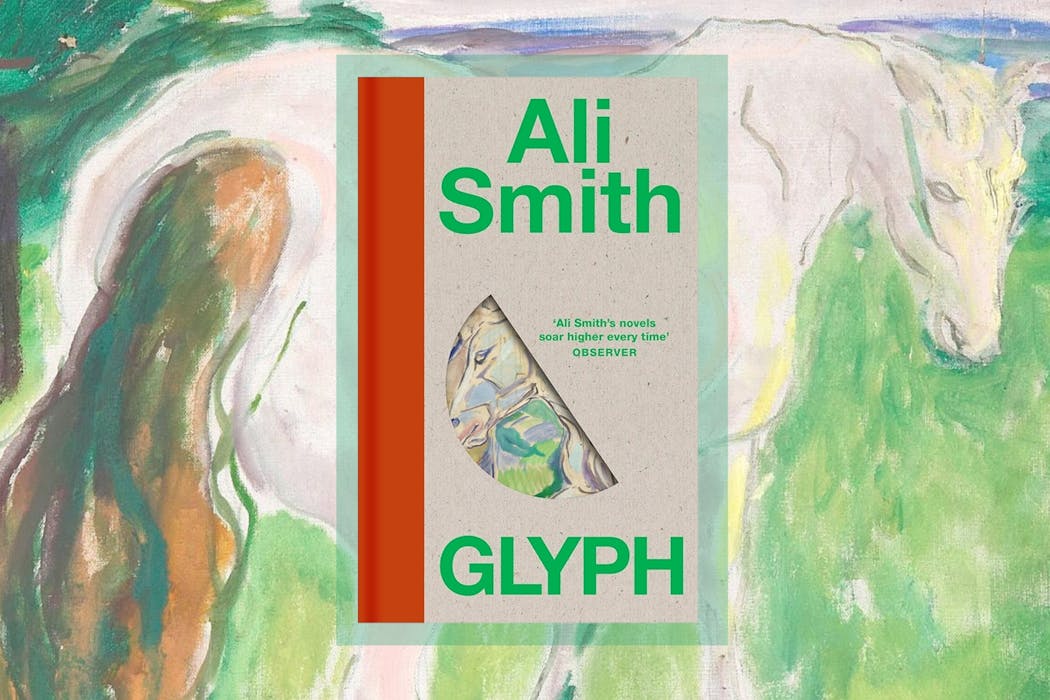
Ali Smith’s Glyph is the companion novel to her earlier novel, Gliff (2024). Gliff was set in a surreal near-future dystopia. Glyph, meanwhile, is set in the present. But like Smith’s earlier Seasonal Quartet, it offers the reader an uncanny version of our world, haunted by ghostly voices from the past.
The novel focuses on two sisters, Petra and Patricia (aka Patch). The action moves between scenes from their childhood in the 1990s and their present-day estrangement.
Two chance family anecdotes of wartime tragedy have a shaping influence on their imaginative lives. One is the story of a first world war soldier who deserted the army, fleeing with a blinded horse he wished to save. We learn that he was eventually court-martialled and executed.
The other is the curious account of how a female agent, travelling under cover through France in the second world war, discovered a mysteriously flattened corpse on the road.
When young Patch becomes distressed by the fate of the flattened man, Petra pretends that she can communicate with him in the afterlife. Episodes from his life are presented in vivid detail, and the reader is invited to speculate that the ghost may be real.
Smith teasingly draws attention to the different levels of reality at work in the novel. The image of a flattened corpse becomes a metaphor for other kinds of flattening, including that of characters in fiction. At one point the narrating voice, with apparent authorial detachment, refers to “the flat character / literary device called Patricia”.
It is then revealed that Patricia herself is narrating this section. And the ghost of the flattened man – who may simply be Petra’s invention – remembers reading a book in which books are described as “flattened flowers at best”.
The novel also asserts a powerful link between stories and ghosts: “Story, however. It is haunting. Everything tells it.”
Glyph v Gliff
Although it can be read as a standalone work, Glyph inevitably invites the reader to explore its relationship with Gliff (2024), adding yet a further dimension to this multilayered novel.
Read more: Ali Smith’s new novel Gliff is a dystopian nightmare with flashes of fairytale enchantment
In many ways Petra and Patch’s relationship mirrors that between Gliff’s siblings, Briar and Rose. Both younger sisters share a fondness for puns and sly malapropisms. And the soldier’s doomed escape with the horse seems to echo the mysterious disappearance of Rose on the back of a horse she rescued from being slaughtered.
Smith adds a further complication into the mix when it is revealed that the novel Gliff exists in the world of Glyph. A brief discussion of its merits (and weaknesses) between Petra and Patch offers a humorous reflection of real-world reader responses to Gliff: “A bit too dark for me. A bit too clever-clever, a bit too on the nose politically, for a novel.”
The presence of Gliff within Glyph also complicates the meaning of some of the links between the two novels. Petra is sure she is being haunted by the blind horse of family legend. But Patch suggests that this is a delusion sparked by reading Gliff. The duology forms a kind of textual Möbius strip – a mind-bending twisted loop with just one side – perhaps nodding back to the double strands of Smith’s 2014 novel How to be Both.
Alongside all this playful twistiness sits a passionate commitment to a more just society. Billie, Patch’s teenage daughter, is central to this element of the novel. She resembles young Florence in Ali Smith’s earlier novel Spring (2019). Both are charismatically exuberant Greta Thunberg-style campaigners for social justice.
The future world of the earlier novel Gliff seemed horrifyingly absurd in its unfairness. Viewed through Smith’s bitterly satirical lens in Glyph, our own present world seems little less surreal in its destructiveness, its attacks on creativity, freedom and the environment, and its addiction to war and violence.
Like all of Smith’s works, Glyph is multifaceted. She is equally adroit at capturing the emotional nuances of family life, mapping out the larger political landscape, or beguiling the reader with joyfully witty metafictional and linguistic games.
Readers often feel pulled in two directions when reading her novels. There is so much to pause on, so many startling turns of phrase or clues to hidden mysteries. Yet there is also an irresistible compulsion to turn the pages, to find out what happens next.
Looking for something good? Cut through the noise with a carefully curated selection of the latest releases, live events and exhibitions, straight to your inbox every fortnight, on Fridays. Sign up here.
This article features references to books that have been included for editorial reasons, and may contain links to bookshop.org. If you click on one of the links and go on to buy something from bookshop.org The Conversation UK may earn a commission.

Sarah Annes Brown does not work for, consult, own shares in or receive funding from any company or organisation that would benefit from this article, and has disclosed no relevant affiliations beyond their academic appointment.
This article was originally published on The Conversation. Read the original article.