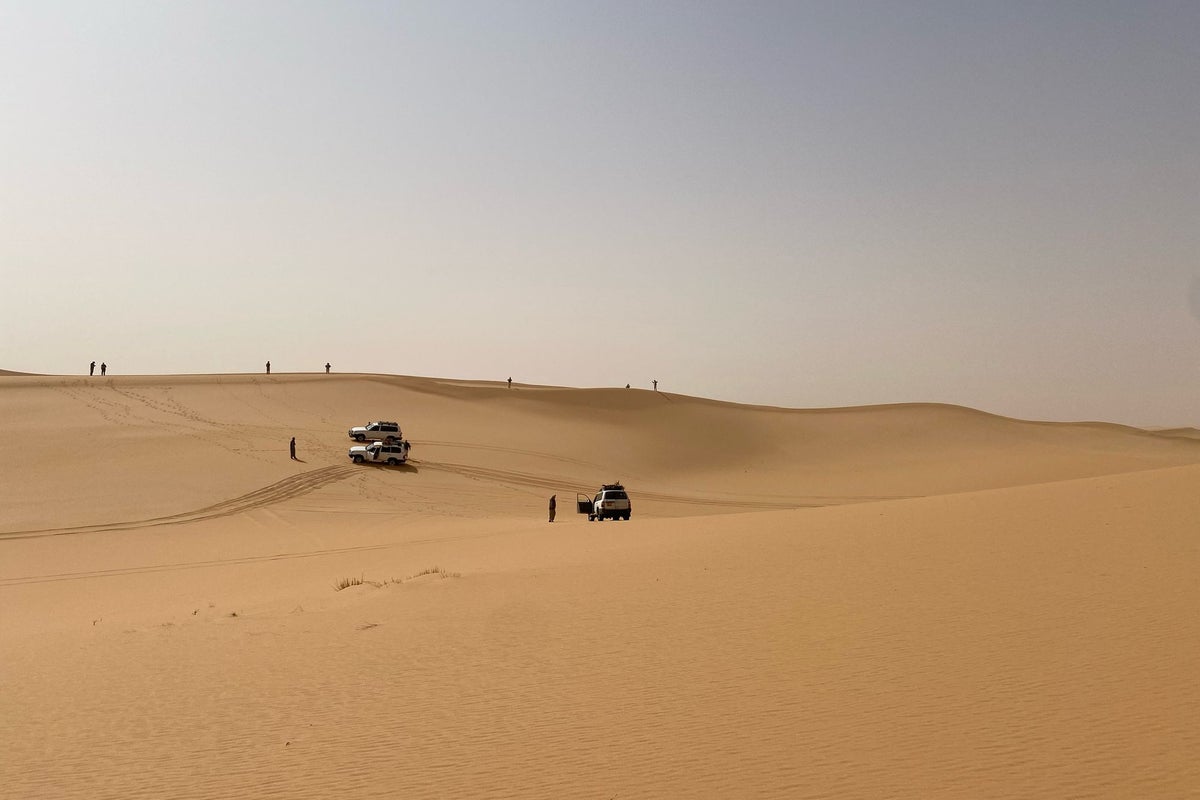
My guide gestured across a tumble of Algerian dunes that stretched out to the horizon, the saffron sand glowing under the setting sun.
“In that direction,” he said, his eyes straining for emphasis under the dark blue band of his Tuareg headscarf, “it is just sand. Five hundred miles to Mali.”
I tried to comprehend, humbled by the immensity of it all. Five hundred miles to Mali, and the dunes didn’t stop there.
I had been in the Sahara before, in neighbouring Morocco, where I’d joined a crowd of other tourists riding camels, plodding our way from the rear of our hotel to luxurious bell tents and a fridge full of refrigerated drinks.
The edge had been taken off the experience by the sight of dozens of tyre tracks criss-crossing our trail. My Moroccan excursion was not a venture into an unexplored desert; it was a hairy theme park ride. Algeria was different.
My time in Africa’s largest country had started in the capital, Algiers: a city that can trace its past back to the 6th century BCE, when it started life as a Phoenician outpost.
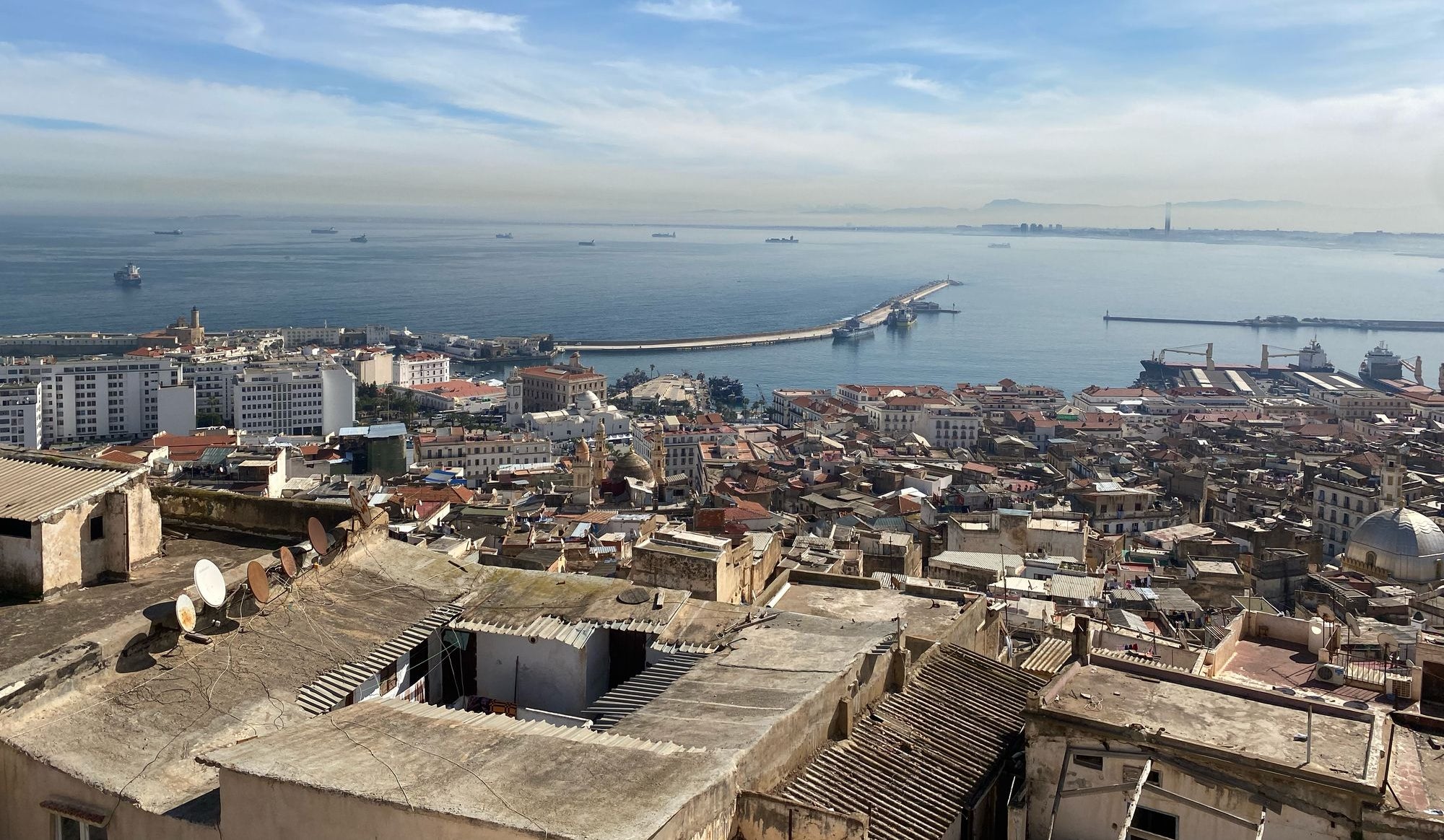
Successive rulers from afar – Romans, Ottomans, French – built around that original site, placing their own layers of influence on the hills that rise from the Bay of Algiers. This has formed a city of multiple architectural styles, stacked up around avenues that plunge with the contours of the land.
The oldest section of Algiers is the kasbah. Its steep steps and winding alleyways remain a living, breathing hub of daily activity. There are workshops and small stores selling crafts, but these are oriented towards local shoppers – there are no tourist trap trinkets, no aggressive touts selling false promises of authenticity.
Lively traders’ calls come from market stalls, and vendors talk among their colourful trays, each stacked with pomegranates, grapes, apricots and dates.
That there’s no heavy hustle is due in part to the lack of tourists. I met only one other Brit in my week in the country and saw just a handful of foreign visitors across the sites I visited.
But this will change. Algeria’s government has set ambitious tourism targets, aiming for 12 million annual international visitors by 2030 (their record-breaking 2023 saw 2.2 million foreigners visit the country) – though it is worth nothing that most UK visitors require a visa that cannot be processed online.
Investment is being directed towards increasing hotel capacity and improving internal transport links, as well as the quality of tourism services. Even before this, Algeria has advantages over its neighbours. Direct flights from London Gatwick reach Algiers in under three hours – a quicker hop than flights to Marrakech, Casablanca or Fez.
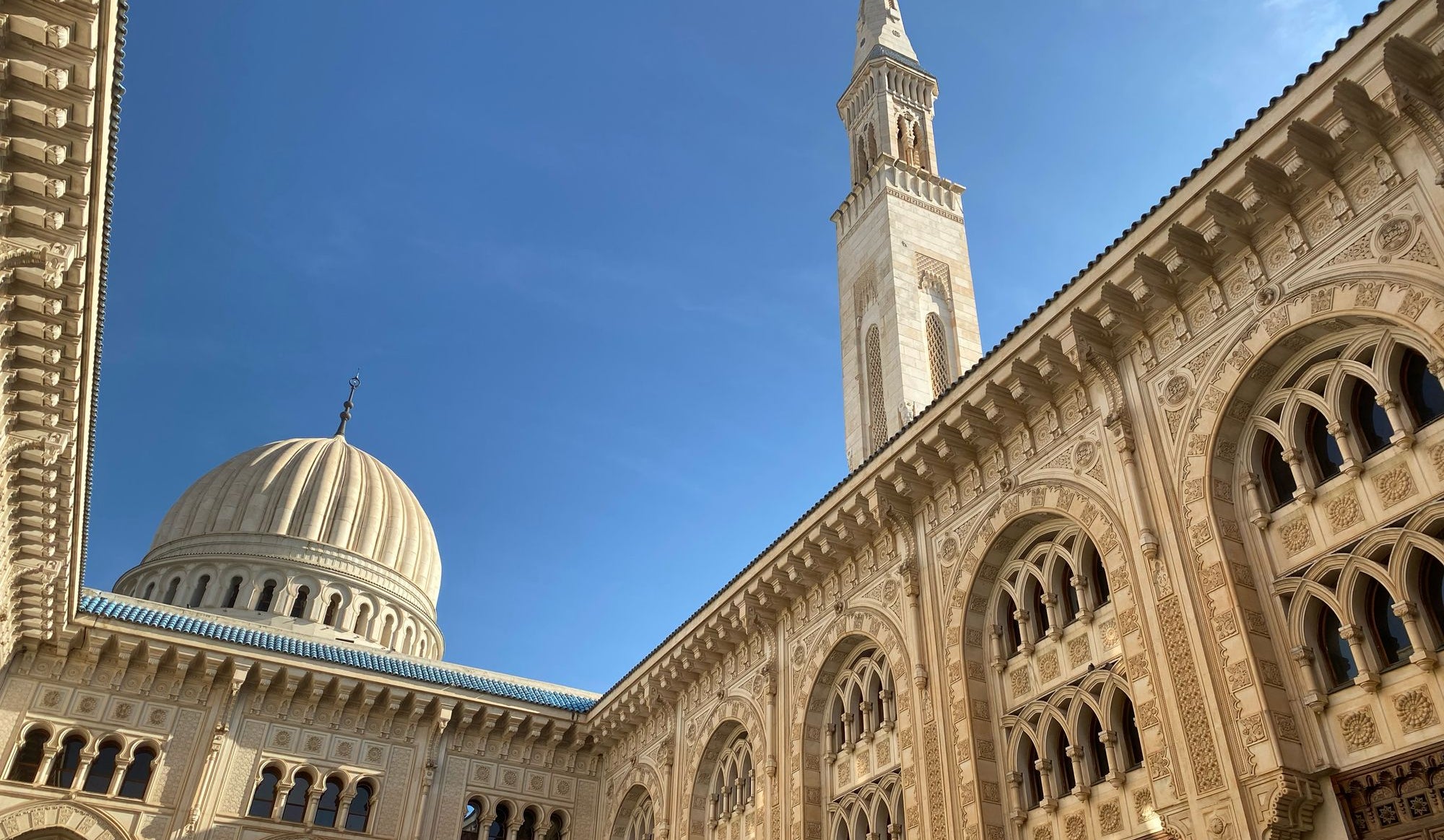
From Algiers, I flew one hour east to Constantine, for a wander of the lofty walkways that give the place its nickname, the “City of Bridges”.
Read more: Where to stay, eat, drink and shop in Muscat, Oman
Algeria’s third city is sliced in two by a vertiginous ravine, from which there’s an enviable glut of incredible vantage points.
On the northern edge of the city, the stone arches of the Falls Bridge cross the river at the point at which it plunges down into the plains below the city. Some 175 metres above that, the Sidi M’Cid Bridge, a suspension bridge for road traffic, was for a time the highest bridge in the world.
Most troubling for a travel writer with a fear of heights is the Mellah Slimane Bridge, a pedestrian walkway that has a nasty habit of swaying – perfectly safely, they say – as you cross.
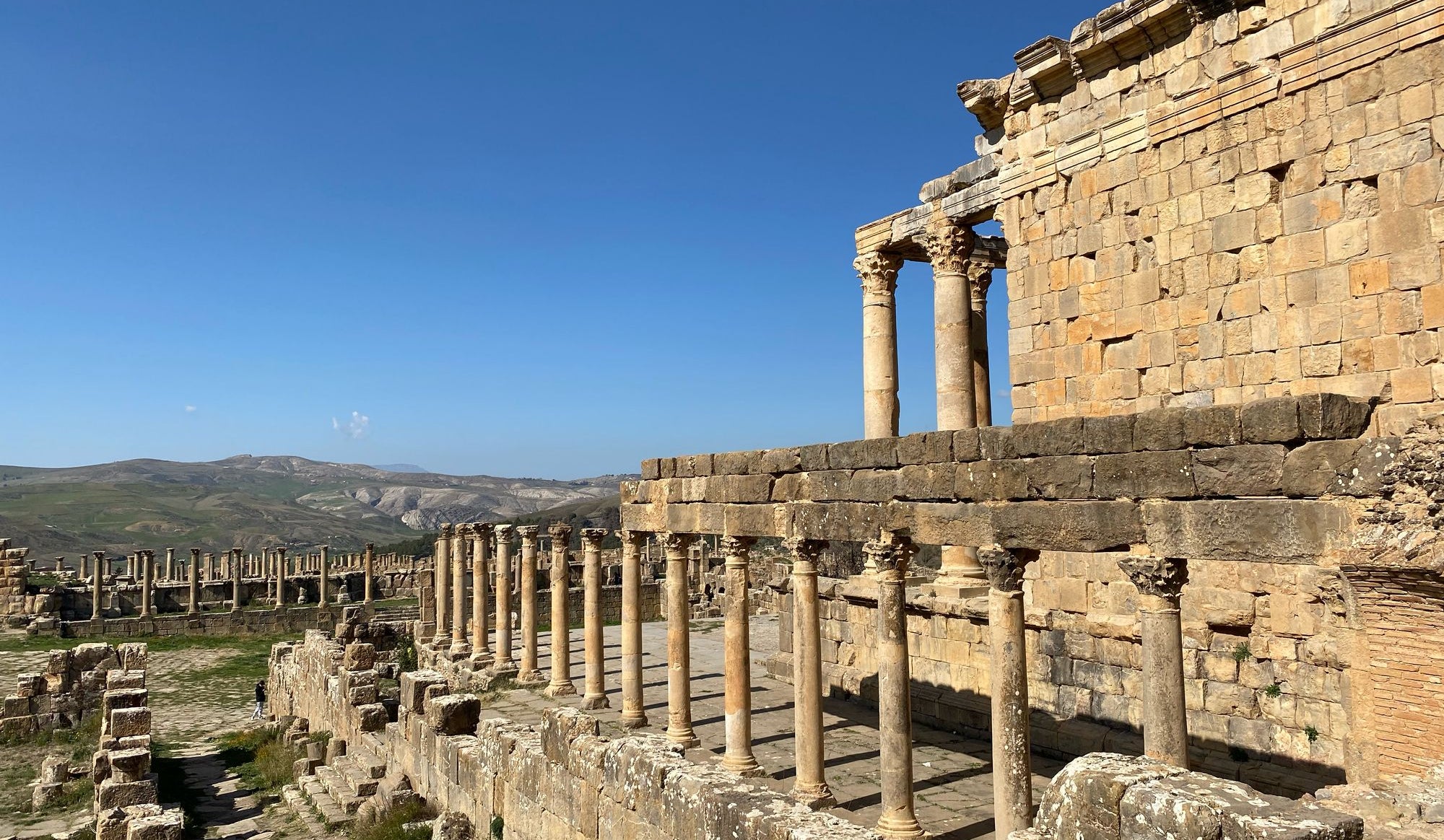
A two-hour drive from Constantine took me to the Roman ruins at Djemila. Home to around 4,000 people at its peak in the third century AD, Djemila spreads out across a peaceful hillside. I had the site to myself, accompanied just by the rustle of crickets and the whisper of flowers in the wind.
I walked through 2,000 years of crumbling houses, marketplaces and temples, where thick blocks of limestone surrounded intricate mosaics, rich in detail.
I found Djemila – the name has its roots in the Arabic word for “beautiful” – as impressive as any Roman ruins I’d visited around the Mediterranean. The highlight was the ancient theatre, built into a natural curve of the hill.
Standing at the front of what was once the stage, I looked out at rising, semi-circular rows of seating. My guide encouraged me to sing or shout. The precision-engineered acoustics of the site amplified my call to an audience of none.
Then it was on to Djanet, an oasis outpost deep in Algeria’s southeastern nook – as close to the centre of the Sahara as it’s possible to get. Before delving into the desert, I climbed through the mud-walled remains of Zelouaze Castle for a hilltop view across a band of date palms.
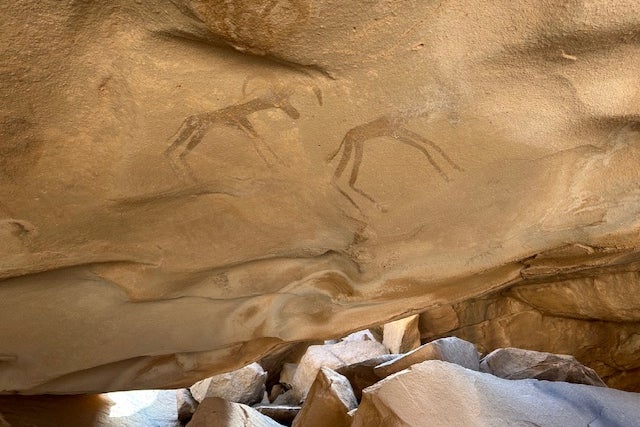
That wave of green foliage was replaced by sandstone stacks as I headed into the Tassili n’Ajjer National Park. Its name means “plateau of rivers”, referring to the waters that flowed here 6,000 years ago.
Evidence of lusher times can be found on the walls of the canyons and rocky outcrops: remarkable, rust-red cave paintings of the people and animals that used to roam these plains.
In this distant corner of Algeria, these ancient images show a land of giraffes and elephants. It’s unthinkable now as the desert extends incredible distances in every direction; five hundred miles to Mali, and more beyond.
How to do it
Untamed Borders offers a 10-day “Into the Heart of the Sahara” tour, covering Algiers, Constantine, Djemila, Djanet Tassili n’Ajjer National Park, from £1,750 excluding international flights.
British Airways fly direct from London Gatwick to Algiers Houari Boumediene International Airport from £180. Flights take just under three hours. Individual visa from £85.
Dom was a guest of Untamed Borders
I stayed in one of Wetherspoon’s award-winning hotels – here’s what I really thought
Premier Inn overtaken by Wetherspoons in hotel rankings after guest complaints
I stayed in this Traitors-esque Scottish hotel – here’s why you should too
The best riads in Marrakech to stay in for winter sun
Why you should swap hectic Marrakech for authentic and laidback Rabat
The Oberoi, Marrakech hotel review
Move over Brighton, this northern city is ready to snatch England’s queer crown
This laidback Caribbean island is perfect for a screen-free family break
What I discovered travelling Missouri’s lesser-trodden stretch of Route 66