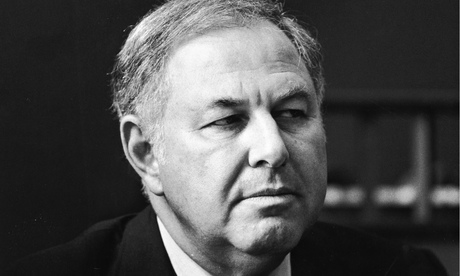
According to Alfred Taubman, the US property entrepreneur and former chairman of Sotheby’s auction house, who has died aged 91, leaders play the hands they are dealt. If so, he played his own modest cards with extraordinary skill, although in 2001 he was convicted of fixing commissions behind the scenes with the rival auctioneer Christie’s.
Taubman’s rise from poor kid to multimillionaire was the stuff of the classic American dream. Through the development of a string of retail shopping malls, he became one of the US’s richest citizens and a generous public benefactor concentrating particularly on causes in Detroit, his “home town”.
Taubman’s involvement with Sotheby’s began in 1983 when he stepped in to buy a controlling stake in the business, which was under threat of being taken over by a New-York based financial group. He was a significant collector of art and a frequent buyer at Sotheby’s and Christie’s, both bastions of the British class system, but he felt they treated him with disdain. Sotheby’s staff had failed to recognise they were in a service business, he thought, and it was clear to Taubman that, if the business was properly organised, it could make him a fortune.
Some people saw his purchase differently: here was a social climber from the American midwest seeking status and trying to impress his new wife, the beautiful Judy Mazor, a former Miss Israel. While the social status conferred upon Taubman by his chairmanship of Sotheby’s was undeniable, his business instincts transformed the auction house. He reformed its whole approach to its customers and its focus on profitability.
It was 10 years after Taubman acquired his controlling interest in Sotheby’s that Sir Anthony Tennant joined the board of Christie’s with a promise that he would become the next chairman. Sotheby’s and Christie’s were beating the daylights out of each other, and the profitability of both houses was suffering. There then began a series of meetings between the two men at which, according to the federal grand jury at the trial in Manhattan, New York in 2001, an agreement to fix commission rates was made.
Tennant refused to stand trial, and could not be extradited from the UK, because price fixing is a civil rather than a criminal offence in Britain. Taubman’s chief executive at the time of the crime, “Dede” Brooks, co-operated with the prosecution and received a sentence of three years’ probation, including home detention and community service. Christopher Davidge, the chief executive of Christie’s, was exempt from prosecution because he blew the whistle on the scheme. Taubman never admitted guilt, and was sent to prison for a year and a day.
Son of Philip and Fannie Taubman, he was born in Pontiac, Michigan, into an aspiring German Jewish immigrant family. His father was a struggling fruit grower and builder, and the young Alfred was obliged to contribute to the family budget. Starting out as a petrol pump attendant, he then worked in a shoe shop, where his fascination with retailing was born. Flatter the customers, treat them right and you may sell two pairs of shoes, not one, he learned.
His architecture studies at the University of Michigan were cut short by second world war service in the US Army Air Corps and although he went back to study at the Lawrence Technological Institute in Detroit, Taubman was in a hurry to get moving in business. In 1950, he borrowed $5,000 and set up the Taubman Company. Two and a half years later, he opened his first development, a 26-shop open-air centre at Flint, Michigan.
The modern indoor mall had yet to be invented, and it was another 10 years before Taubman opened his first enclosed mall, in Hayward, California. This was inspired, it is said, by the renowned architect Victor Gruen’s mall at Southdale, Minneapolis. This is sometimes disputed, but what is beyond argument is that between them, Gruen and Taubman changed the way in which Americans would shop for the rest of the century and beyond. Taubman went on to develop a string of similar properties across the US, earning admiration and opprobrium in equal measure.
One of Taubman’s greatest friends was the civil rights lawyer Damon Keith, and Taubman endowed Wayne State University Law School, Detroit, to house the Keith Law Collection of African-American Legal History. He devoted many millions of dollars and a great deal of his time to work on what he always believed would be the renaissance of Detroit, but his interest in human rights was not confined to the major public issues for which he liked to be known. For instance, when the veteran civil rights activist Rosa Parks was mugged in 1994, Taubman and one of his business associates found her an apartment in one of their developments in which she lived until her death in 2005.
Taubman’s stretch in prison did little damage to his reputation in Detroit, where he continued to participate in a wide range of civic, cultural, and educational activities. He established and funded the Taubman Center for State and Local Government at the John F Kennedy School for Government, Harvard University, and was the principal benefactor of the University of Michigan’s college of architecture and urban planning, health care centre and medical library, each of which bears his name, as well as a supporter of a number of other arts and educational organisations. He was awarded many honorary degrees.
He is survived by Judy; his two sons, Robert and William, and daughter, Gayle, from his first marriage, to Reva (nee Kolodney), which ended in divorce; and by nine grandchildren and a great-grandchild.
• Adolph Alfred Taubman, industrialist and philanthropist, born 31 January 1924; died 17 April 2015