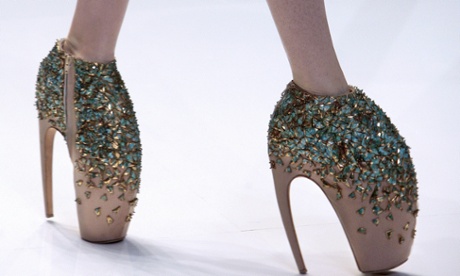
The recent Alexander McQueen: Savage Beauty exhibition at the V&A raised, for me at least, some important questions about the connections between fashion and advertising. It was the first and largest retrospective of the late designer’s work to be presented in Europe and it didn’t disappoint. Savage Beauty showcased a lot of McQueen’s incredible work, but one collection that really stood out for me was his Spring/Summer 2010 collection, Plato’s Atlantis.
After seeing the exhibition I drew three parallels between what I saw in McQueen’s approach and what I do (as an art director). These can be described as concept, inspiration, and collaboration.
Concept
The Plato’s Atlantis collection was inspired by the story of the lost city of Atlantis. According to the classical philosopher Plato, the city was submerged in seawater following a volcanic eruption more than 2,000 years ago. In a process of reverse-evolution, the human race regressed to an amphibian state, creating a glistening new species that McQueen brought to life on the runway. This was the imaginative concept behind McQueen’s most spectacular show.
Inspiration
Before focusing on the technical aspects and intricacy of his work, McQueen did his research. Layers of references were epitomised in his designs.
The study by the 19th century biologist Ernst Haeckel into marine life was a huge inspiration for Plato’s Atlantis. By mirroring structures from Haeckel’s drawings, McQueen found his vision. Another reference was the alien-aquatic species in McQueen’s favourite film The Abyss. Coral, fish skin and scales permeated the collection, which included a dress made from razor clam shells.
Collaboration
McQueen had great ideas, but he didn’t always have the skills to execute them. As well as hat designer Philip Treacy, one of McQueen’s long-term collaborators was jewellery designer Shaun Leane. McQueen said to Leane: “If you just apply your skills to any medium, any material, you can create anything.”
This challenging attitude drove Leane to create some of the most amazing conceptual jewellery in fashion history, including his breath-taking “spine” corset in 1998. The human skeleton became a recurring theme in Leane’s work with McQueen and featured again in Plato’s Atlantis. McQueen’s vision had no boundaries, and collaboration made everything possible.
So, what does this say about what fashion has to do with advertising? Concept, inspiration and collaboration are what ultimately shape and define creative work; the output is completely dependent on them. Whether it’s fashion, advertising, or another form of creative expression these qualities play an essential part in constructing a work of art.
Lee Manton is senior art director at Lowe Open
This advertisement feature is brought to you by the Marketing Agencies Association, sponsors of the Guardian Media Network’s Agencies hub