And finally, before we all start, why does all this matter, beyond the obvious and very painful desire of Marina Litvinenko and her son, Anatoly, to know what happened? Primarily, it’s because the inquiry could have major repercussions for UK-Russian relations.
Before he died Litvinenko directly blamed Vladimir Putin for his murder. The Crown Prosecution Service has charged Andrei Lugovoi and Dmitry Kovtun in absentia with the crime. Both remain in Russia, where Lugovoi is now a politician and deputy.
If the inquiry concludes the Russian state was directly behind such a murder on British soil, it could have a chilling effect on relations. It could also, potentially, expose a lot of unsavoury aspects of Putin’s Russia to very public global view.
The evidence starts at 10.30am London time.
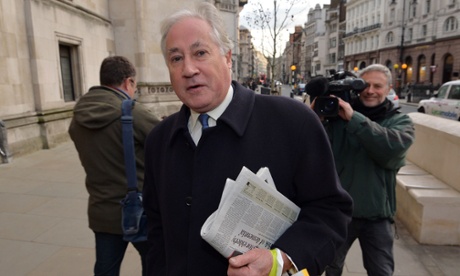
Here’s Sir Robert Owen arriving at the high court for the hearing.
As you’ll see at the top of this blog we have a live stream of the hearing. It’s being broadcast with a five-minute delay, lest anything is said with security implications. For that same reason the reporters in the court are not being allowed to tweet the evidence.
What will we get today? We begin with some opening comments from the inquiry chairman, Sir Robert Owen, a high court judge. Then we get the opening speech by various counsel to the inquiry, and then opening speeches by what the inquiry website calls “core participants”. This will mean the opening address by Ben Emmerson, the highly-respected QC representing Litvinenko’s widow, Marina.
Emmerson’s speech – which is roughly parallel to the prosecution opening speech in a trial – should lay out most of the main arguments by the family, and should be very interesting.
Another good introduction as to what’s happening today is Luke’s curtain-raising story for today, which you can read in full here. This is a snippet:
Litvinenko was poisoned on 1 November 2006, after meeting two Russian contacts, Andrei Lugovoi and Dmitry Kovtun, in the Millennium hotel in London. The pair allegedly slipped radioactive polonium-210 into Litvinenko’s green tea. Litvinenko died in a London hospital 22 days later, after blaming Vladimir Putin for his Cold War-style assassination.
The Crown Prosecution Service has charged Lugovoi and Kovtun with Litvinenko’s murder. Putin, however, has refused to allow them to be extradited from Moscow. In 2007 Britain expelled four Russian diplomats in protest, with Russia following suit. Neither of the two suspects will take part in the inquiry. They say they are innocent.
Litvinenko’s widow Marina and son Anatoly – aged 12 at the time of his father’s death and now 20 – are expected to attend. The inquiry will hear for the first time from the Metropolitan police, whose officers interviewed Litvinenko in the intensive care ward of University College hospital, London, shortly before his death.
The Met is also likely to make public compelling forensic evidence showing a trail of polonium left by Lugovoi and Kovtun in their hotel, and in numerous other locations around London. Detective inspector Craig Mascall will give evidence on Wednesday, followed by two forensic pathologists, Dr Nathaniel Carey and Dr Benjamin Swift...
Marina Litvinenko appealed and the home secretary Theresa May agreed to an inquiry last summer, days after the shooting down of a civilian airliner, Malaysian Airlines Flight MH17, over eastern Ukraine by pro-Russian rebels. May had previously ruled out an inquiry on the grounds it might damage the UK’s relations with Moscow.
Just over eight years after Alexander Litvinenko, a former Russian intelligence officer and MI6 informant based in London, was killed by – as he claimed shortly before his slow death from apparent radiation poisoning – agents of the Russian state, a public inquiry opens into his alleged murder.
The inquiry will take place at the high court in London for the next ten weeks. What is it all about? Well, a very good place to start is this explanatory video made by my colleagues, Luke Harding and Guy Grandjean.