With wonderful inevitability, human rights barrister Charlotte Proudman has been accused of overreacting to solicitor Alexander Carter-Silk commenting on her photograph on LinkedIn. For those who aren’t aware, Carter-Silk wrote to Proudman: “I appreciate that this is probably horrendously politically incorrect but that is a stunning picture”, awarding her best photo he’d seen on LinkedIn (Carter-Silk says he was remarking on the quality of the photo).
Proudman responded that his remarks were “unacceptable and misogynistic”, then shared their interaction on Twitter, remarking that men were using LinkedIn like Tinder. For this, she has been castigated for not being able to take a compliment, branded a “feminazi” and told that she has committed career suicide. And yet, if we remember, it’s Ms Proudman who’s supposed to have overreacted.
There are several layers here. First, there are still some men, old and young, who fail to realise that women are subjected to ceaseless inappropriate, unasked-for commentary about their looks (having them/not having them/needing them/losing them/mourning them) to the point that being paid a clumsy, creepy “compliment” by a stranger becomes an issue. What’s more, as this was a professional website, both parties, not just Carter-Silk, needed to behave appropriately. Unfortunately, this time-honoured system just doesn’t work if only one party does so.
Nor is Proudman a hypocrite for writing things such as “hot” under photographs of male friends on Facebook, as she has been “outed” as doing. How people communicate informally with their friends on something such as Facebook (the relaxing of boundaries; the shorthand they use; the mutually accepted levels of irony) is completely different to what they might deem acceptable in a professional setting, and with a complete stranger at that. Proudman could be scrawling “GER EM OFF!”, or sending photos of herself drunkenly mooning to her Facebook friends, for all I care – this still wouldn’t in any way undermine her reaction to Carter-Silk on LinkedIn.
Most interestingly, there was Carter-Silk’s attempt to cloak and defuse his comment, by observing from the off that it was potentially offensive. He does the same thing with his remark under a social media photograph of his 27-year-old daughter: “Whilst I should not encourage lascivious comments about my daughter… Yeee gods, she is hot.” (Yes, I died a little too; let’s be kind and presume that embarrassing father-to-daughter “on-trend” lingo is a new form of dad dancing.)
By contrast to Proudman’s straightforward “hot” (supremely confident that she’s behaving appropriately among friends) in both instances, Carter-Silk signals that he’s entirely cognisant that these kinds of remarks should not really be made, yet still he makes them, all the time grimly clutching what he fondly imagines to be some sexist version of a get-out-of-jail-free card. But then, as some feminazis out there might be groaning sourly by now – what’s new?
Many women would recognise this kind of behaviour as a form of “cheeky chappie chauvinism”, where some men style themselves as wicked, naughty, devilish, refusing to be tamed, not playing by the rules (or whatever they tell themselves as they’re squirting on the Lynx). But conversely they’re not above a bit of nifty linguistic arse covering should it prove necessary.
Basically, it’s an evolution from sexism proper, as in, the sexism still happens, the inappropriateness is still there, the women are still having to deal with it, but the man slyly references it, in an attempt to destabilise and neutralise any potential objection.
One supposes the woman is meant to be either disarmed or confused – and it must come as a grave disappointment when, like Charlotte Proudman, she turns out to be neither.
The fact that some men do this is one thing. The inference that women are too dumb to have noticed them doing it is a whole new stratosphere of insult to anyone’s intelligence.
Keep your hair on, Donald – and button your lip
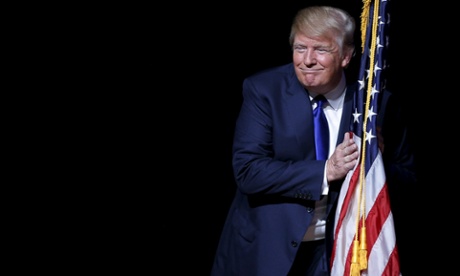
It is my sad duty to inform Donald Trump that his hair is not a feminist issue. Trump remarked about fellow Republican candidate Carly Fiorina: “Look at that face! Would anyone vote for that? I mean, she’s a woman, and I’m not supposed to say bad things, but really, folks.”
Trump later claimed he was referring to Fiorina’s “persona”, adding that he was constantly ridiculed about his hair and no one complained about that.
Ostensibly, Trump appears to be exposing a double standard: if a woman’s appearance is off-limits, why should a man have his hair mocked, say, for instance, likened to a mouldering Weetabix stuck on with Pritt Stick by a three-year-old displaying early sociopathic tendencies?
However, Trump’s observation only works if you completely ignore socio-historical context, gender inequality and the fact that a comedian or chatshow host mocking your barnet is different to a fellow political candidate announcing that your “persona” is too ugly to vote for.
Trump can shout: “Hey, me too!’ all he likes, but here the gender imbalance is so obvious that all he’s proving is that some people might be too stupid for anyone to want to vote for them.
Hating Andy Murray is hard work

We all know about devoted fans, but what about devoted anti-fans? I know someone who made a point of staying up into the early hours the other night to witness Andy Murray in the US Open. No, scratch that – it was specifically to watch Murray get knocked out of the US Open (which happened, much to the anti-fan’s delight). How awful, I thought; it’s as though he was standing sentinel over Murray’s failure, thinking he could somehow will it to happen, hellbent on witnessing it, and relishing every second of it. Then I thought, oh yeah, I do that as well.
I find myself “keeping up” with public figures for whom I don’t particularly care, presumably to make sure I stay informed, able to disapprove of them better at a later date, fully armed with the facts. Some might call it spite, but it’s harder work than that. And weirder. For instance, among others, I have a bulging mental file on Boris Johnson (fair enough), but also a bizarre one on Jude Law, who has long been on my wrong side, for no real reason, except at some point I decided that he was the sort of person who turns “smug” into a verb.
The trouble with anti-fans is our crazed, inexplicable, inexhaustible persistence. Think Misery, but this time, Kathy Bates says to James Caan: “I can’t stand your stupid books, but I’m going to smash your legs to pieces anyway!” Ironically, I’m sure that this kind of venal, resentful anti-fan interest only serves to bolster the belief that the likes of Johnson are popular.
If public interest is high, you can’t always tell if it’s positive or negative, if it’s fan or anti-fan. So, ultimately, isn’t the joke on us?