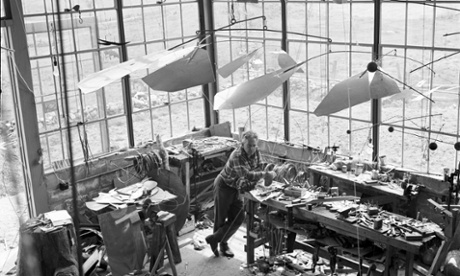
The largest retrospective of Alexander Calder’s mobiles, slowly changing on every breath of moving air – which so enchanted Albert Einstein that the scientist stood gazing at one for 45 minutes – is coming to Tate Modern this autumn.
The term “mobiles” was invented by Marcel Duchamp to describe the creations of his American friend, who trained as an engineer before turning to the family trade of sculpture, like his father and grandfather.
The exhibition will include a giant piece, Black Widow, almost four metres tall, which has left South America for the first time since he gave it as a gift to the Institute of Architects in Brazil, where it has hung, turning gently in the entrance lobby since 1948.
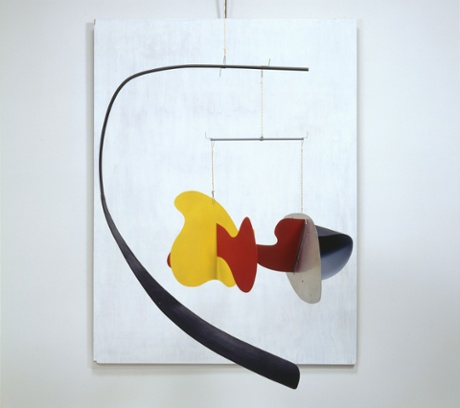
Jose Armenio de Brito Cruz, president of the Institute, said it was their most treasured work of art, but added “Tate Modern’s forthcoming exhibition merits a loan of this magnitude, and we hope that visitors from around the world will enjoy our masterpiece before it returns home.”
The sculpture has been moved to New York, where it is being conserved by the Calder Foundation, which is headed by the artist’s grandson, specially for the Tate exhibition.
Achim Borchardt-Hume, director of exhibitions at the Tate and co-curator of Alexander Calder: Performing Sculpture, which comes to the gallery for six months from November, said Calder had upended preconceptions about the nature of sculpture, that the work of art stayed still and the viewer moved around it to see the whole piece: “Calder transformed this, we don’t have to move, the sculpture moves for us.”
He said that, although many of the pieces look elegantly simple, it will be the most difficult exhibition to install that he has ever tackled. “The pieces will arrive flatpacked – but as soon as you remove them from the packing they spring out in all directions.”
No modern curator would dare tackle the works as Calder himself, a genial soul, did: an archive photograph shows him walking down a Parisian street with one of the sculptures slung over his shoulder like a coil of rope.
The exhibition will include portraits in wire of his friends and fellow artists among the Parisian avant garde, where he studied and worked in the 1920s and 30s, including Joan Miro and Fernand Leger, and one of the renowned cabaret artist Josephine Baker, a superstar in the Paris of the day.
By the late 1920s, fascinated by the circus, he was wondering why sculptures couldn’t move and balance like acrobats. His earliest mobiles incorporated little motors – but the best-preserved, still with their original machinery, have now been stilled forever, too fragile and precious to use.
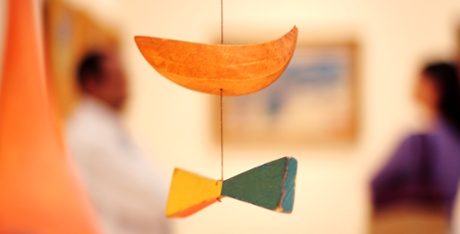
Fortunately for the exhibition, Calder soon progressed to mobiles that moved slowly and gracefully by themselves in the merest wisp of a draft. Technical tests are being carried out in the galleries to make sure that the breath of visitors and the air conditioning will create a current of air strong enough to set the pieces moving – but warding staff will be standing guard to make sure nobody attempts to give them a helping hand.
Calder often worked closely with architects, and the exhibition is being designed by Herzog & de Meuron, the Swiss firm of architects responsible for the transformation of the Tate itself from an old power plant into one of the most successful art museums in the world.