More than any living abstract artist, Alexander Calder is the one whose work I should most recommend the sceptic to see. It is now nearly twenty years since New York’s Museum of Modern Art held the first Calder retrospective. It was organised by James Johnson Sweeney, whom we in London may now thank for the largest Calder retrospective ever - at the Tate Gallery until August 12. Mr Sweeney, Mr Calder, and the Arts Council have done themselves - and us - proud.
Calder is of course known the world around as the Yankee inventor of the mobile, that so characteristically modern form of sculpture, which yet owes as much to the art of the blacksmith as to the ambience of flight. Like Mondrian’s lines and squares, which have permeated the entire vocabulary of visual design, the idea of the mobile has sifted relentlessly downwards, until every well thought of nursery has its version in ducks and drakes.
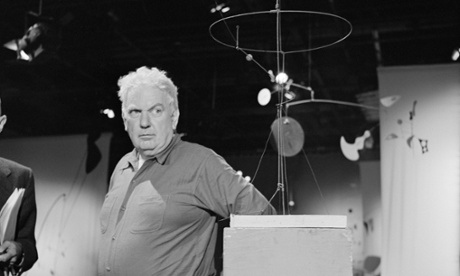
All ages of man, in every age, have delighted in the toy - from the toddler of Mohenjo-Daro with his bullock cart of clay to the lucky daddy of today with his open Daimler. And all of us, with any memory of childhood, will delight in the fantasy and joy that Calder’s genius has brought to the Tate. In person a fine teddy-bear of a man, white-thatched, and with a drawl that triumphs over the “sharps” of the American accent, Calder, as an artist, is unquestionably in the first rank of this century.
As Mr Sweeney so well explains in his introduction, Calder’s most notable contribution to sculpture has been the introduction of movement, on a broad scale, as an aesthetic element. This by itself, however, would have left Calder as only an innovator. What was needed was the gift of personality. And Calder’s gift began with an enthusiasm for the circus. From articulated toy animals, he went on to three-dimensional wire drawings in space. Almost alone, these were, and still are, the animating ideas of all his work. Everywhere, Calder is the master of balance and weight. That movement itself is impossible, in any articulated structure, without the precise calculation of just these forces, is more than coincidence. One admires the lithe stance of the panther about to pounce; of the cobra about to strike; of the crab about to scuttle.

And the seventy-eighth, and most recent work in the exhibition, is a stabile titled simply “The Crab.” Made of steel plates, painted red all over, it is 10 feet high by 20 feet long. It seems a far cry from the wooden “Horse” of nearly thirty-five years ago. But common to both is a posture of vibrant balance, a posture alerted by a question - tails tensed, ears slicked back, claws poised - as though both were about to take off in all directions. This peculiarly weightless balance of all Calder’s stabiles is echoed, hardly altered, in the mobiles hung from above.
Nor is it just that his mobiles move, that his stabiles poise on the threshold of movement, but that everything continually moves farther and farther away from those objects that we put on shelves, hang on walls. Calder’s sculptures - if that is any longer the word for them - create their own space in which to live. Even the caverns of the Tate are suborned by their contents. Simple gaiety and charm flow from the “Red Petals,” the bits flutteringly in balance; but gaiety and charm are raised to the level of art by a presence at once inquisitive and affectionate.