With their bright colours, delicate motion, and abstract playfulness, Alexander Calder’s mobiles ignite a childish delight in the viewer. And many of the American sculptor’s other famous works – a performable model circus, wire sculptures of acrobats, dancers or animals – have also given rise to the perception of a particularly jolly artist. His studio, one imagines, would have been a treasure trove for a child.
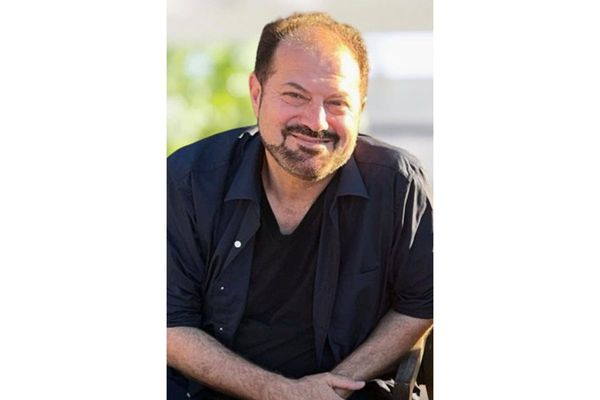
Yes and no, says his grandson. Sandy Rower has dedicated the past 27 years to his grandfather’s legacy, establishing the Calder Foundation which restores, loans and advises on his work; it has been key in helping put together the new Tate Modern blockbuster Calder show.
“I was in his studio all the time,” Rower says over lunch at the Foundation in New York. “My brother and I would go and make stuff. But he wasn’t a funny guy in the studio – at all. If you did something screwy, you’d be kicked out in a micro-second. You were expected to be hard at work.”
As for the famous Calder Circus – not on loan to the show, as its characterful wire figures are so delicate – that certainly wasn’t a toy. It was a work of art: an early, perhaps even the earliest, example of performance art, Rower posits, the figures brought to life meticulously by his grandfather.

Maybe it’s because Rower has been taking his grandfather’s work seriously since he was a little boy, but he now considers that Calder’s perceived accessibility was a double-edged sword. “His popularity is extreme, and it’s a bit of a curse.”
Surely the public loving your work can only be a good thing? But Rower suggests that, historically, Calder’s ethereally light works have been treated as, well, lightweight. “There was such a diminishment of his intelligence… Calder was rejected by critics in the Sixties and Seventies because of the ease of appreciation. That art should just be ‘fun’ is a complete misunderstanding about what he was trying to achieve.”
Lucky, then, that the Tate isn’t mounting Calder: the fun years… its exhibition is taking a more cerebral, conceptual approach to Calder’s sculptures. Rather than a retrospective, the show – titled Alexander Calder: Performing Sculpture – traces movement and performance within his work. And it suggests that each encounter with Calder’s moving sculptures is like a one-off performance, occurring moment by moment with the viewer.
“It’s not a retrospective, it’s a discussion about how his work is present,” says Rower. “Calder starts to refer [in the Thirties] to choreography: it’s a person spinning around and you have an emotional response to it – why? He’s trying to get to the central nature of that, without telling a story. Motion is the subject.”
And motion is there right throughout his work. It’s there in a 1929 wire sculptures of two acrobats – at the Foundation, Rower gives them a gentle touch, and they quiver in their perpetually held pose. It’s there in early motorised kinetic sculptures – wire fish bobbing in a wire tank (1929), or a ball moving up and down in front of a black screen, abstraction as the movement of colour and form through space.
“What we’re getting at is motion in real time: it’s 2015 and we’re experiencing his piece from 1931. The experience is the key – and it’s the key to the mobiles too,” says Rower.
Motion becomes more free and fluid in Calder’s panel works: against eye-poppingly bright backdrops, biomorphic or geometric shapes hang and slowly twirl in space. Some of these are set to startle the Calder super-fan or scholar, with the Tate show featuring works that haven’t been exhibited in many decades.
Finally, the famous mobiles – strung on delicate wires, colourful metal petals slowly turn and glide through the air. In a real coup, the final work of the Tate’s show will be Black Widow, a monumental 12-foot sculpture never before seen in Britain. Calder made it for an architectural institute in Brazil in 1948. Getting it to the Foundation for major restoration work – and then on to the Tate – has been an equivalently monumental achievement.
Black Widow will have a whole room to itself – the final “performance” of the show. Highly sensitive to tiny changes in atmosphere, Calder’s mobiles dance with the viewer – slowly, gracefully, their turnings and driftings altered by the mere presence of people. The heat and humidity of human bodies, their breath or laughter, change the air currents and the motion.
And the Tate show is set to emphasise the unique and live aspect of all this. I stood in front of Black Widow in New York, walked round her, peered at her dark petals. But your experience will be entirely different – for no two can ever be quite the same. Like a dance or a play or a piece of live music, a moment with a mobile can never be repeated exactly. Each is unique.
Alexander Calder: Performing Sculpture is at the Tate Modern (020 7887 8888) 11 Nov to 3 April