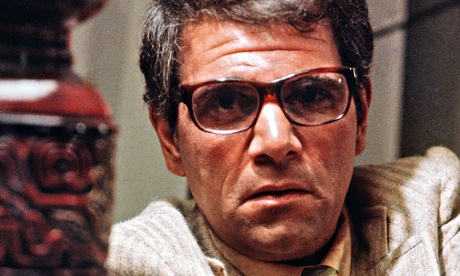
Alex Rocco, who has died of cancer aged 79, might have had bigger and more challenging parts than the Jewish mobster Moe Greene in the first part of Francis Ford Coppola’s The Godfather trilogy (1972), but it remains his most celebrated role.
“The Godfather gave a great boost to my career – although casting directors would always see me as ‘the guy with the bloody eye’, even years later after I had gone in a few different directions,” Rocco commented. “The guy with the bloody eye” was one of several murdered victims who had refused an offer presented to them by Mafia boss Don Vito Corleone (Marlon Brando).
His violent end comes while he is lying on a massage table. A killer enters and shoots him in the eye, a scene that echoes, intentionally or otherwise, the moment in Sergei Eisenstein’s The Battleship Potemkin when the elderly woman wearing pince-nez is shot in the face. Rocco explained how it was done. “It was weird. I was afraid of losing my eye. When the killer came in, there was a guy under the table hidden from the camera with a pump gun. I had two tubes wired to my glasses. One was a pellet that broke the glass outwardly, followed immediately by a blood pellet.” So memorable was the scene that 23 years later Rocco did a cameo on a massage table in the comic crime thriller Get Shorty (1995).
Moe’s fate is sealed after he confronts a deadly calm Michael Corleone (Al Pacino), who tells him that his family is taking over Moe’s Las Vegas casino. After forcing a laugh and nervously tightening his collar, Moe exits on the line: “Do you know who I am? I’m Moe Greene. I made my bones while you were going out with cheerleaders.”
Of Italian descent, the bushy-browed, raspy-voiced Rocco was born Alexander Federico Petricone in Cambridge, Massachusetts. Rocco required little research to play underworld characters because in the early 1960s, with the nickname “Bobo”, he was a member of the Winter Hill Gang in the Boston area. After being arrested and released in connection with the murder of a rival gang member, he left for California.
Years later, during pre-shooting in Boston of Peter Yates’s The Friends of Eddie Coyle (1973), Rocco introduced Robert Mitchum to local Irish-American gangsters to research his title role. It was Rocco’s second-best film, a low-key crime drama in which he is effective as a slick, professional bank robber, opposite Mitchum as a world-weary, middle-aged two-bit gangster.
On deciding to become an actor, he approached fellow Bostonian Leonard Nimoy for lessons, but the latter advised him to get rid of his Boston accent first. With a seemingly more acceptable New York accent, Rocco returned to Nimoy.
After the usual quota of odd jobs for a novice actor, Rocco started to get parts as heavies on TV and in the movies. But he had to wait for The Godfather for his first decent payday – a far better payday, in fact, than he had expected. The Moe Greene scenes were planned as a three-day shoot, but because of trouble between Coppola and the producers and Brando’s difficult temperament, it was delayed six months, with Rocco being paid all the time. “I bless Brando for the problems he caused,” Rocco declared.
Apart from The Friends of Eddie Coyle, most of Rocco’s subsequent films featured the actor in supporting roles. Among the exceptions was Detroit 9000 (1973), a blaxploitation film in which he had the co-lead. He plays a street-smart white detective teamed up with an educated black detective (Hari Rhodes) on the trail of a robbery. “The best thing in the movie is the performance by Alex Rocco, as the white cop,” wrote the film critic Roger Ebert. “He’s got an easy, cynical charm and he moves wearily – and isn’t one of those matinee-idol types that somehow always get the cop roles on TV.”
Other films in which Rocco appeared on the right side of the law, though unsympathetically, were Freebie and the Bean (1974) and The Stunt Man (1980), both directed by cultish, unprolific Richard Rush. But it was television that gave Rocco far more scope, and allowed him to reveal his comic side. As he said: “I’m not a marquee name in film, so I rarely got the lead – but in television it didn’t matter.”
He made guest appearances in dozens of TV series, such as The Rockford Files, Starsky and Hutch, The Love Boat, The Golden Girls and Murder, She Wrote. Rocco popped up from time to time as the concerned father of one of the schoolgirls at a boarding school in the sitcom The Facts of Life (1981-88), and in The Famous Teddy Z (1989-90) he played talent agent Al Floss, a role which won him an Emmy. “What a sleaze,” Rocco commented on his character. “I got even for all the agents who screwed me in my career.” He also voiced a number of animated characters in The Simpsons and Family Guy.
Rocco is survived by his second wife, Shannon Wilcox, and a son, Lucian, and daughter, Jennifer, from his first marriage, to Sandie Elaine Garrett, who died in 2002. Marc, an adopted son from that marriage, died in 2009.
• Alex Rocco (Alexander Federico Petricone), actor, born 29 February 1936; died 18 July 2015