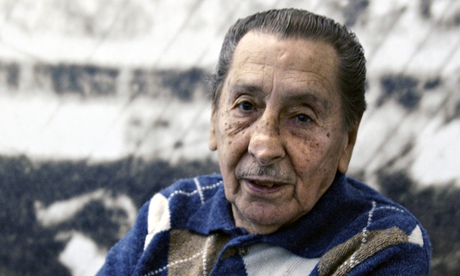
The Uruguayan footballer Alcides “Chico” Ghiggia, who has died aged 88, was the scourge of Brazil in the World Cup decider of 1950 in Rio de Janeiro. Small, thin and hunched, the right-winger did not look much of an athlete, but nonetheless displayed great ball control, dynamic pace and a surprisingly powerful right foot.
When in the immense Maracanã stadium in Rio, Uruguay faced Brazil in the last game of their final group – there was no World Cup final as such – the Brazilians were the ineluctable favourites. They had scored no fewer than 13 goals in their first two games against Sweden and Spain, each of whom had given the Uruguayans a hard run for their money. Thus Brazil needed only to draw, to take the world title.
Ghiggia, like other Uruguayan players, was not worried. He was aware, he later said, that while European teams may have found Brazil an insoluble problem, Uruguay knew them, their players and their tactics well, and had played three tight games against them in the Rio Branco trophy, the competition held from time to time between the two nations, on Brazilian soil that very year – winning the first, losing the next two, each time by the margin of a single goal.
The previous year, Ghiggia had been one of a team of amateurs whom Uruguay had sent to Brazil for the South American championships, when their professional players were on strike. Uruguay lost 5-1 to Brazil, but it was useful experience for three of the team who would play great parts in the triumph of the following year: Ghiggia and the two gifted inside-forwards Juan Schiaffino and Julio Pérez.
Uruguay were undoubtedly lucky that the vagaries of the 1950 tournament obliged them to play only Bolivia in their so-called qualifying group, only 13 teams in total having agreed to compete. 8-0 was the margin of victory, and Ghiggia scored one of the goals. He would continue to score in the final pool.
In the opening game of the final round, versus Spain in São Paulo, it was Ghiggia, described as “tiny, matchstick-limbed”, who gave his team the lead, though in the end they were quite hard pressed to draw 2-2. In the next match, against Sweden, again in São Paulo, Ghiggia once more got the first Uruguayan goal, equalising after the Swedes had gone ahead. Uruguay ran out winners, though hardly convincing ones, 3-2. And so to the grand decider before 200,000 spectators.
In the first half, Uruguay survived tremendous pressure. But there was one warning moment for Brazil when Ghiggia and his centre-forward, Óscar Míguez, breaking away, provided an opening for Schiaffino, whose shot was only just reached at full stretch by Brazil’s keeper, Moacir Barbosa.
Two minutes into the second half, Friaça (Albino Friaça Cardoso), Ghiggia’s Brazilian equivalent, put his team ahead to ecstatic applause. The floodgates seemed to be about to open; but they stayed shut. Uruguay now began to carry the battle to Brazil, and on 65 minutes they equalised. The mighty Obdulio Varela, Uruguay’s ubiquitous centre half, sent Ghiggia flying down the right wing. His eventual pass inside found Schiaffino utterly unmarked. Four strides and the ball was driven past Barbosa.
Fourteen minutes later, Ghiggia received the ball and found Pérez. He in turn shook off Brazil’s inside left, Jair (Jair da Rosa Pinto), and returned the ball to Ghiggia, who cut inside Brazil’s defence and shot home between Barbosa and the keeper’s near post. For decades to come, poor Barbosa was made the culprit, but Ghiggia did not blame him for the goal, for which he had sped past the defenders Juvenal (Juvenal Amarijo) and Bigode (João Ferreira – the nickname means moustache). Barbosa, he said, did the “logical thing” in taking the position he did; he himself did the “illogical”.
Born in Montevideo, the Uruguyan capital, Ghiggia made his name with the city’s Peñarol club, like so many of the 1950 national team. Standing 1.69m (5ft 6½in), weighing only 62 kg (137lb), he never found his slight physique a problem. In the 1953-54 season he moved to Italy to play for Roma and the following season helped them take a third place in the championship, which became second when Udinese, the runners-up, were relegated for being found guilty of bribery the season before. Ghiggia in that campaign played 26 times for just a couple of goals.
Qualifying as an oriundo, that is, a foreign player of Italian origin, he was pressed into service for the Italian national team, with whom he played five times, making his debut in Lisbon against Portugal in May 1957, a World Cup qualifier that Italy lost 3-0. The following December in Belfast he scored Italy’s opening goal against Northern Ireland in a 2-2 draw invalidated as a World Cup qualifier since the Hungarian referee was held up by fog at an airport. Ghiggia’s inside-left on that occasion and in the next two games was his Uruguayan teammate Schiaffino. But they could not stop Northern Ireland winning a sensational victory when the teams met again at Windsor Park in January 1958. The home team won 2-1 and Ghiggia disgraced himself, being sent off for kicking an opponent. As a result, Northern Ireland reached the finals, and Italy did not.
Ghiggia gained one more international cap, against Spain, in Rome in February 1959. He concluded his Italian career with Milan in the 1961-62 season, but made only four appearances in their championship-winning team.
After returning to Montevideo, he played for the Danubio club (1962-68). He then worked for the Casino Montevideo, managed a supermarket, gave driving lessons and was compelled to sell his World Cup winner’s medal, which a businessman bought back for him. Though he went through difficult times, his achievement was better remembered in recent years, and in 2009 he returned to the Maracanã to leave his footprints in the stadium’s walk of fame, alongside those of Pelé, Eusébio and Franz Beckenbauer.
He is survived by his third wife, Beatriz, and two sons.
• Alcides Edgardo Ghiggia, footballer, born 22 December 1926; died 16 July 2015