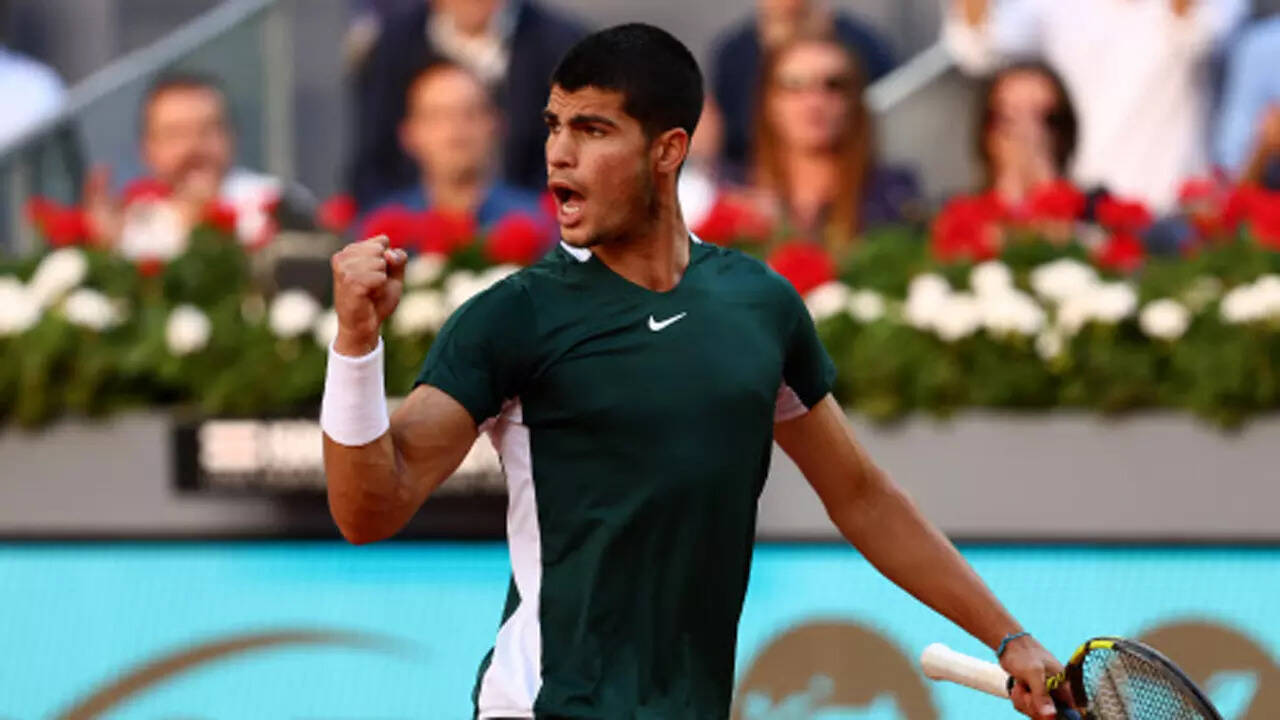
PARIS: The boldest statement of the season came from 19-year-old Carlos Alcaraz in Madrid. A thunderbolt much like his forehand. That the Spaniard closed back-to-back wins over the Czars of the sport en route to his second ATP Masters title two weeks ago, underscored his mettle.
With just one more top tier tango to go in the run-up to the French Open, Alcaraz had emerged as the man to beat. It was about timing, not unlike his featherlight dropshots.
That was until the world No.1 Novak Djokovic checked in with his record-extending 38th ATP Masters title in Rome on Sunday. It wasn’t the stat, staggering as it is, it was the circumstances. At that point, the 35-year-old, the only player to win all nine ATP Masters 1000 titles, had just eight match wins from four tournaments in 2022. Djokovic didn’t land that winner from an impossible position, he wasn’t even on the court.
The Serb’s charge in Rome showcased his steel which is exactly what Roland Garros’ red clay rewards. The French Open, ostensibly the most arduous of tennis’ four Slams, is the sport’s ultra. While Rafael Nadal, with 13 crowns, maybe this Grand Slam’s plus ultra, further and beyond as Spain’s motto scores, Djokovic has raised the level of the game played between the ears right to the thermosphere.
It's a pity that Djokovic and Nadal, who between them have 41 major titles, could face-off in the quarters rather than the final. The winner of that clash might run into Alcaraz in the semifinals. Fireworks on a weekday. Had Nadal, whose achy left-foot ensured his preparations were as brief as a G-string design, held on to a top-four slot, the draw might’ve sparked a different look. But that’s for the connoisseur’s column.
Djokovic, who covers the court with an elasticity that puts spandex to shade, is not confusing matters.
“In a best-of-five things are different obviously,” Djokovic said of the format that has proved to be a stumbling block for the younger generation of players. “Grand Slams awakens motivation and emotions in players. That's why you cannot underestimate anyone and also probably not compare the performances in other tournaments to a Slam.”
Alcaraz, whose gravity-defying athleticism, will be on display on Sunday when he takes on Argentina’s Juan Ignacio Londero, is clearly not listening.
The world No.6, who was ranked 114 a year ago, owns a 28-3 win-loss record. “I’m not afraid to say that I’m ready to win a Grand Slam,” the teenager said in an interview. “Physically I feel very well. I’m mentally strong. I am a strong player and in the end that is what it takes to win a Grand Slam.”
Nadal, the 21-time major winner, has answered more questions on his teenaged compatriot than he has match wins on clay this year. The 35-year-old, who was forced to miss the early part of the clay-court swing courtesy a rib fracture, has won a mere three matches on the dust.
The next couple of weeks for Nadal will be about managing the pain that has been his nagging companion for almost two decades. “The pain is something that I live with every day,” he said of his foot. “I’m here to play tennis and make the best possible result. If I didn't believe that would happen, I probably would not be here.”
Still, pain or no pain, Nadal is in the French capital. The sun-kissed 10 ft tall statue of the Spaniard, which stands at the entrance of the Philippe Chatrier court, is a reminder of what he’s capable of. The steel structure resonates his signature intensity -- hair-flying as he follows through on his forehand. The echo of the grunt is in the air.